
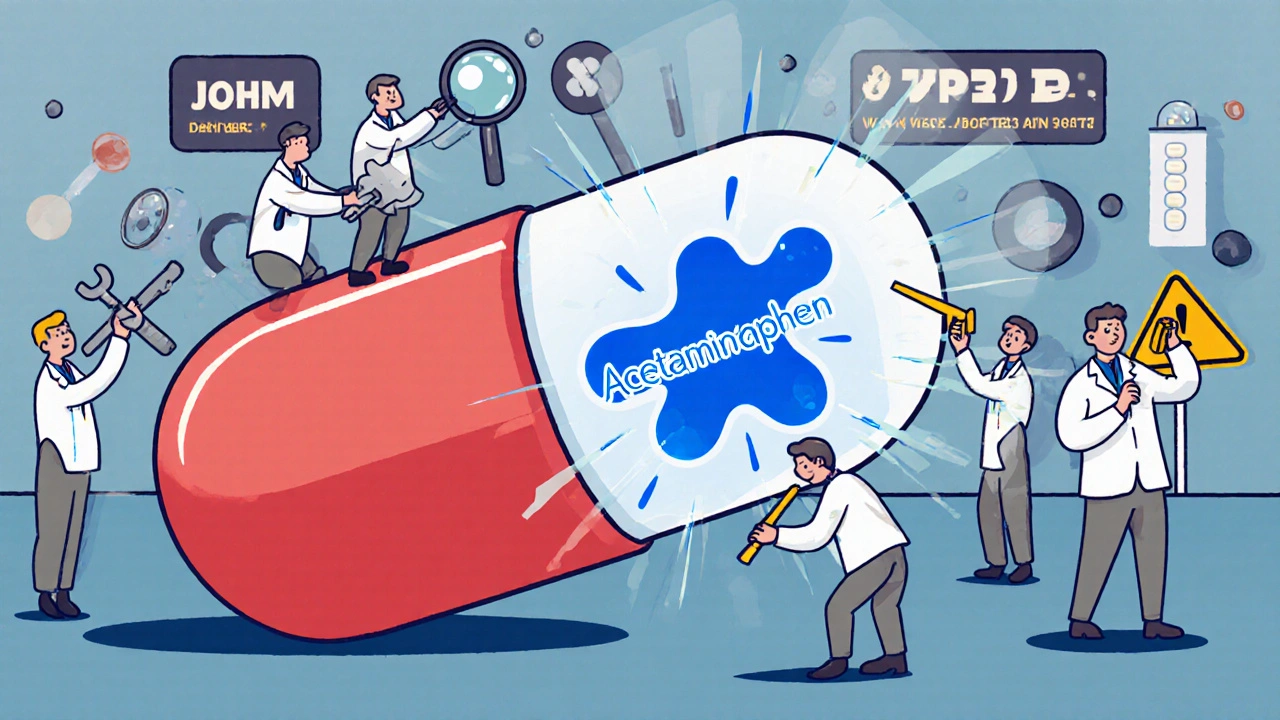
When you pick up a pill from the pharmacy, you might think it’s just one thing: the medicine. But inside that capsule or tablet are two very different kinds of ingredients-and only one of them is actually doing the work you expect. The other? It’s there to help, but it’s not harmless. Understanding the difference between active ingredients and inactive ingredients isn’t just for pharmacists. It’s something every patient should know.
What’s actually making the medicine work?
The active ingredient is the part of the drug that changes your body. It’s what lowers your blood pressure, kills bacteria, or eases your headache. Take Tylenol: the active ingredient is acetaminophen. Advil? That’s ibuprofen. Lipitor? Atorvastatin. These are the molecules that bind to receptors in your cells, block enzymes, or trigger chemical reactions to produce the effect you’re after.
These ingredients don’t get approved lightly. Before a drug hits the shelf, the active ingredient goes through years of testing-lab studies, animal trials, and clinical trials with thousands of people. The FDA requires proof that it’s both safe and effective. Over 90% of new active ingredients fail during this process. That’s how strict the bar is.
What are the inactive ingredients doing in there?
If the active ingredient is the star, the inactive ingredients are the crew. They’re called excipients. They don’t treat your condition. But without them, the medicine wouldn’t work-or wouldn’t even be possible to make.
Think of them like the parts of a car that aren’t the engine. You don’t drive the fuel pump, but without it, the engine won’t run. Inactive ingredients do things like:
- Hold the pill together (binders like gelatin or microcrystalline cellulose)
- Give it the right size (fillers like lactose or starch-sometimes making up 90% of the tablet)
- Help it dissolve in your stomach (disintegrants like croscarmellose sodium)
- Prevent sticking during manufacturing (lubricants like magnesium stearate)
- Make it easier to swallow (coatings like hydroxypropyl methylcellulose)
- Stop it from going bad (preservatives like parabens or benzyl alcohol)
- Make it taste better (flavorings, sweeteners, colorants)
The FDA keeps a database of over 1,000 approved inactive ingredients. They’re listed by how they’re used-in tablets, liquids, injections-and how much is safe per dose. For example, you can have up to 50 milligrams of lactose in a pill, but only 1 milligram of benzyl alcohol if it’s meant for an IV.
They’re called ‘inactive’-but are they really?
The term ‘inactive’ is misleading. It doesn’t mean harmless. It means they don’t have a direct therapeutic effect. But that’s not the same as biologically neutral.
A 2021 study from the University of California, San Francisco, and Novartis tested 639 common inactive ingredients against over 3,000 human proteins. They found that about 14% of these so-called ‘inerts’ actually bound to proteins involved in disease pathways. Some, like D&C Red 7 calcium lake (a red dye) and propyl gallate (a preservative), showed strong activity at very low doses.
That’s not just a lab curiosity. If a preservative binds to a liver enzyme, it could change how your body processes other drugs. If a dye interacts with immune cells, it might trigger a reaction in sensitive people. The FDA took notice. In 2022, they launched the Excipient Safety Initiative, pouring $4.2 million into studying these hidden interactions.
Can inactive ingredients hurt you?
Yes. And it’s more common than you think.
Lactose is in over half of all oral medications. But about 65% of the world’s population can’t digest it well. If you’re lactose intolerant, that pill could give you bloating, cramps, or diarrhea-even if you’re taking it for high blood pressure.
Gluten is another hidden problem. Some pills use wheat starch as a filler. For people with celiac disease, even tiny amounts can damage the gut. About 15% of people in the U.S. avoid gluten for health reasons.
Sulfites, used as preservatives in some injectables and eye drops, can trigger asthma attacks in 5-8% of asthmatics. Benzyl alcohol, found in some IV fluids, can cause serious reactions in newborns. And artificial colors? Some are linked to hyperactivity in kids.
The FDA estimates that about 0.5% of all adverse drug reactions are caused by inactive ingredients. That sounds small, but with billions of prescriptions filled each year, that’s tens of thousands of avoidable reactions.
Why this matters for you
Here’s the real takeaway: your medication isn’t just about what it’s supposed to do. It’s also about what it’s made of.
If you’ve ever had an unexpected side effect-rash, stomach upset, dizziness-and your doctor couldn’t explain it, check the inactive ingredients. That’s often where the answer lies.
Pharmacists see this all the time. In 2022, nearly a quarter of medication switches in U.S. pharmacies were because of concerns over excipients-not because the active ingredient wasn’t working, but because the patient couldn’t tolerate the filler, dye, or preservative.
That’s why Australia started requiring doctors to prescribe by active ingredient in 2020. It lets pharmacists substitute cheaper generics without changing the excipients. In the U.S., prescriptions are still often written by brand name, hiding the fact that two pills with the same active ingredient can have totally different fillers.
What you can do
You don’t need a chemistry degree to protect yourself. Here’s how to take control:
- Read the label. Over-the-counter meds list both active and inactive ingredients on the back. Prescription meds have them in the package insert. Look for ‘inactive ingredients’ or ‘other ingredients’.
- Know your triggers. If you’re allergic to nuts, avoid oils like peanut or soybean. If you’re gluten-sensitive, avoid wheat starch. If you get migraines, watch for artificial colors like FD&C Red 40.
- Ask your pharmacist. They can tell you if a generic version uses different fillers than your brand-name pill. They can also find alternatives.
- Use the FDA’s Inactive Ingredient Database. It’s free and public. Search by ingredient or drug form. It tells you safe limits and approved uses.
- Keep a list. Write down which inactive ingredients cause you trouble. Bring it to every appointment.
The future of drug ingredients
Pharma companies are starting to treat excipients like active ingredients. Sixty-eight of the top 100 drugmakers now use computer models to screen for biological activity before adding a new excipient. Some are even replacing dyes and preservatives with truly inert alternatives.
Soon, you might see labels that say ‘low-impact excipients’ or ‘bio-neutral formulation.’ The FDA is exploring a new classification system-not just ‘active’ or ‘inactive,’ but a spectrum of biological activity.
This isn’t just science. It’s personal. Your body reacts to every molecule you swallow. The active ingredient is the target. The inactive ones? They’re the background noise. But sometimes, that noise is loud enough to cause harm.
Knowing the difference isn’t about being paranoid. It’s about being informed. Your medicine should work-and it shouldn’t make you sick in the process.
Are inactive ingredients really safe?
Yes, at the levels used in medications. The FDA requires all inactive ingredients to be Generally Recognized As Safe (GRAS) or previously approved in similar products. But ‘safe for most people’ doesn’t mean safe for everyone. Some people react to lactose, gluten, dyes, or preservatives-even in tiny amounts. That’s why checking ingredients matters.
Can generic drugs have different inactive ingredients than brand-name ones?
Absolutely. By law, generics must have the same active ingredient, strength, and dosage form as the brand-name drug. But they can-and often do-use different fillers, dyes, or preservatives. That’s why someone might tolerate a generic version of a drug but react to another generic, or to the brand. Always check the label.
Why don’t doctors tell patients about inactive ingredients?
Most doctors aren’t trained to focus on excipients. Medical school teaches you about drugs and diseases, not tablet coatings. But awareness is growing. Pharmacists are often the best resource-if you ask. In countries like Australia, prescribing by active ingredient is now standard, making it easier for pharmacists to match patients with safe formulations.
Is there a list of dangerous inactive ingredients?
There isn’t a single ‘dangerous’ list because it depends on your body. But known troublemakers include lactose (for intolerant people), gluten (for celiacs), sulfites (for asthmatics), and certain artificial colors (like Red 40 or Yellow 5) linked to sensitivities. The FDA’s Inactive Ingredient Database shows safe limits, but not individual risk. If you’ve had a reaction before, avoid that ingredient.
Can inactive ingredients affect how well a drug works?
Yes. The wrong filler or coating can change how fast a drug dissolves, which affects how much gets into your bloodstream. For example, a newer version of fenofibrate used a special surfactant that boosted absorption by 35%. That’s why some generics don’t work as well for certain people-not because the active ingredient is different, but because the delivery system is.

Daniel Rod
November 28, 2025 AT 12:17Wow, this is one of those posts that makes you realize how little you actually know about what you swallow every day. I always thought 'inactive' meant harmless, but now I'm reading labels like they're secret codes. 🤯
Sue Barnes
November 29, 2025 AT 22:47Of course the FDA lets this slide. They're paid off by Big Pharma. Lactose in pills? Gluten? Dyes? It's all deliberate. They want you sick so you keep buying more pills. Wake up, sheeple.
King Property
November 30, 2025 AT 02:31You're all missing the real point. The FDA doesn't regulate excipients like active ingredients because they're not profitable enough to test properly. The real scandal? They approve new excipients faster than they approve new drugs. And no one's talking about it.
Pawittar Singh
November 30, 2025 AT 20:10Guys, this is actually huge. I had chronic stomach issues for years until my pharmacist pointed out my generic blood pressure med had lactose. Switched to a different brand-poof, symptoms gone. Don't ignore the 'other ingredients'! 💪
Ifeoma Ezeokoli
December 2, 2025 AT 09:37I'm from Nigeria and we don't have access to brand-name meds most of the time. But I’ve seen people react to generics like they're poisoned-and now I know why. It's not the medicine, it's the filler. This needs to be taught in schools. 🌍❤️
Diana Askew
December 3, 2025 AT 03:04So you're telling me the red dye in my vitamin is secretly talking to my immune system? I knew it. I've been avoiding red foods since 2017. This confirms it. The government is hiding this. I'm not taking anything with 'FD&C' on it anymore.
Yash Hemrajani
December 3, 2025 AT 15:54Lmao. You all act like you just discovered fire. I've been checking excipients since my first allergic reaction at 14. The real issue? Pharmacists don't tell you because they're overworked and you didn't ask. You're welcome.
Alexander Levin
December 4, 2025 AT 17:48Why do I care? I just want the pill to work. 🤷♂️
Jacob Keil
December 4, 2025 AT 22:21So... the body is a quantum field and excipients are just vibrational interference? I think this is why I feel weird after taking melatonin. The starch is disrupting my aura. 🌀
Sachin Agnihotri
December 6, 2025 AT 13:19Wait, so if I'm gluten-free, I need to check every single pill? Even aspirin? That's insane. I just took a ibuprofen last week... did I just damage my gut? 😭
Allison Reed
December 7, 2025 AT 23:23This is such an important topic. I'm so glad someone took the time to break it down clearly. I always tell my patients to ask their pharmacist about fillers-it’s one of the most underused resources in healthcare. Knowledge is power! 💊✨
jobin joshua
December 9, 2025 AT 00:06Bro, I took a generic version of my anxiety med and felt like I was going to die. Turns out the new one had titanium dioxide. I googled it-apparently it's banned in Europe. So now I'm importing my brand-name from Canada. 🇨🇦💊
gina rodriguez
December 9, 2025 AT 03:19My mom had a rash for months and no doctor could figure it out. Then I checked the label-her generic thyroid med had FD&C Yellow 5. Switched brands, rash gone in 3 days. It’s wild how something so small can cause so much harm. Always check the fine print!
Josh Evans
December 9, 2025 AT 20:03My pharmacist gave me a list of all the inactive ingredients in my meds last time I picked up a script. I didn’t even know they did that. Best. Pharmacist. Ever. 🙌
Barbara McClelland
December 10, 2025 AT 07:59Just had a breakthrough with my kid’s ADHD meds. We switched generics because the old one had artificial colors-he stopped having meltdowns after school. I didn’t even know colors could do that. Thanks for the heads-up! You’re all doing great work here.