
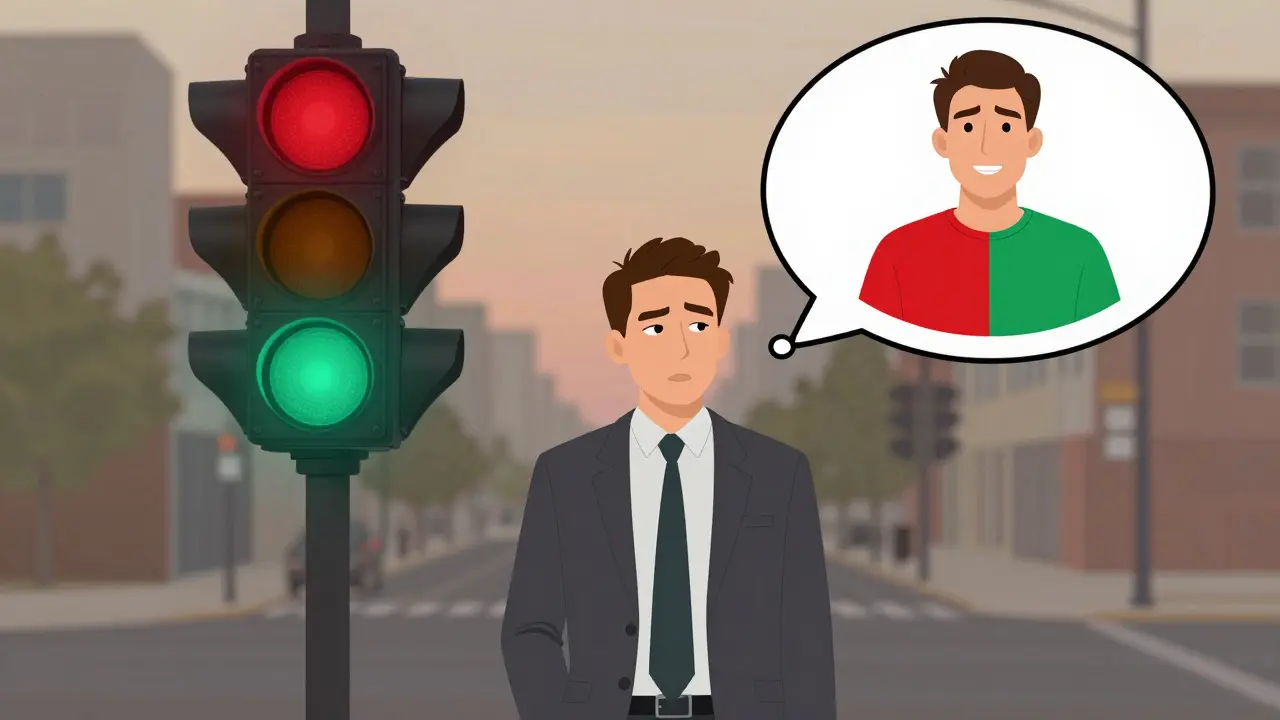
Most people think color blindness means seeing the world in black and white. That’s not true. For the vast majority of people with color vision issues, it’s about red-green color blindness-a condition that makes it hard to tell reds, greens, browns, and oranges apart. It’s not a disease. It’s not something that gets worse over time. And it’s not rare. About 8% of men and 0.5% of women worldwide live with it. If you’ve ever mixed up traffic lights, struggled with color-coded wiring, or been told your shirt doesn’t match when you thought it did, you might be one of them.
How Red-Green Color Blindness Actually Works
Your eyes have three types of cone cells that detect color: one for red, one for green, and one for blue. Red-green color blindness happens when the red or green cone cells don’t work properly. It’s not that you can’t see those colors at all-you just see them differently. Some people see red as darker or duller. Others can’t tell green from yellow or brown. The most common form is deuteranomaly, where the green cones are faulty. It affects about 5% of men. Protanomaly, where red cones are off, is less common. Then there’s the more severe versions: protanopia (no red cones) and deuteranopia (no green cones). These are rarer, affecting less than 1% of men.
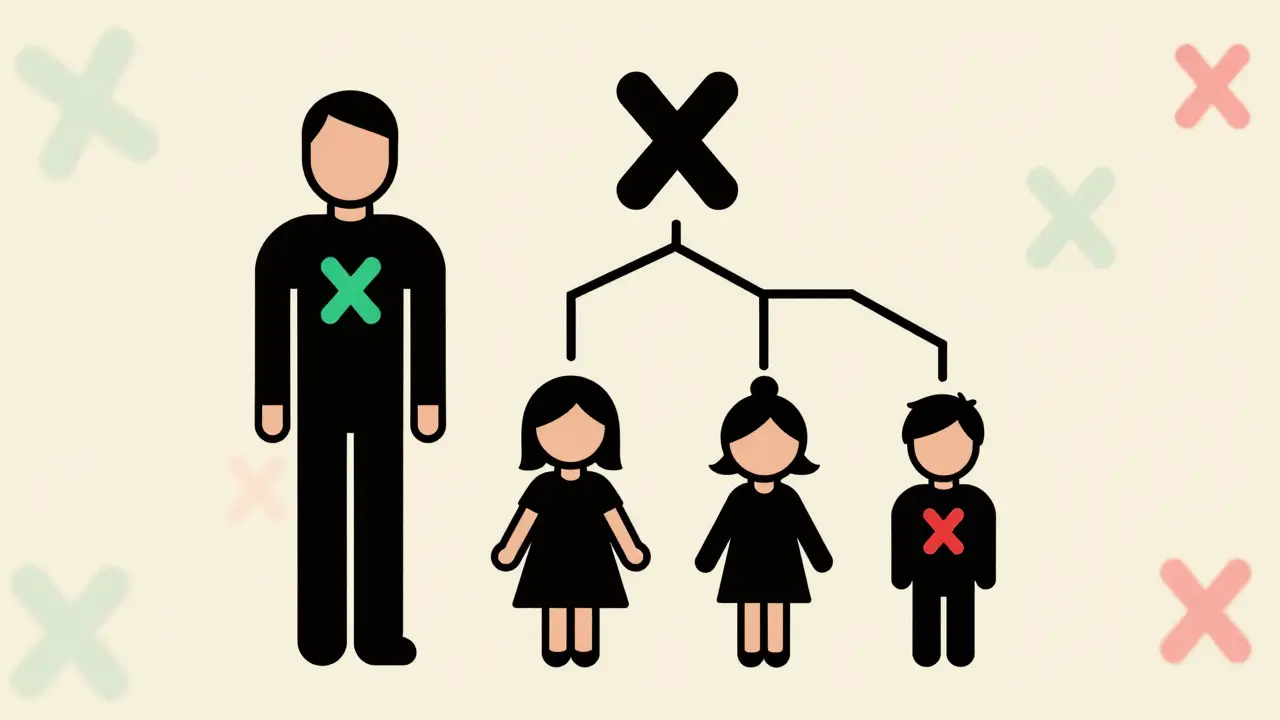
The real surprise? It’s not about the eyes being broken. It’s about the genes. The proteins that let your cones detect red and green light are made by two genes: OPN1LW (for red) and OPN1MW (for green). These genes sit on the X chromosome. Men have one X and one Y chromosome. Women have two Xs. That’s why men are far more likely to be affected. If a man inherits a faulty red-green gene on his single X chromosome, he’ll have color blindness. A woman needs two faulty copies-one on each X-to have it. Most women with one faulty gene are carriers. They usually see color fine, but they can pass the gene to their kids.
Why Men Are More Likely to Be Affected
It’s simple math. If 8% of men have red-green color blindness, that means about 1 in 12 men carry the gene. For a woman to have it, she’d need to inherit the faulty gene from both her mother and father. Statistically, that’s 8% of 8%, or about 0.64%. Real-world data shows it’s even lower-around 0.5%-because of something called X-inactivation. In women, one X chromosome gets turned off randomly in each cell. Sometimes, the healthy X stays active in enough eye cells to compensate. That’s why most female carriers don’t notice any difference in color vision.
This inheritance pattern explains why color blindness often skips generations. A grandfather with red-green color blindness passes the gene to his daughter (who doesn’t have it). She then passes it to her son, who ends up with the condition. It’s not random. It’s biology. And it’s predictable.
What It Feels Like to Live With It
People with red-green color blindness aren’t blind. They have normal vision, normal depth perception, and normal sharpness. But everyday tasks get tricky. A Reddit user who’s a commercial pilot described being disqualified because he couldn’t pass the color test-even though he could see the lights perfectly well in daylight. An engineer on a forum said he labels wires with numbers because red and green look too similar. A graphic designer shared how she learned to rely on brightness and patterns instead of hue-and ended up creating clearer, more accessible designs.
Studies show 78% of people with red-green color blindness struggle with color-coded school materials. 65% have trouble with traffic lights, especially in fog or glare. 42% say apps and websites are hard to use because buttons or alerts rely solely on color. And 37% have felt embarrassed when wearing mismatched clothes because they couldn’t tell red from green.
But here’s the thing: 92% of people with the condition say it’s a minor inconvenience, not a disability. They adapt. They use tools. They learn tricks. It doesn’t define them.
How It’s Tested
The most common test is the Ishihara test. It’s those plates with colored dots forming numbers. People with normal color vision see a 5 or a 2. People with red-green color blindness see a different number-or nothing at all. It’s quick, cheap, and widely used. But it’s not perfect. Some people pass the test but still struggle in real life. Others fail but see color just fine in most situations.
More advanced tests exist, like the Farnsworth-Munsell 100 Hue Test, which asks you to arrange colored caps in order. These are used in jobs where color accuracy matters-like aviation, electrical work, or graphic design. But for most people, the Ishihara test is enough to confirm the condition.
Can It Be Fixed?
No. There’s no cure. Color blindness is genetic. You’re born with it. It doesn’t get worse. And it doesn’t go away.
But there are tools. EnChroma glasses, which cost between $329 and $499, claim to help 80% of people with red-green color blindness see more color. They don’t restore normal vision. They don’t make you see red and green like someone without the condition. But they can make colors feel more distinct-especially in bright light. Some people report seeing new shades of green in grass or red in fire trucks. Others feel no difference at all. It’s not magic. It’s filtering.
Digital tools are more reliable. Apple and Windows both have built-in color filters. You can turn your screen to grayscale, or adjust colors to make reds and greens pop differently. The Color Oracle simulator lets designers see how their work looks to someone with color blindness. The Colorblindifier plugin for Photoshop has been downloaded over 45,000 times. These aren’t fixes for the eye-they’re fixes for the world around you.
What’s New in Research
Scientists are making real progress. In 2022, researchers at the University of Washington gave gene therapy to adult squirrel monkeys with red-green color blindness. Within weeks, they started seeing red and green like normal monkeys-and kept that ability for over two years. It’s not ready for humans yet. But it’s proof that the brain can learn to use new color signals, even as an adult.
The National Eye Institute is investing millions into restoring color vision. One day, gene therapy might help children born with the condition. But that’s still years away. For now, the best tools are the ones we already have: better design, better lighting, better labeling.
How to Design for Color Blindness
If you’re a designer, teacher, or developer, your job isn’t to fix color blindness. It’s to make sure your content works for everyone. Here’s how:
- Don’t rely on color alone. Add patterns, labels, or icons. A red warning light should also have an exclamation mark.
- Use high contrast. Dark green on light yellow is hard to tell apart. Black on white is always safe.
- Test your designs with tools like Color Oracle or Sim Daltonism. See what it looks like from their eyes.
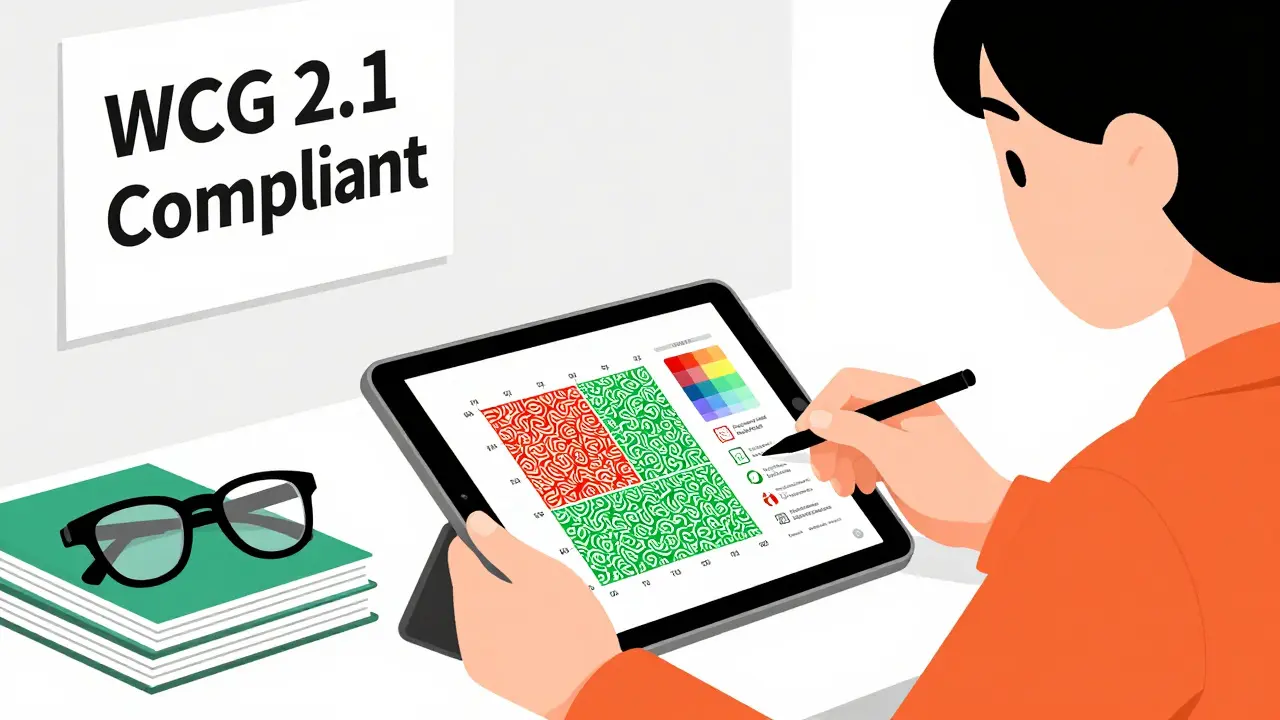
- Follow WCAG 2.1 guidelines. They require enough contrast and non-color cues for accessibility.
- Use ColorADD symbols-simple shapes that represent colors. They’re used in public transit systems in 17 countries.
It’s not about pity. It’s about inclusion. Good design helps everyone-not just those with color vision differences.
What You Should Know If You’re a Parent
If your son has red-green color blindness, he’s not behind. He’s not broken. He just sees the world differently. Talk to his teachers. Ask for color-accessible materials. Encourage him to use tools like color filters on his tablet or phone. Let him know he’s not alone-millions of people feel the same way.
If you’re a woman and you carry the gene, there’s a 50% chance your son will have it. Your daughter has a 50% chance of being a carrier. That’s not a tragedy. It’s genetics. And knowing helps you prepare.
Legal Rights and Workplace Accommodations
Color blindness is recognized as a disability under laws like the UK’s Equality Act 2010. Employers must make reasonable adjustments. That means: labeling wires, using text labels on charts, allowing color filters on screens. If you’re denied a job because of color blindness-and you can do the job just fine-there may be legal recourse.
Some careers still have strict color vision rules: pilots, electricians, military roles. But even here, accommodations are growing. Some airlines now allow pilots with color blindness to fly if they pass alternative tests. More employers are moving away from rigid color requirements.
Final Thoughts
Red-green color blindness isn’t a flaw. It’s a variation. Like being left-handed or having blue eyes. It’s part of human diversity. The problem isn’t the condition. It’s a world designed for one kind of vision.
With better tools, better design, and better understanding, people with color blindness don’t need to be fixed. They just need the world to adapt. And that’s something we can all work on.

laura Drever
January 14, 2026 AT 03:54Randall Little
January 14, 2026 AT 08:28Acacia Hendrix
January 16, 2026 AT 07:42Rosalee Vanness
January 16, 2026 AT 20:53Diana Campos Ortiz
January 18, 2026 AT 17:56Jesse Ibarra
January 20, 2026 AT 15:17James Castner
January 21, 2026 AT 11:25Adam Rivera
January 22, 2026 AT 06:58