
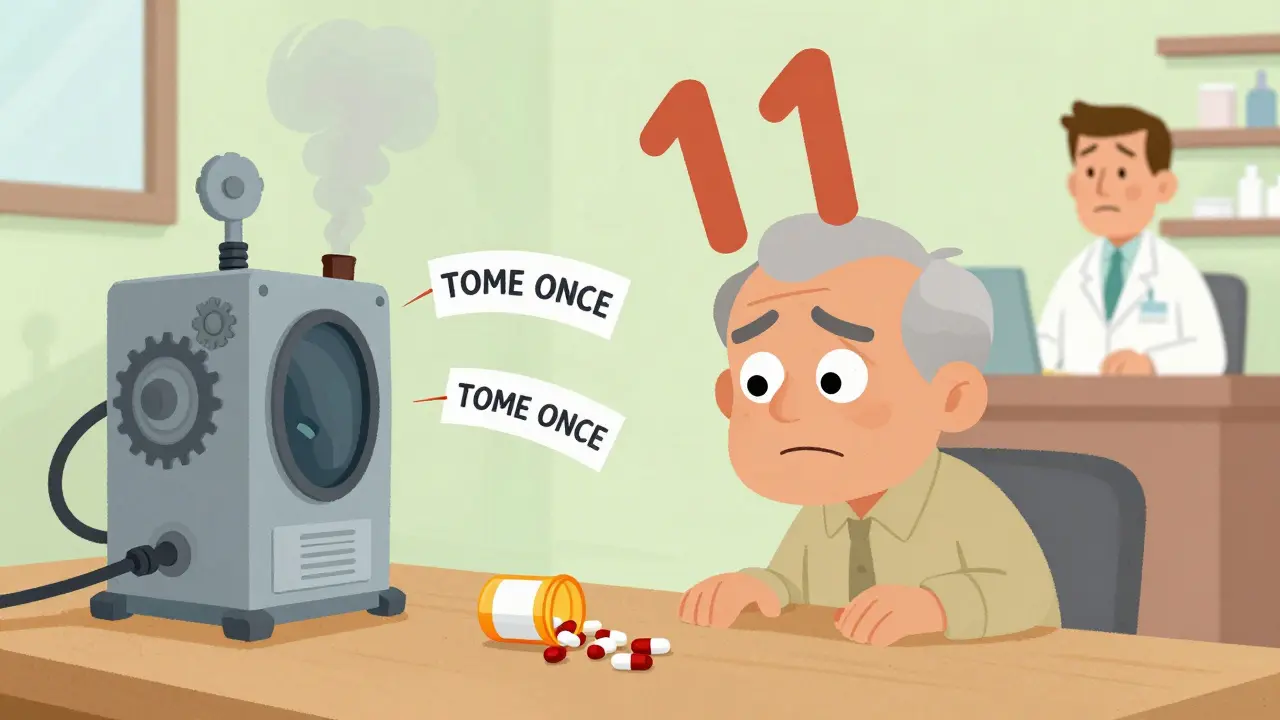
Imagine this: you pick up your medication, read the label, and it says "tome once". You think, "Okay, take one time." But in Spanish, "once" doesn’t mean "one time"-it means "eleven". So you take eleven pills instead of one. That’s not a hypothetical. That’s happened. And it’s not rare.
Every year, millions of Americans with limited English proficiency get prescription labels translated by machines that don’t understand medical context. The result? Confusing, dangerous, sometimes deadly mistakes. A 2010 study in the Pediatrics journal found that half of all Spanish-language prescription labels in New York pharmacies had errors. And that was over a decade ago. Things haven’t improved nearly enough.
How Translation Errors Happen on Prescription Labels
Most pharmacies don’t hire real translators. They use cheap, automated systems that pull phrases from a database and stitch them together. Think of it like using Google Translate on a legal contract. It might get the words right, but not the meaning.
Here’s how it breaks down:
- False cognates: Words that look similar but mean something totally different. "Once" = 11 in Spanish. "Embarazada" doesn’t mean "embarrassed"-it means "pregnant."
- Inconsistent terminology: One pharmacy says "take twice daily," another says "take two times a day." Same instruction, different wording. Patients get confused.
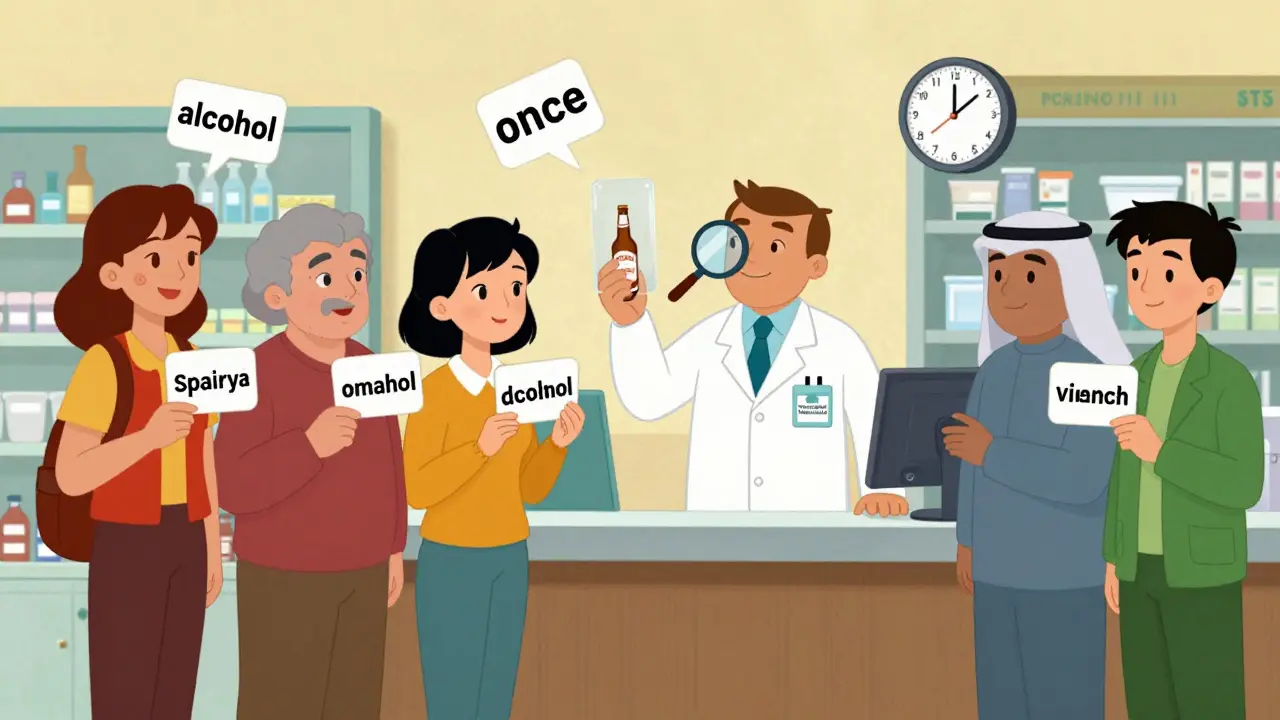
- Dialect differences: "Alcohol" in Latin America often means rubbing alcohol. In Spain, it means drinking alcohol. A label saying "avoid alcohol" could mean "don’t bathe in it" or "don’t have a beer."
- Missing context: "Take with food" doesn’t tell you which food. "Take on an empty stomach" doesn’t say how long to wait after eating.
A 2023 MedShadow report found that the same English phrase could be translated five different ways across pharmacies, depending on which system they used. That’s not just confusing-it’s a safety hazard.
Who’s Most at Risk?
About 25.5 million Americans-8.3% of the population-have limited English proficiency. That’s 1 in 12 people. Spanish speakers make up the largest group: over 15 million. But it’s not just Spanish. Chinese, Vietnamese, Arabic, and Russian speakers also face serious gaps.
Here’s the scary part: only two states-California and New York-have laws requiring accurate prescription translations. In the rest of the country, it’s a gamble. A 2022 survey by the National Council for Prescription Drug Programs found that only 23% of pharmacies offer translation in Chinese, Vietnamese, or Arabic. Meanwhile, 87% offer Spanish.
And it’s not just about language. It’s about trust. A 2023 National Health Law Program survey found that 63% of LEP patients were confused by their label instructions. Nearly 3 out of 10 admitted they took the wrong dose because they didn’t understand it.
Real Stories, Real Consequences
Reddit threads like r/pharmacy are full of horror stories:
- A woman in Texas took her diabetes medication "twice weekly" instead of "twice daily" because the label said "dos veces semanal." She ended up in the ER.
- A man in Florida was told to take his blood thinner "una vez al día." He thought it meant "one pill," but didn’t realize the pill was double strength. He had a stroke.
- A grandmother in California was given a label that said "tome dos tabletas dos veces diario." One pharmacy got it right. Another said "dos veces semanal." Her family didn’t catch it until she missed her next heart appointment.
These aren’t outliers. They’re symptoms of a broken system.
What’s Being Done to Fix It?
Some places are getting it right.
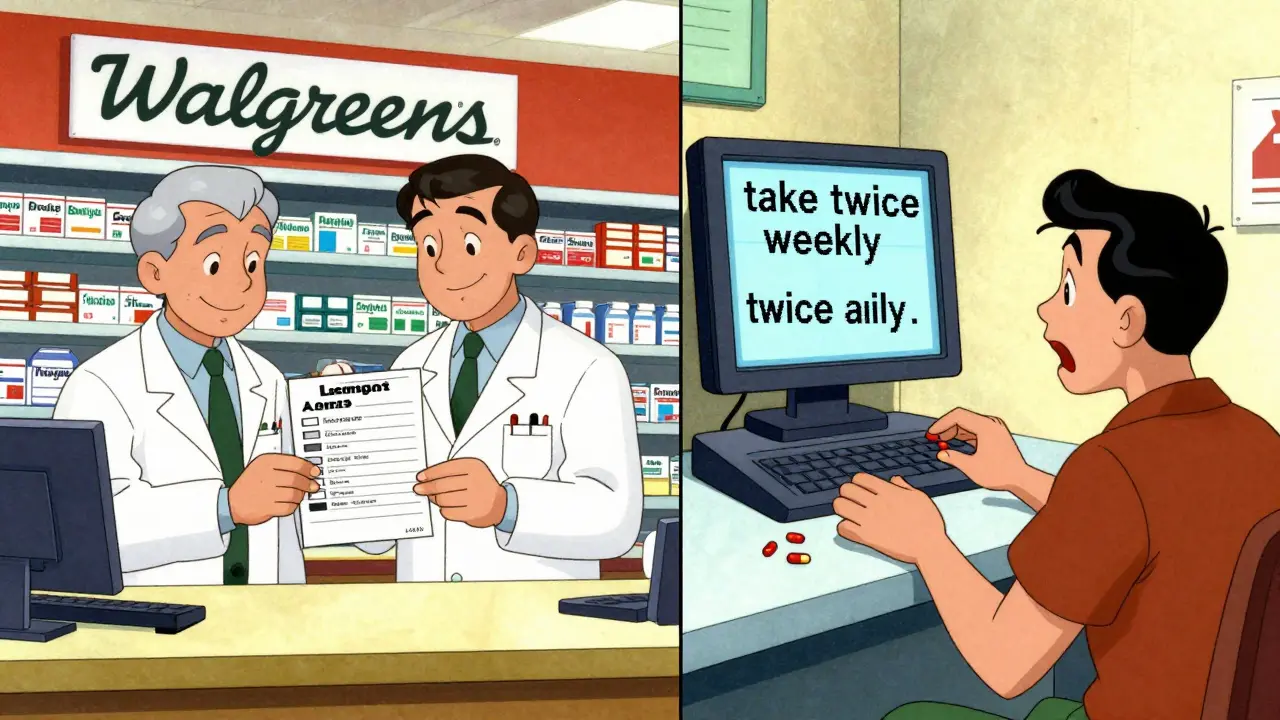
California passed Senate Bill 853 in 2016, requiring all prescription labels to be translated by certified professionals-not machines. Since then, medication errors among Spanish-speaking patients dropped by 32%. ER visits related to translation mistakes fell by 27%.
How? They use certified medical translators with at least five years of experience in pharmacy settings. They don’t just translate-they verify. Two people check every label: one translator, one pharmacist. It costs more, but it saves lives.
Major chains are catching on. Walgreens rolled out its MedTranslate AI system in late 2023. It uses neural translation, but it still requires a pharmacist to sign off. CVS launched LanguageBridge in early 2024 with the same model. Both report a 60%+ drop in errors in pilot locations.
The FDA’s 2024 draft guidance pushes for plain-language labels that are easier to translate. Instead of "take on an empty stomach," it now recommends "take at least 1 hour before eating." Simpler. Clearer. Less room for error.
How to Get Help If Your Label Doesn’t Make Sense
You don’t have to accept a dangerous label. Here’s what you can do:
- Ask for a human translator. Say: "Can I speak with someone who speaks my language?" Most pharmacies have phone interpreter services-even if they don’t have someone on-site.
- Request a printed copy in your language. Under Title VI of the Civil Rights Act, pharmacies receiving federal funding (which is almost all of them) must provide language assistance. You have a legal right to this.
- Call your doctor’s office. Ask them to send a clear instruction sheet in your language. Many clinics now provide bilingual medication cards.
- Use a trusted pharmacy. Look for pharmacies that advertise certified translators. Walgreens, Kaiser Permanente, and some community clinics have better systems. Yelp reviews often mention this-search for "certified translator" or "Spanish-speaking pharmacist."
- Check your medication with a pharmacist. Don’t just pick up the prescription. Take 5 minutes to ask: "Can you explain this to me in my language?"
If you’re in California or New York, you can file a complaint with the state health department if your label is wrong. In other states, contact the pharmacy’s corporate office. Many have customer service lines that handle language access complaints.
What’s Still Missing
Even with progress, big gaps remain:
- Most pharmacies still use automated systems because they’re cheap. Translation costs $0.15-$0.30 per label with humans. Machines? $0.02-$0.05.
- Less common languages still get ignored. Hmong, Somali, Tagalog-there’s little to no translation support.
- Federally funded clinics still lag. A May 2024 GAO report found 61% lack certified translators.
- There’s no national standard. Rules vary by state. A label that’s legal in Texas might be illegal in California.
The solution isn’t just better tech. It’s policy. It’s funding. It’s making language access a non-negotiable part of patient safety.
What You Can Do Now
If you or someone you care about relies on prescription labels:
- Always double-check the instructions with a pharmacist.
- Keep a written list of medications and instructions in your language.
- Ask your doctor for a bilingual medication card.
- If you see a translation error, report it. Call the pharmacy. Email the corporate office. Tell your local health department.
Medication errors kill more people than car accidents in the U.S. every year. A single mistranslated word can turn a life-saving drug into a poison. You have the right to understand your medication. Don’t let a bad translation cost you your health.
Why are prescription labels often translated incorrectly?
Most pharmacies use automated translation systems because they’re cheaper and faster than hiring professional translators. These systems often rely on generic databases that don’t understand medical context, leading to errors like false cognates (e.g., "once" meaning "eleven" in Spanish) or inconsistent phrasing. Without human review, these mistakes go unnoticed until a patient takes the wrong dose.
Which languages are most commonly translated on prescription labels?
Spanish is by far the most common, offered at 87% of major pharmacy chains. Chinese, Vietnamese, and Arabic translations are available at only about 23% of locations. Other languages like Tagalog, Hmong, and Somali often have no translation support at all, even in areas with large communities.
Are pharmacies legally required to provide translated prescription labels?
Under Title VI of the Civil Rights Act, pharmacies that receive federal funding must provide language assistance to patients with limited English proficiency. However, only California and New York have laws specifically requiring accurate, human-translated prescription labels. In other states, enforcement is inconsistent, and many pharmacies rely on automated systems without meeting legal standards.
How can I get a correct translation of my prescription label?
Ask the pharmacy for a certified translator-either in person or via phone. You can also request a printed version in your language. If they refuse, ask to speak with a manager or contact the pharmacy’s corporate office. Your doctor’s office may also be able to provide a bilingual medication sheet. In California and New York, you have the legal right to accurate translation.
What should I do if I think my prescription label has a translation error?
Don’t take the medication until you confirm the instructions. Call your doctor or pharmacist and ask them to explain the label in your language. If you’re still unsure, go to a different pharmacy that offers certified translation services. Report the error to the pharmacy’s corporate office and consider filing a complaint with your state’s health department.
