
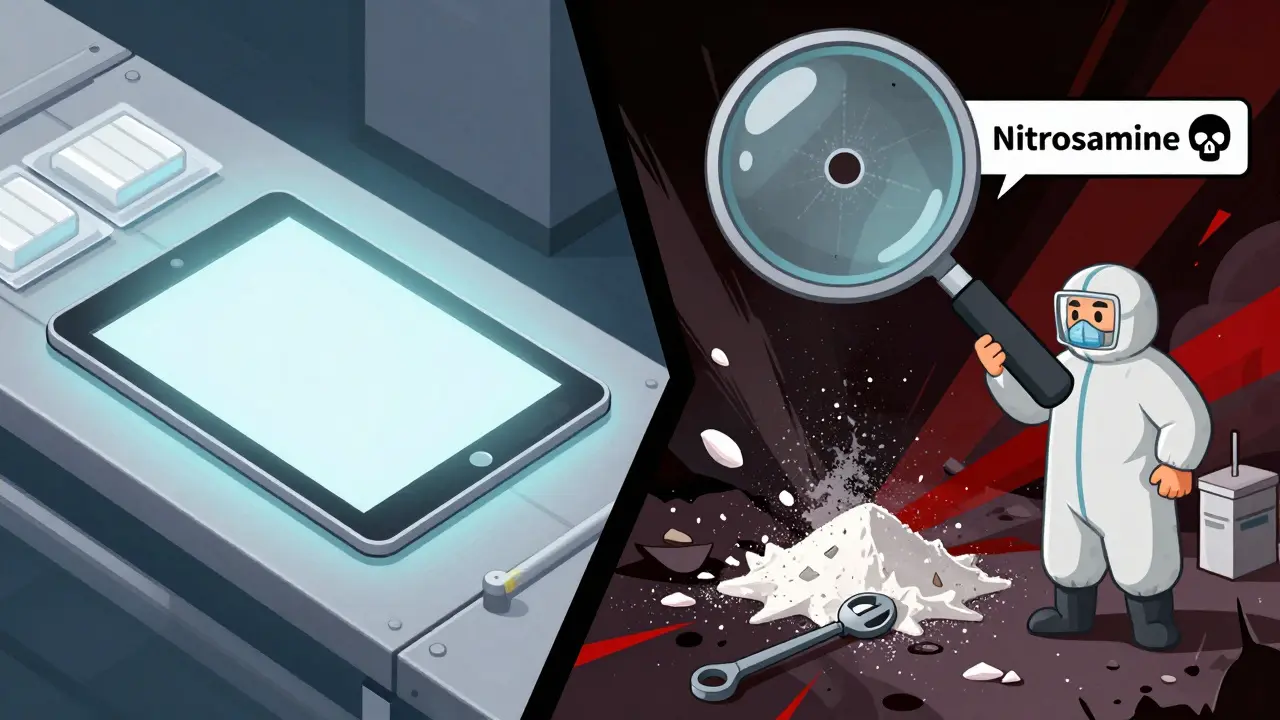
When you pick up a generic pill at the pharmacy, you expect it to work just like the brand-name version. But what you don’t see is the intense battle happening behind the scenes to keep that pill clean. Contamination controls aren’t just paperwork-they’re the line between a safe medicine and a dangerous one. In generic drug manufacturing, where margins are thin and volumes are high, even a tiny amount of the wrong substance can turn a batch into a public health risk. This isn’t theoretical. In 2020, a single chemical contaminant called nitrosamine slipped into blood pressure meds, triggering global recalls and costing manufacturers over $1.2 billion. That’s why every step in production-from raw materials to packaging-is locked down with science, not guesswork.
What Counts as Contamination?
Contamination in pharmaceuticals isn’t just dirt or dust. It’s anything that shouldn’t be there: leftover drug from a previous batch, bacteria from a worker’s skin, chemical residues from cleaning tools, or even airborne particles that settle on tablets. The FDA defines a drug as adulterated if it’s made under unsanitary conditions that could make it harmful. That’s a legal line, not a suggestion. In 2022, over a third of all FDA Warning Letters to drug makers were about contamination issues. That’s more than any other single problem.
Think about it this way: if a factory makes ten different pills in one building, and one of them is a powerful hormone, you can’t let even a speck of that hormone mix into a blood pressure pill. That’s cross-contamination. The limit? As low as 1 nanogram per square centimeter-so small you’d need a microscope to see it. And that’s just for high-potency drugs. For others, the rule is simpler: no more than 10 parts per million of leftover chemical residue. Any more, and the batch gets destroyed.
How Clean Is Clean Enough?
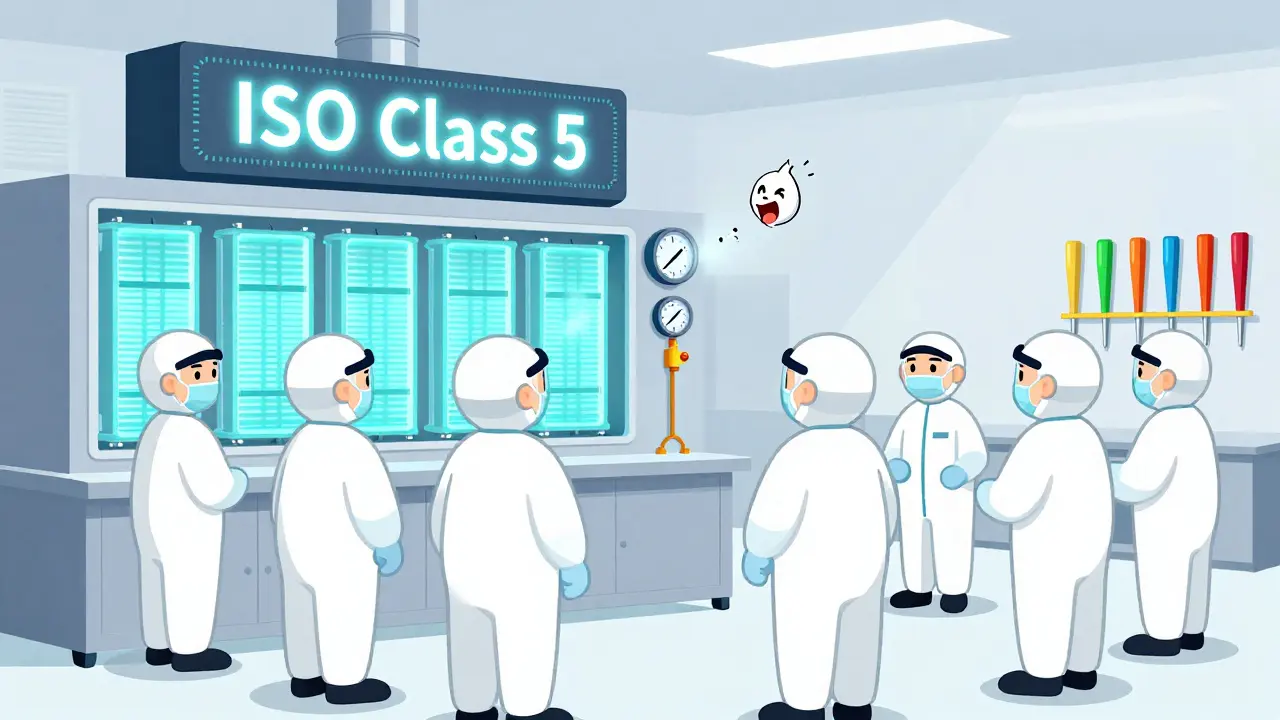
Generic drug plants don’t look like hospitals. They look like high-tech warehouses with sealed rooms, airlocks, and workers in full-body suits. The cleanest areas-where pills are filled or injected-are classified as ISO Class 5. That means no more than 3,520 tiny particles per cubic meter of air. For context, a busy city street has over 10 million particles in the same space. To keep that clean, air is pumped through HEPA filters that catch 99.97% of particles as small as 0.3 microns. Some newer facilities even use ULPA filters, which catch 99.999% of particles down to 0.12 microns. But those cost more energy-up to 40% more-so they’re only used where absolutely necessary.
Pressure matters too. Rooms are kept at different air pressures so that air always flows from cleanest to least clean areas. If the pressure drops, dirty air can sneak in. HVAC systems must deliver 20 to 60 air changes per hour, depending on the zone. And every surface? It’s cleaned, tested, and retested. Swabs are taken from tables, machines, and even gloves. Microbial limits? No more than 10 colony-forming units on a 25cm² surface. That’s like finding one dirty spoon in a pile of 10,000.
Old Ways vs. New Tech
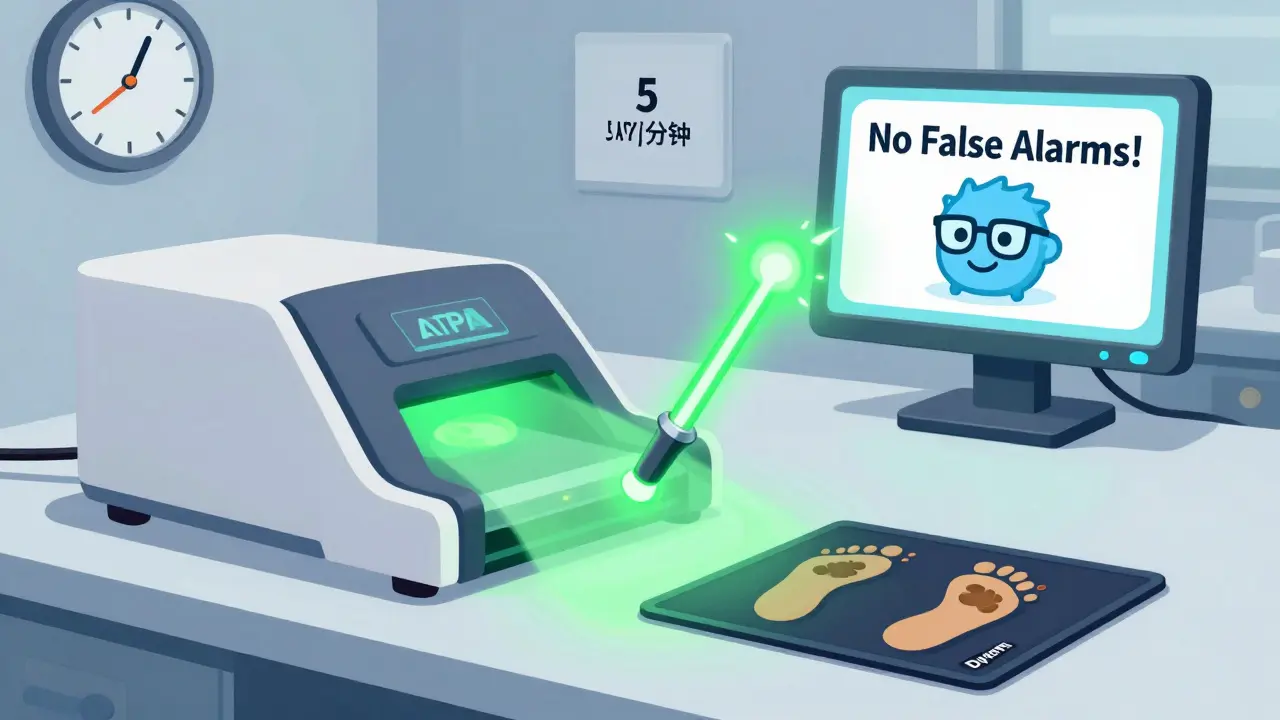
For years, manufacturers relied on manual swabbing and lab cultures that took five to seven days to give results. By then, thousands of pills were already made-and maybe already shipped. Today, rapid microbiological methods (RMMs) cut that time to 24 to 48 hours. Even better, some labs now use ATP bioluminescence scanners. You swipe a surface, plug it in, and get a number in five minutes. It’s 95% as accurate as old-school cultures, but you can act on it the same day.
Real-time particle counters are another game-changer. Devices like the MetOne 3400+ monitor air quality 24/7. A 2022 study found they cut contamination incidents by 63%. Why? Because manual checks miss 78% of short bursts of contamination-like when a worker sneezes or a door opens. These systems alert operators immediately. One facility in India reported a 40% drop in batch rejections after installing them.
But tech isn’t magic. It costs $15,000 to $25,000 per unit. Small manufacturers can’t always afford it. That’s why many still use color-coded equipment, strict shift schedules, and laminar flow hoods. A 2023 survey found that facilities using color-coded tools reduced mix-ups by 65%. Simple, cheap, and effective.
Human Error Is the Biggest Threat
Here’s the uncomfortable truth: most contamination doesn’t come from broken machines. It comes from people. A 2023 study by Dr. Michael Gamlen found that 83% of contamination events trace back to human actions. Think: a worker skipping gowning steps, not washing hands, or using the same tool on two different products.
One Teva Pharmaceuticals employee reported a 30% spike in gowning violations after switching to reusable suits. Why? The suits were harder to put on correctly. They had to invest $185,000 in upgraded air showers to fix it. Another facility found that after eight hours, compliance with gowning rules dropped by 40%. That’s why some plants now use staggered shifts-fewer people moving through clean zones at once.
And it’s not just about hygiene. Raw materials can be contaminated too. Indian suppliers report 22% more contaminated ingredients than EU sources, according to EDQM data. That means generic makers can’t just trust their suppliers-they have to test, test, and test again.
What’s Changing in 2025?
The rules are tightening. In September 2023, the FDA released a draft rule requiring all solid oral drug manufacturers to use health-based exposure limits (HBELs) by 2025. That means every single product-no matter how common-must have a scientifically calculated safety threshold for cross-contamination. For a medium-sized plant, that could mean $1.2 million in new testing, validation, and training.
AI is stepping in to help. Honeywell’s Forge Pharma system, tested at a Merck generics plant, cut false alarms by 68%. It learns patterns in real-time data and tells operators when something’s truly wrong-not just when a sensor flickers. Meanwhile, waterless cleaning tech is cutting utility costs by 22%. GlaxoSmithKline’s pilot showed you can clean equipment with dry wipes and ultrasonic vibrations instead of gallons of water and chemicals.
But not everyone agrees on how far to go. Dr. Paul Garmory warns that over-engineering containment for low-risk drugs wastes millions. A $2.8 million annual cost for a facility making aspirin? That’s not smart. The goal isn’t perfection-it’s proportionate risk control.
Why This Matters to You
Generic drugs make up 90% of all prescriptions in the U.S. But they only cost 22% of what brand-name drugs do. That’s possible because manufacturers run tight operations. But if contamination controls slip, everything collapses. Recalls cost money. Loss of trust costs more. And in the worst cases, people get sick.
The good news? Facilities using integrated systems-real-time monitoring, risk-based cleaning, and staff training-see 3.2 times better returns over five years. Fewer batch failures. Faster inspections. Fewer warning letters. It’s not just about compliance. It’s about staying in business.
For small manufacturers, the challenge is real. But the tools are there: color-coded tools, Dycem CleanZone mats (which reduce foot contamination by 72%), and simple procedural fixes. You don’t need a $2 million system to be safe. You just need to be smart, consistent, and never assume it won’t happen to you.
What is the biggest cause of contamination in generic drug manufacturing?
Human error is the leading cause, accounting for 47% of contamination incidents, according to a 2023 PDA survey. This includes improper gowning, inadequate hand hygiene, and failure to follow cleaning procedures. Equipment cleaning failures come second at 29%, followed by raw material contamination at 18%.
How do manufacturers test for contamination?
Manufacturers use swabbing and rinse sampling to detect chemical residues and microbial growth. Swabs are taken from surfaces like equipment and walls, then analyzed in labs. For chemical limits, they check for residues below 10 ppm. For microbes, they aim for fewer than 10 CFU per 25cm². Newer methods like ATP bioluminescence and rapid microbiological methods (RMMs) give results in hours instead of days.
What are ISO cleanroom classifications and why do they matter?
ISO 14644-1 defines cleanroom levels based on particle count. ISO Class 5 (Grade A) is the cleanest, used for sterile filling, with under 3,520 particles per cubic meter. ISO Class 7 (Grade C) and Class 8 (Grade D) are for less critical areas. These standards ensure airborne particles don’t settle on products. They’re required under EU GMP Annex 1 and FDA CGMP guidelines.
What’s the difference between innovator and generic drug contamination controls?
Innovator companies spend about 2.3 times more on facility design-$185 million vs. $80 million for equivalent capacity-because they often produce unique, high-potency drugs. Generic manufacturers rely more on procedural controls: strict cleaning protocols, color-coded equipment, and operational discipline. They can’t match the capital investment, so they focus on flawless execution.
What happens if a generic drug fails contamination testing?
The entire batch is quarantined and destroyed. If the issue is systemic, the FDA may issue a Warning Letter, halt production, or even ban the facility from exporting. A single contamination failure can cost millions in lost product, recalls, and regulatory fines. In 2020, nitrosamine contamination led to over $1 billion in losses across 22 manufacturers.
Are there any low-cost ways to reduce contamination?
Yes. Color-coded equipment reduces mix-ups by 65%. Dycem CleanZone mats reduce foot-borne contamination by 72%. Staggered shifts cut traffic in clean zones. Simple training on gowning and hand hygiene improves compliance. These low-tech fixes are often more effective than expensive tech for small facilities.

Ian Kiplagat
March 5, 2026 AT 15:53Vikas Verma
March 6, 2026 AT 07:15Joey Pearson
March 6, 2026 AT 15:40Amina Aminkhuslen
March 8, 2026 AT 03:23Pranay Roy
March 8, 2026 AT 16:42Jeff Mirisola
March 10, 2026 AT 06:34Joe Prism
March 11, 2026 AT 20:21Roland Silber
March 13, 2026 AT 16:58Sean Callahan
March 15, 2026 AT 07:15Patrick Jackson
March 15, 2026 AT 22:04Tim Hnatko
March 16, 2026 AT 21:53Ferdinand Aton
March 16, 2026 AT 23:18amber carrillo
March 17, 2026 AT 03:47Adebayo Muhammad
March 18, 2026 AT 10:33Aaron Pace
March 19, 2026 AT 06:27