
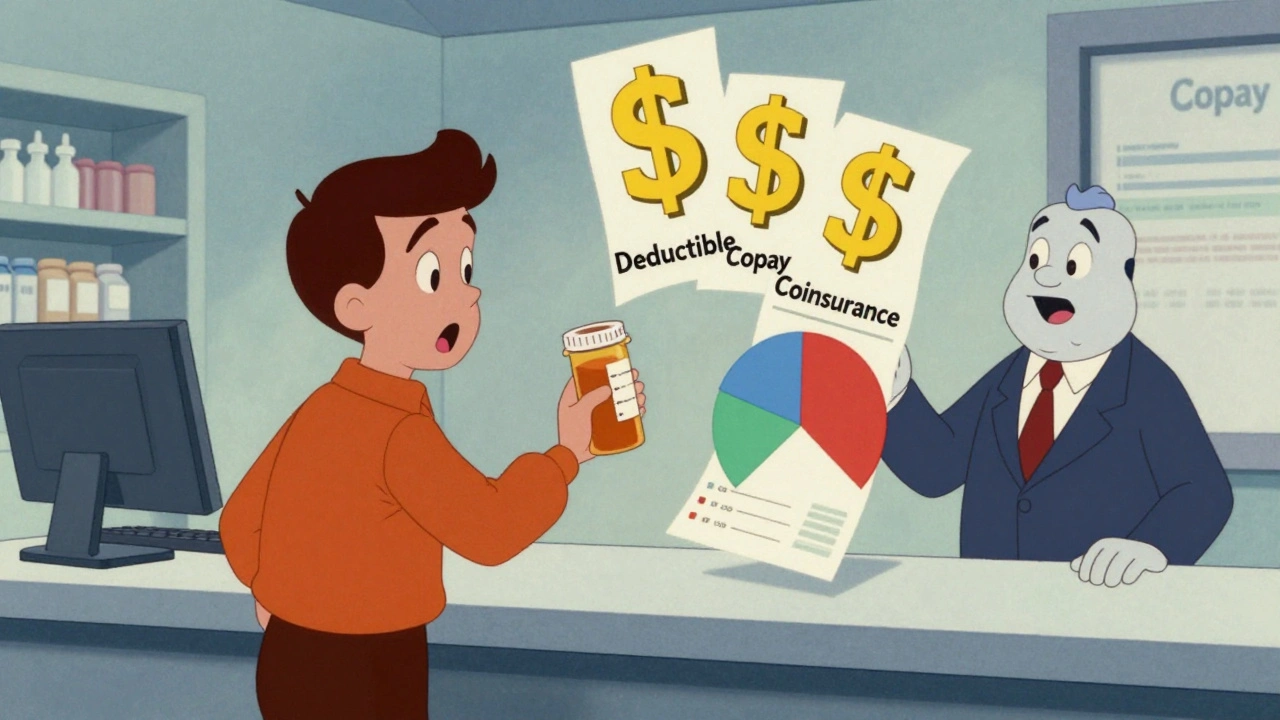
When you pick up your prescription, you might be surprised by the price on the receipt-even though you have insurance. That’s because cost sharing is how you and your insurance company split the bill for your meds. It’s not just about your monthly premium. It’s about what you pay at the pharmacy counter, and understanding the difference between deductibles, copays, and coinsurance can save you hundreds-or even thousands-each year.
What Is Cost Sharing, Really?
Cost sharing is the part of your healthcare bill you pay out of your own pocket. It doesn’t include your monthly premium. It’s the money you hand over when you see a doctor, get lab work, or fill a prescription. Insurance companies use cost sharing to keep premiums lower. If you paid nothing out of pocket, your monthly bill would be way higher. So instead, you pay a little now, and your insurer covers the rest-once you hit certain thresholds.For medications, this plays out in three main ways: deductibles, copays, and coinsurance. Each one works differently, and your plan might use one, two, or all three. Knowing how they stack up helps you pick the right plan and avoid sticker shock at the pharmacy.
Deductibles: The First Hurdle
Your deductible is the amount you pay each year before your insurance starts helping with most costs. For meds, that means you pay 100% of the price until you hit that number.Let’s say your plan has a $1,500 deductible. You take a $120 monthly medication. That’s $1,440 in a year just for that one drug. You’re paying full price. When you hit $1,500 in total out-of-pocket spending (including doctor visits, labs, and other meds), your insurance kicks in. After that, you might only pay a copay or coinsurance for your prescriptions.
High-deductible plans (HDHPs) are common. In 2023, the average individual deductible for bronze plans was around $7,000. These plans have lower monthly premiums, but you’re on the hook for more up front. If you’re healthy and don’t take many meds, this might make sense. But if you’re on a chronic medication, you could end up paying thousands before your insurance helps.
Important: Not all services count toward your deductible right away. Preventive care-like annual checkups or certain vaccines-is often covered 100% even before you meet your deductible. But prescriptions? Usually not. Always check your plan’s Summary of Benefits and Coverage (SBC). It’ll show exactly which meds are subject to the deductible.
Copays: Fixed Fees at the Counter
A copay is a flat fee you pay each time you get a service. For prescriptions, it’s usually $10, $25, or $50 per fill-no matter how much the drug actually costs.Some plans have tiered copays based on the type of drug:
- Generic drugs: $10
- Brand-name drugs: $45
- Specialty drugs (like for rheumatoid arthritis or MS): $100+
Here’s the catch: copays may or may not count toward your deductible. In many plans, you pay your copay even before you meet your deductible. That means you’re paying $25 for a $200 pill, and that $25 goes toward your $1,500 deductible. Other plans require you to pay full price until the deductible is met-then you switch to the copay. This varies by insurer and plan type.
Some plans don’t use copays at all for meds. Instead, they use coinsurance after the deductible. So if you’re on a plan with a $5,000 deductible and 30% coinsurance, you’ll pay the full price of your meds until you hit $5,000, then pay 30% of the cost after that.
Pro tip: Always ask your pharmacist if the copay you’re being charged counts toward your deductible. Many people assume it does, only to find out later it doesn’t-and they’re still far from meeting their deductible.

Coinsurance: The Percentage Game
Coinsurance is your share of the cost as a percentage. After you meet your deductible, your insurance pays, say, 80% of the cost of your medication. You pay the other 20%.Let’s say your insulin costs $150 per month. Your coinsurance is 20%. Once you’ve hit your deductible, you pay $30. Your insurer pays $120.
Coinsurance can be tricky because it’s based on the plan’s allowed amount-not the actual price. For example, your pharmacy might charge $180 for a drug, but your insurer negotiated a lower rate of $120. Your coinsurance is 20% of $120, so you pay $24, not $36. This is why it’s smart to use in-network pharmacies. Out-of-network prices aren’t discounted, so your coinsurance could be way higher.
Coinsurance also counts toward your out-of-pocket maximum. Once you hit that cap, your insurance pays 100% for covered services for the rest of the year. In 2025, the federal out-of-pocket maximum for individual plans is $9,200. For families, it’s $18,400. That’s the most you’ll ever pay in a year for covered care-including meds.
How These Three Work Together
Most plans combine these elements. Here’s a typical scenario:- You start the year with a $2,000 deductible.
- You fill a $100 prescription. You pay the full $100. Your deductible is now $1,900.
- You fill another $100 prescription. You pay $100. Deductible: $1,800.
- After 20 fills, you’ve paid $2,000. Deductible met.
- Now your plan switches to 30% coinsurance. Your next $100 prescription costs you $30.
- You keep paying $30 per fill until you hit your out-of-pocket max of $9,200.
- After that, your meds are free.
Some plans use copays after the deductible instead of coinsurance. So after you pay $2,000, you pay a flat $30 per script, no matter the drug’s price. That’s simpler-but not always cheaper.
What’s Not Included in Cost Sharing
Don’t confuse cost sharing with other expenses:- Premiums: Your monthly insurance payment. These never count toward your deductible or out-of-pocket max.
- Non-covered drugs: If your plan doesn’t list your medication on its formulary, you pay 100%. No help from insurance.
- Out-of-network charges: If you use a pharmacy outside your plan’s network, you might pay way more-or nothing gets counted toward your max.
- Penalties: Late fees, cash payments, or non-prescription items like vitamins aren’t part of cost sharing.
Always check your plan’s formulary-the list of covered drugs. If your medication isn’t on it, talk to your doctor about alternatives. Sometimes, a generic version or another brand is covered and costs far less.
Real-World Impact: How This Affects Your Wallet
A 2022 study by the Patient Advocate Foundation found that 31% of people with chronic conditions got hit with unexpected bills because they didn’t understand how coinsurance worked with specialty meds. One woman on a $6,000 monthly drug thought her $50 copay was all she’d pay. She didn’t realize her plan required her to pay 40% coinsurance after a $7,000 deductible. She ended up paying $24,000 in one year.On the flip side, people who used their insurer’s online cost estimator saved an average of 22% on out-of-pocket drug costs. Why? They compared prices between pharmacies and picked the one with the lowest copay or coinsurance.
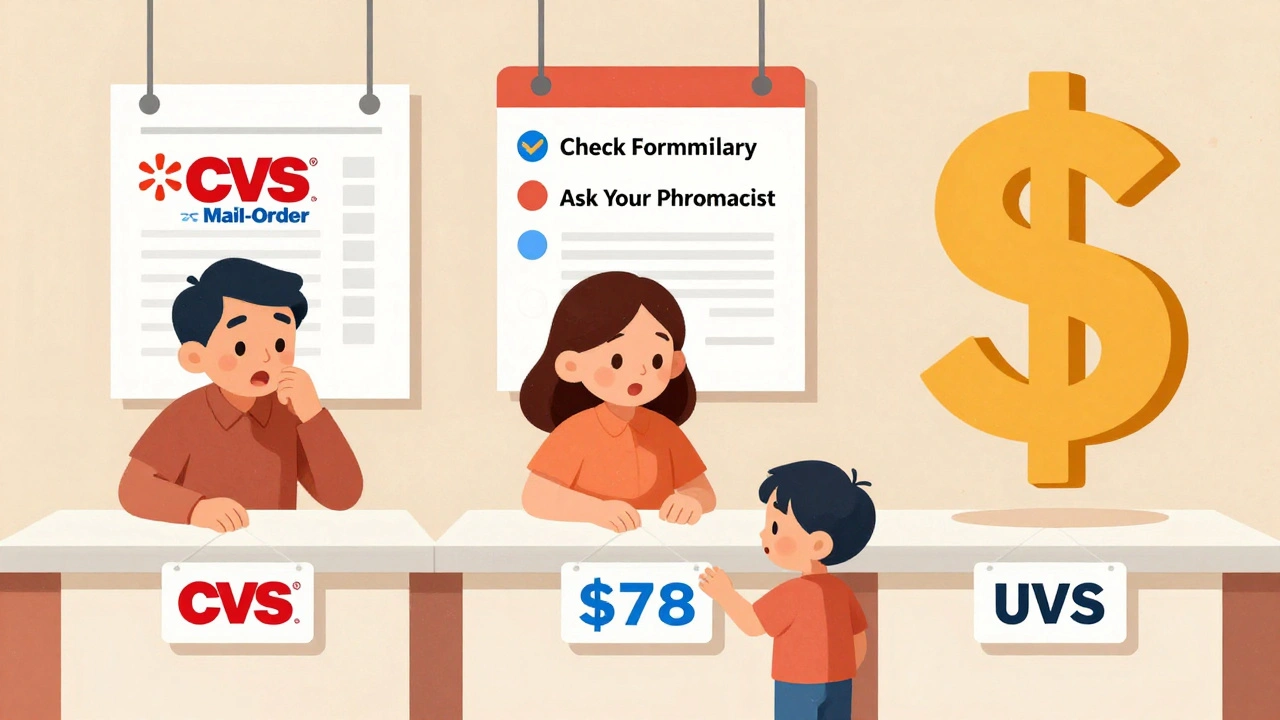
For example, you might pay $40 at CVS, $25 at Walmart, and $15 at a mail-order pharmacy for the same generic. That’s $300 a year difference. That’s a vacation. Or a new pair of shoes. Or just peace of mind.
How to Avoid Surprises
Here’s what you can do right now:- Get your plan’s Summary of Benefits and Coverage (SBC). It’s required by law. Read it.
- Check your formulary. Is your medication listed? In which tier?
- Use your insurer’s pharmacy locator tool. Find the cheapest in-network option.
- Ask your pharmacist: “Does this copay count toward my deductible?”
- Call your insurer. Ask: “What’s my deductible? My coinsurance rate? My out-of-pocket max?” Write it down.
- If you’re on a high-deductible plan, consider an HSA. You can use pre-tax dollars to pay for meds, and the money rolls over year to year.
The Inflation Reduction Act of 2022 capped insulin at $35 per month for Medicare patients. That’s huge. But it doesn’t apply to everyone. If you’re under 65, you still need to know your plan’s rules.
Final Thought: It’s Not Just About Price-It’s About Predictability
The goal isn’t to find the cheapest plan. It’s to find the one that matches your needs. If you take three prescriptions a month, a $5,000 deductible might crush you. A $1,000 deductible with a $45 copay might be better-even if the premium is $100 more.Think of it like a car. A cheap car might have low monthly payments, but if it breaks down every month, you’re spending more in repairs. A slightly more expensive car with reliable service? That’s the smart buy.
Know your numbers. Ask questions. Use tools. You’re not just paying for insurance-you’re paying for peace of mind. And that’s worth understanding.
Do copays count toward my deductible?
It depends on your plan. Some plans let copays count toward your deductible, while others require you to pay full price until the deductible is met-then you switch to the copay. Always check your plan’s Summary of Benefits and Coverage or call your insurer to confirm.
What’s the difference between coinsurance and a copay?
A copay is a fixed dollar amount you pay per prescription-like $25-no matter how much the drug costs. Coinsurance is a percentage-like 20%-of the drug’s allowed cost, which changes depending on the price. Coinsurance usually applies after you meet your deductible, while copays can apply before or after, depending on your plan.
Do all medications count toward my out-of-pocket maximum?
Only covered medications count. If your plan doesn’t include your drug on its formulary, you pay 100% and it doesn’t count toward your max. Also, out-of-network prescriptions may not count. Always verify your drug is covered and you’re using an in-network pharmacy.
Can I avoid paying my deductible on prescriptions?
Only if your plan covers certain prescriptions without requiring you to meet the deductible first. This is rare for regular meds, but some plans cover preventive or chronic disease meds (like blood pressure or diabetes drugs) with no deductible. Check your plan’s rules carefully.
What happens after I hit my out-of-pocket maximum?
Once you hit your out-of-pocket maximum for the year, your insurance pays 100% of all covered services-including prescriptions-for the rest of the year. You won’t pay anything else for covered meds until the next plan year.
If you’re on a long-term medication, don’t guess your costs. Use your insurer’s online tools, compare pharmacy prices, and talk to your pharmacist. Small steps like these can cut your annual drug bill by hundreds-or even thousands.

Deborah Andrich
December 12, 2025 AT 14:25Stop guessing. Check your SBC.
Tommy Watson
December 12, 2025 AT 18:33Karen Mccullouch
December 14, 2025 AT 11:47Here we got spreadsheets and pharmacy clerks who don’t even know what coinsurance means 😭
Michael Gardner
December 16, 2025 AT 05:38Ronan Lansbury
December 17, 2025 AT 17:26And yes, I’ve read the FDA filings.
Jade Hovet
December 19, 2025 AT 06:26nithin Kuntumadugu
December 20, 2025 AT 17:58John Fred
December 20, 2025 AT 23:42Harriet Wollaston
December 22, 2025 AT 22:01Tyrone Marshall
December 24, 2025 AT 02:24Emily Haworth
December 25, 2025 AT 00:52Tom Zerkoff
December 25, 2025 AT 10:42Yatendra S
December 27, 2025 AT 07:59Himmat Singh
December 28, 2025 AT 15:15kevin moranga
December 30, 2025 AT 10:18