
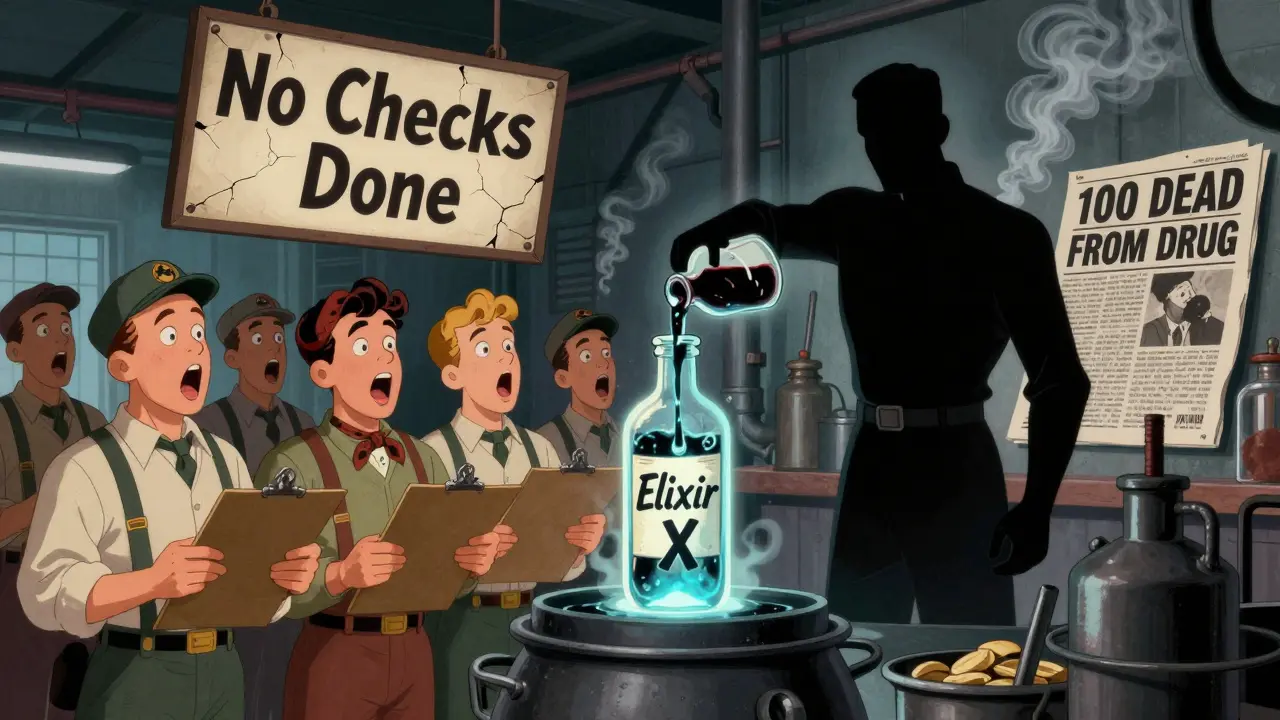
When you think about manufacturing quality, you probably picture machines, assembly lines, or lab tests. But the real backbone of safety and consistency? Documentation. It’s not paperwork for the sake of bureaucracy-it’s the system that stops contaminated medicine, wrong dosages, or unsafe devices from ever reaching people. In manufacturing, especially in pharmaceuticals, medical devices, and food production, documentation isn’t optional. It’s legally required. And if it’s done wrong, the cost isn’t just a fine-it’s a recall, a shutdown, or worse, a life lost.
Why Documentation Isn’t Just Paperwork
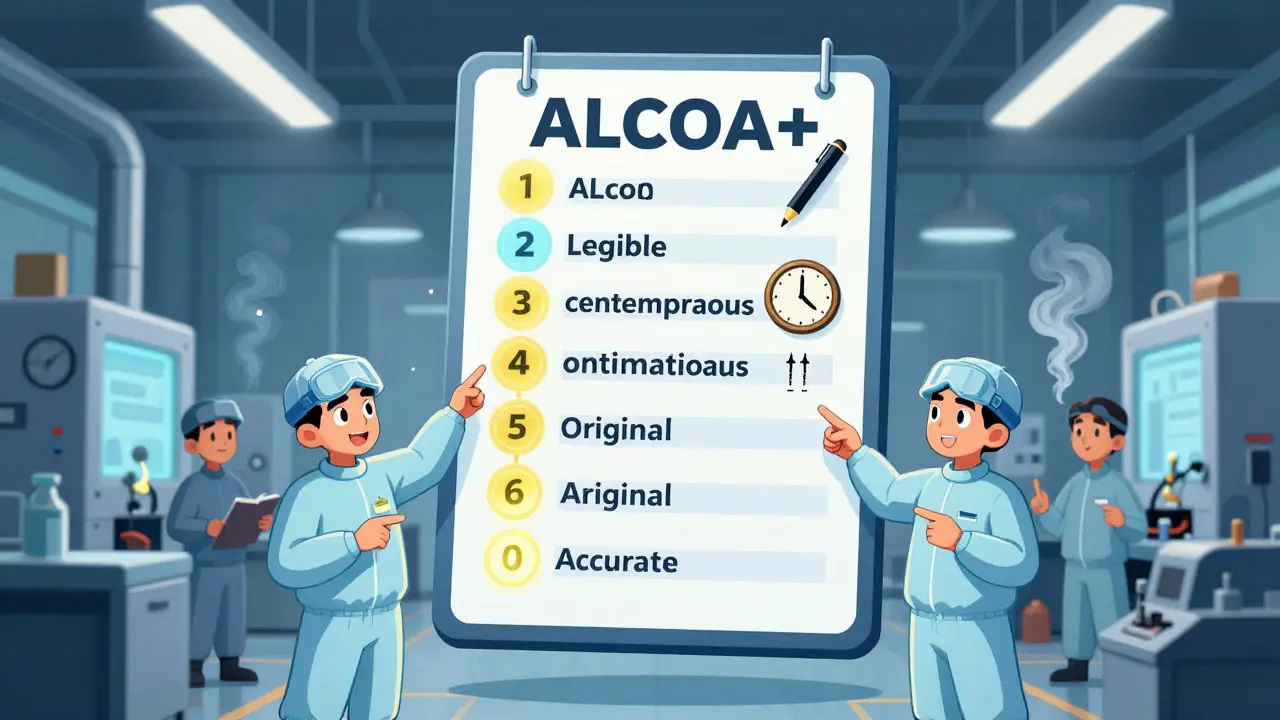
In 1937, over 100 people died after drinking a toxic elixir because no one checked what was in it. That tragedy led to the first real rules for manufacturing quality. Today, those rules live in regulations like the FDA’s 21 CFR Part 211 and the EU’s EudraLex Volume 4. They don’t just say “keep records.” They demand records that are trustworthy. That’s where ALCOA+ comes in. It’s not a fancy acronym you memorize for an audit-it’s the daily checklist for every note, log, and digital entry you make.- Attributable: Who made the entry? No vague initials. No “operator.” It’s your name, your ID, your signature-electronic or handwritten.
- Legible: If it can’t be read in 10 years, it’s useless. Smudged ink? Blurry scan? That’s a red flag.
- Contemporaneous: You don’t write it down after shift. You write it as you do it. Delayed entries are treated like lies in audits.
- Original: Copies don’t count. If you transcribe a reading from a machine, you still need the raw data. No “I wrote it down on a sticky note.”
- Accurate: One decimal point off in a moisture level? That could mean a batch is ruined. Or worse, unsafe.
- Complete, Consistent, Enduring, Available: Every step must be covered, no gaps, no missing pages, and it must survive a 10-year audit.
These aren’t suggestions. They’re the bare minimum. And regulators are watching. In 2022, over 41% of FDA inspection findings were about documentation errors-not equipment, not cleanliness, but records.
What Must Be Documented? The Must-Have Records
You can’t document everything. But you must document these:- Standard Operating Procedures (SOPs): These aren’t wall posters. They’re step-by-step guides written in plain language. FDA recommends 8th-grade reading level. If a new hire can’t follow it without training, it’s not good enough. Example: “Add 500 mL of water at 25°C ± 2°C while stirring at 120 RPM for 15 minutes.” Not “Stir until mixed.”
- Batch Records: Every batch of medicine, device, or food has its own record. It must include start and end times, equipment used (with serial numbers), environmental conditions (temperature, humidity), in-process test results, and final approval signatures. Missing one? That batch is suspect.
- Material Specifications: Not just “sugar.” It’s “Dextrose Monohydrate, USP Grade, moisture content: 3.5% ± 0.2% w/w.” Numbers matter. Tolerances matter.
- Calibration and Maintenance Logs: A machine that hasn’t been checked in 11 months? That’s a risk. Logs must show date, technician, readings before and after, and approval.
- Deviation and Investigation Reports: If something went wrong-temperature spike, missed step, equipment alarm-you document it immediately. Not tomorrow. Not next week. And you don’t just say “it happened.” You explain why, how it was fixed, and if it could happen again.
- Electronic System Validation: If you use software to log data, that software must be validated. That means testing it with over 150 scenarios to prove it doesn’t lose data, doesn’t allow unauthorized changes, and creates full audit trails. GAMP 5 is the industry standard for this.
Regional Differences That Trip Up Manufacturers
You’d think global standards mean global consistency. But they don’t. The U.S. FDA requires every calculation to be checked by a second person. The EU lets software do it. Japan demands all documents be in Japanese-even if your HQ is in Germany. And if you’re making medical devices? ISO 13485 demands traceability from design to final test. The FDA doesn’t. That means a company making the same product for both markets ends up with two sets of records, two sets of training, two sets of headaches.A 2022 study found manufacturers targeting both the U.S. and EU spent 37% longer getting approval because of documentation conflicts. One company I know spent $2.1 million a year just to reconcile their records. That’s not efficiency-that’s waste.
What Goes Wrong? The Top 3 Failures
Based on thousands of inspection reports, here’s what keeps auditors up at night:- Incomplete batch records (32% of citations): Missing signatures, skipped steps, no environmental data.
- Inadequate investigations (27%): “The machine broke.” No. “The motor overheated at 4:15 AM due to failed cooling fan. Fan was not replaced per maintenance schedule dated 2023-11-03.”
- Untimely entries (21%): Writing records a day-or a week-after the fact. Auditors treat this as data manipulation.
And here’s the scary part: 87% of FDA warning letters in 2021 were about data integrity. That’s not a fluke. It’s a pattern. People think “I’ll write it later.” They don’t realize: later is too late.
How to Get It Right
You don’t need a $5 million system. But you do need discipline. Here’s what works:- Write SOPs like you’re teaching a 14-year-old. No jargon. No passive voice. “Press the START button.” Not “The system shall be initiated.”
- Use the four-eyes rule: Every critical record gets reviewed by someone else. Not just a checkbox. A real look.
- Train like it’s life-or-death: New hires spend 40 hours on documentation before touching equipment. That’s not overkill. That’s insurance.
- Go digital-but validate it: Electronic systems cut errors by 55%, according to ISPE. But only if they’re properly validated. A poorly built system is worse than paper.
- Designate documentation champions: One person in each department whose job is to spot gaps, answer questions, and keep the team honest.
One pharmaceutical plant in Melbourne cut documentation errors by 76% by linking their electronic batch records to the production line. If a machine doesn’t complete a step, the system won’t let the next step be recorded. No bypass. No excuses.
The Future Is Digital-But Not Automated
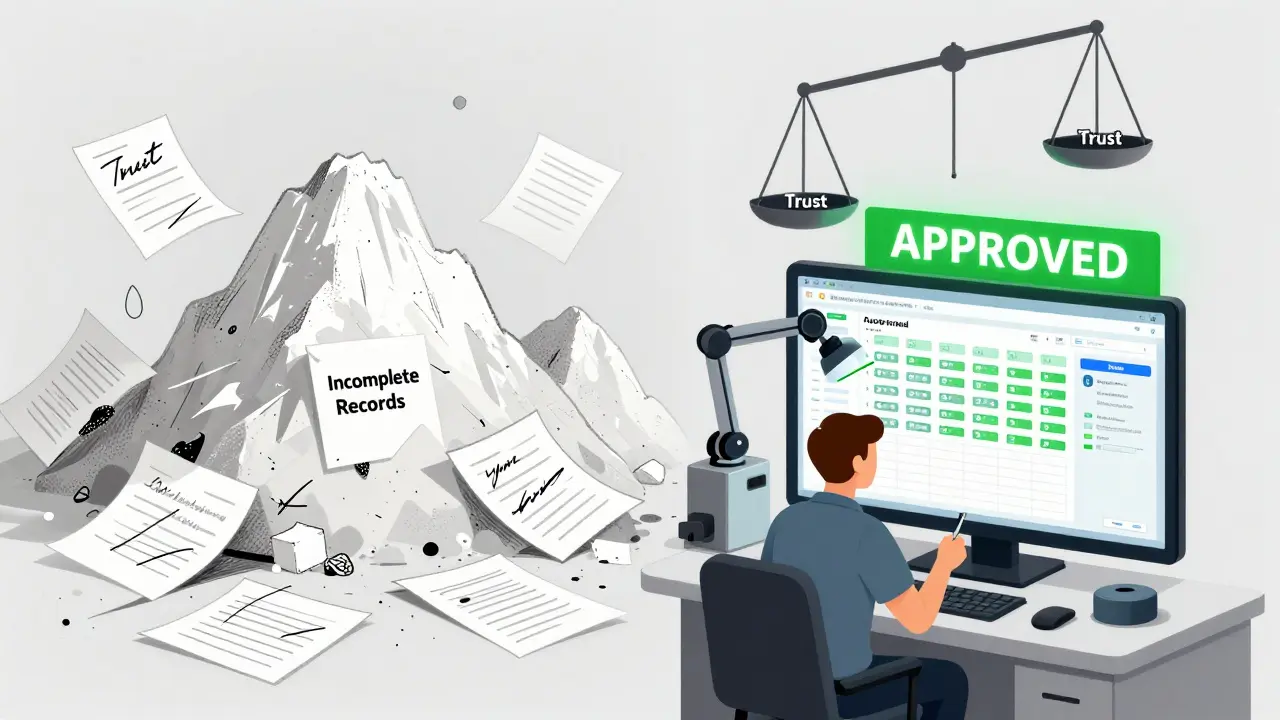
AI is starting to generate batch records from sensor data. One MIT study showed a 45% drop in documentation time. But regulators aren’t ready. Why? Because AI can’t explain why it made a choice. And audits need traceable human judgment.The next big shift? Risk-based documentation. The EU’s 2024 update will require manufacturers to prove they’ve assessed which records are critical-and which can be simplified. That’s good. It means you stop documenting the unimportant stuff. But it also means you must prove you know what’s important. No more blanket rules.
Final Reality Check
Documentation isn’t about compliance. It’s about trust. It’s the paper trail that says: “We didn’t cut corners. We knew what we were doing. And if something went wrong, we knew why.”Manufacturers who treat documentation as a cost? They pay more in recalls, delays, and lost licenses. Those who treat it as a system? They sleep better. They grow faster. And they keep people safe.
What happens if I don’t follow documentation rules in manufacturing?
Failure to follow documentation rules can lead to FDA Form 483 observations, warning letters, product recalls, or even facility shutdowns. In 2022, the average recall cost manufacturers $10 million. Beyond financial loss, it damages reputation and can result in criminal liability if patient safety is compromised.
Can I use handwritten records instead of electronic systems?
Yes, handwritten records are still allowed under FDA and EU regulations. However, they must meet ALCOA+ standards: legible, dated, signed, and stored securely. Many companies are moving to electronic systems because they reduce human error, improve traceability, and simplify audits-but paper is not illegal if properly managed.
How long do I need to keep manufacturing records?
Regulations require records to be kept for at least one year beyond the product’s expiration date. In the EU, records must be retained for three years after the product is distributed. For medical devices, some records-like design history files-must be kept indefinitely.
What’s the difference between an SOP and a batch record?
An SOP (Standard Operating Procedure) is a general instruction that tells you how to do a task-like cleaning a machine or calibrating a scale. A batch record is the actual documentation of what happened during a specific production run. The SOP says “add 500 mL of solvent.” The batch record says “500 mL of solvent added at 10:15 AM on 2026-02-15, verified by Jane Doe.”
Is electronic signature required for manufacturing records?
Electronic signatures are required if you use electronic systems under 21 CFR Part 11. They must be linked to a unique user ID, include a timestamp, and be protected by audit trails. For paper records, handwritten signatures are acceptable. The key is that the signature must be attributable to a specific individual and cannot be copied or reused.
Can I use AI to generate manufacturing documentation?
AI can assist in generating documentation by pulling data from sensors and systems, but it cannot replace human review. Regulators require human judgment to validate critical decisions. AI-generated records must still be reviewed, approved, and have a full audit trail. No regulatory body currently accepts fully automated documentation without human oversight.

phyllis bourassa
March 6, 2026 AT 18:04Tim Hnatko
March 7, 2026 AT 06:21Joey Pearson
March 8, 2026 AT 18:54Jeff Mirisola
March 9, 2026 AT 10:27Susan Purney Mark
March 11, 2026 AT 01:33Ian Kiplagat
March 11, 2026 AT 12:44Amina Aminkhuslen
March 13, 2026 AT 05:54amber carrillo
March 15, 2026 AT 05:32