
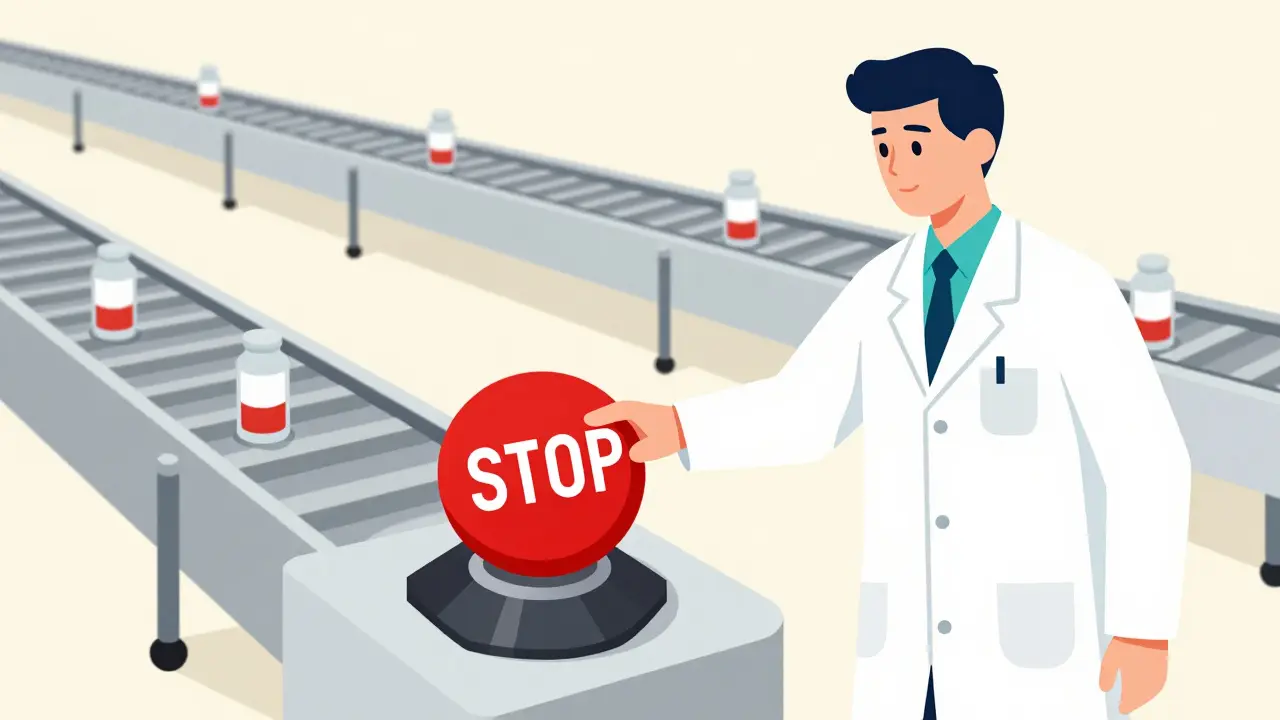
Imagine a pharmacy shelf empty of a critical heart medication or a hospital running out of sterile injectables. When we talk about drug shortages, we often blame logistics or raw material scarcity. But there is a more invisible, more dangerous cause: the decision to stop the machines. In the world of pharmaceutical manufacturing, a production halt isn't just a technical glitch; it is a high-stakes safety maneuver. When a quality deviation is spotted, the choice is binary-either stop everything immediately or risk shipping a batch of medicine that could harm thousands of patients.
The High Cost of "Just Keeping the Line Moving"
In most industries, a mistake on the assembly line means a rejected part. In pharma, a mistake can be fatal. This is why the industry treats production halts as essential safeguards. According to the Automotive Industry Action Group, fixing a defect after it reaches the customer costs 200 times more than catching it during production. In medicine, that "cost" isn't just financial; it is measured in human lives. This is why 89% of Fortune 500 manufacturers now give quality technicians a mandatory "stop-work authority," allowing anyone on the floor to freeze production the moment something looks wrong.
When production stops, the financial bleed is immediate. Benchmarking studies show that unplanned downtime can cost manufacturers an average of $260,000 per hour. However, for pharmaceutical facilities, the stakes are different. While they experience fewer halts than automotive plants-averaging about 0.7 per month-those stops last significantly longer. This is because regulatory requirements from bodies like the FDA (U.S. Food and Drug Administration) demand exhaustive documentation and testing before a line can restart.
Why the Machines Actually Stop
Not all halts are created equal. To manage them, the industry breaks them down into specific categories to find out where the system is failing. One primary framework is the Six Big Losses, which helps managers distinguish between a total system crash and a "micro stop." A micro stop is a glitch lasting a minute or less-perhaps a misaligned sensor or a material jam-but these can eat up to 18% of total production time over a month.
Then there are the heavier hits. Induced downtime happens when something external fails, like a shortage of an active pharmaceutical ingredient (API). Maintenance downtime is when the machines themselves break. But the most critical are the quality-driven halts. These occur when a batch fails a purity test, a label is printed incorrectly, or a contamination risk is detected. In process manufacturing-where chemicals are mixed in large vats-these halts average 4.7 hours, as engineers must scrub the system and verify that no residue remains.
| Industry | Avg. Monthly Halts | Avg. Duration | Primary Cause of Quality Halt |
|---|---|---|---|
| Pharmaceuticals | 0.7 | High (Regulatory) | Contamination / Purity Failure |
| Automotive | 3.2 | Moderate | Improper Assembly / Poor Welds |
| Electronics | 5.1 | 1.8 Hours | Component Defects |

The Ripple Effect: From the Factory to the Pharmacy
When a pharmaceutical line stops, the impact doesn't stay inside the factory walls. It creates a ripple effect that hits the entire supply chain. On average, a single halt impacts 3.2 downstream processes. If a facility producing a key stabilizer for a drug stops for 48 hours, every other company relying on that stabilizer may also have to pause. This is how a quality problem in one plant in Europe can lead to a shortage of a medication in a clinic in Australia.
The irony is that the more a company tries to avoid these halts, the more they might actually risk. A 2021 Toyota recall showed that when a company keeps halting for the same issue but fails to perform a proper root cause analysis, the halt becomes a bandage rather than a cure. In pharma, ignoring a "micro stop" can lead to a catastrophic failure. One food processing plant ignored repeated small alerts, which eventually led to a $4.3 million recall-a nightmare scenario for any drug manufacturer.
Solving the Problem: Root Cause Analysis
Stopping the line is the easy part; figuring out why it stopped is where the real work begins. The Society of Manufacturing Engineers suggests a four-phase approach to get things moving again safely:
- Immediate Containment (15-30 mins): Stop the bleed. Isolate the affected batch so it doesn't mix with good product.
- Root Cause Analysis (2-4 hours): Use tools like the "5 Whys" or Fishbone diagrams to find the actual source of the error.
- Corrective Action (4-8 hours): Fix the machine, replace the faulty raw material, or retrain the operator.
- Verification (1-2 cycles): Run a small test batch to ensure the fix actually worked before full-scale production resumes.
The efficiency of this process often depends on the tools being used. Facilities that use an MES (Manufacturing Execution System) combined with PFMEA (Process Failure Mode Effects Analysis) are 42% more efficient at resolving halts. Digital work instructions also play a huge role; they can cut the time it takes to resolve a halt by over 50% compared to old-school paper manuals.

The Future: AI and Predictive Quality
We are moving away from the era of "stop and fix" toward an era of "predict and prevent." Experts like Dr. John W. Sutherland argue that unplanned halts are actually a failure of predictive systems. By using AI-driven quality prediction, some facilities have already reduced quality-related halts by 47%.
Take BMW's Spartanburg facility, where AI reduced unnecessary stops by 39% in 2023. In the pharmaceutical world, blockchain is being used to create total visibility in the supply chain, which can decrease material-related halts by over 50%. The goal is "Zero Quality Halts," where the system detects a drift in quality and adjusts the machine settings in real-time without ever needing to stop the line.
However, there is a warning here. An MIT study found that too much automation can actually increase minor defects by 27% because the "human gut feeling"-the ability of an experienced operator to notice a strange sound or smell-is removed from the equation. The most successful plants are those that blend AI precision with human judgment.
Why do drug shortages happen even when factories are running?
Shortages often occur because a quality deviation forces a production halt. Even if the machines are physically capable of running, they must stop to investigate purity or contamination issues. This creates a gap in supply that can take weeks or months to fill due to strict regulatory testing and batch validation requirements.
What is "stop-work authority" in manufacturing?
Stop-work authority is a policy that empowers any employee, regardless of rank, to halt production if they perceive a quality or safety risk. This prevents defective products from leaving the factory and has been shown to significantly reduce customer returns and recall risks.
How long does a typical quality-related halt last?
In general discrete manufacturing, halts average 2.3 hours. However, in process manufacturing (like pharmaceuticals), they average 4.7 hours because of the need for deep cleaning and extensive regulatory documentation.
Can AI completely eliminate production halts?
While AI can reduce *unnecessary* halts by predicting quality drifts, it cannot eliminate *critical* halts. In fact, AI may increase critical stoppages because it is better at detecting dangerous anomalies that a human might miss, thus preventing a catastrophic failure.
What is the difference between induced and maintenance downtime?
Induced downtime is caused by external factors, such as a missing shipment of raw materials or staff shortages. Maintenance downtime is caused by internal issues, such as a machine breaking down or a quality-related stop to recalibrate equipment.
Next Steps for Operations Management
If you are managing a production environment, the first step is to audit your "micro stops." Are you ignoring one-minute glitches? Those are often the early warning signs of a total system failure. Transitioning from paper-based logs to digital work instructions can immediately slash your resolution time.
For those in highly regulated sectors, focus on integrating your MES with a robust PFMEA practice. Don't just treat a halt as an emergency; treat it as a data point. If you stop the line for the same reason three times in a month, you don't have a production problem-you have a system design problem.
