
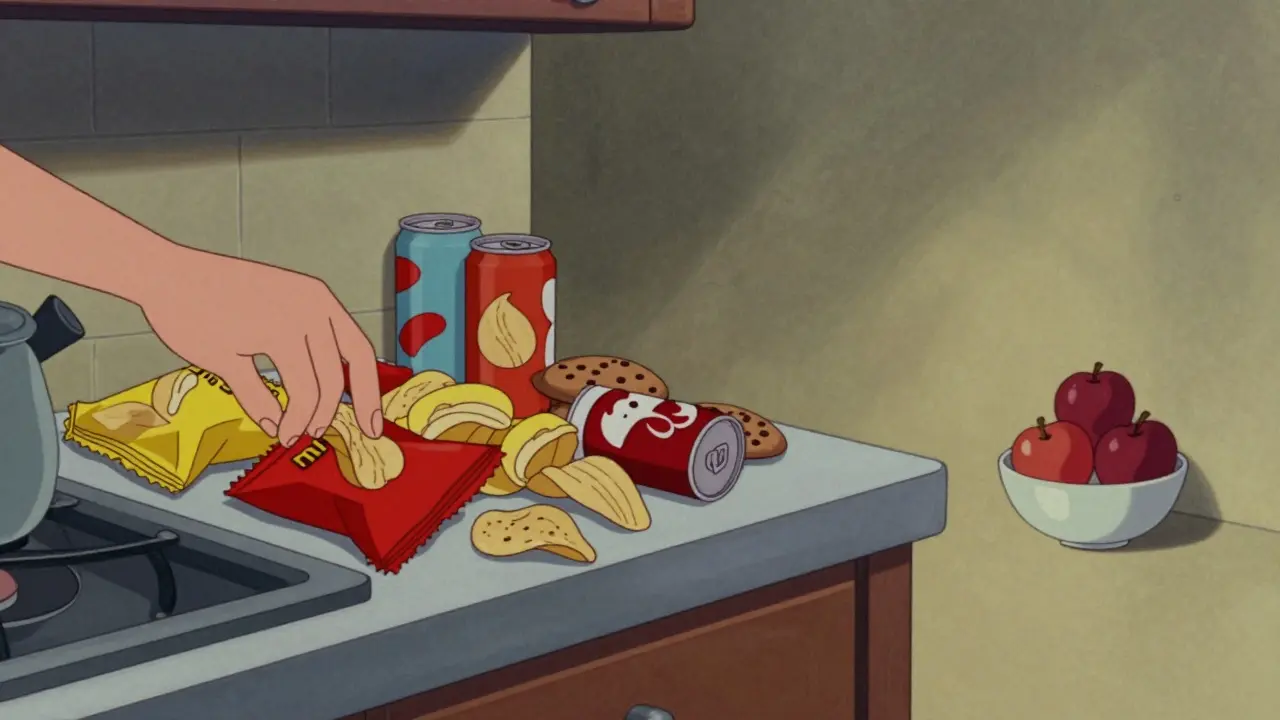
Ever wonder why you keep reaching for chips even when you’re not hungry? It’s not weakness. It’s your kitchen.
Your home is where you eat 70 to 80% of your meals. And if your fridge, pantry, and counters are wired for junk, your brain will follow suit-no willpower needed. The science is clear: the layout of your kitchen has more impact on your weight than most diets. A 2021 NIH study found people with a well-organized food environment were 3.2 times more likely to eat enough fruits and vegetables and had 28% lower odds of being overweight. This isn’t about willpower. It’s about design.
Start with the Purge: Remove the Triggers
The first step isn’t buying new containers or organizing shelves. It’s throwing stuff away.
Go through your pantry, fridge, and cabinets. Take out every bag of chips, box of cookies, sugary cereal, and soda. Don’t just move them to the back. Get them out of the house. The Mayo Clinic’s research shows that simply removing visible unhealthy snacks cuts unplanned snacking by 42%. If you can’t see it, you won’t think about it. And if you don’t have it, you can’t eat it.
This isn’t about deprivation. It’s about removing friction from bad choices. You don’t need to ban treats forever. But if they’re not in your home, you’ll have to make a deliberate trip to the store to get them. That pause gives your brain time to reset. Most people who do this report fewer cravings within a week.
Make Healthy Food the Easiest Choice
Now that you’ve cleared the clutter, it’s time to make good food impossible to ignore.
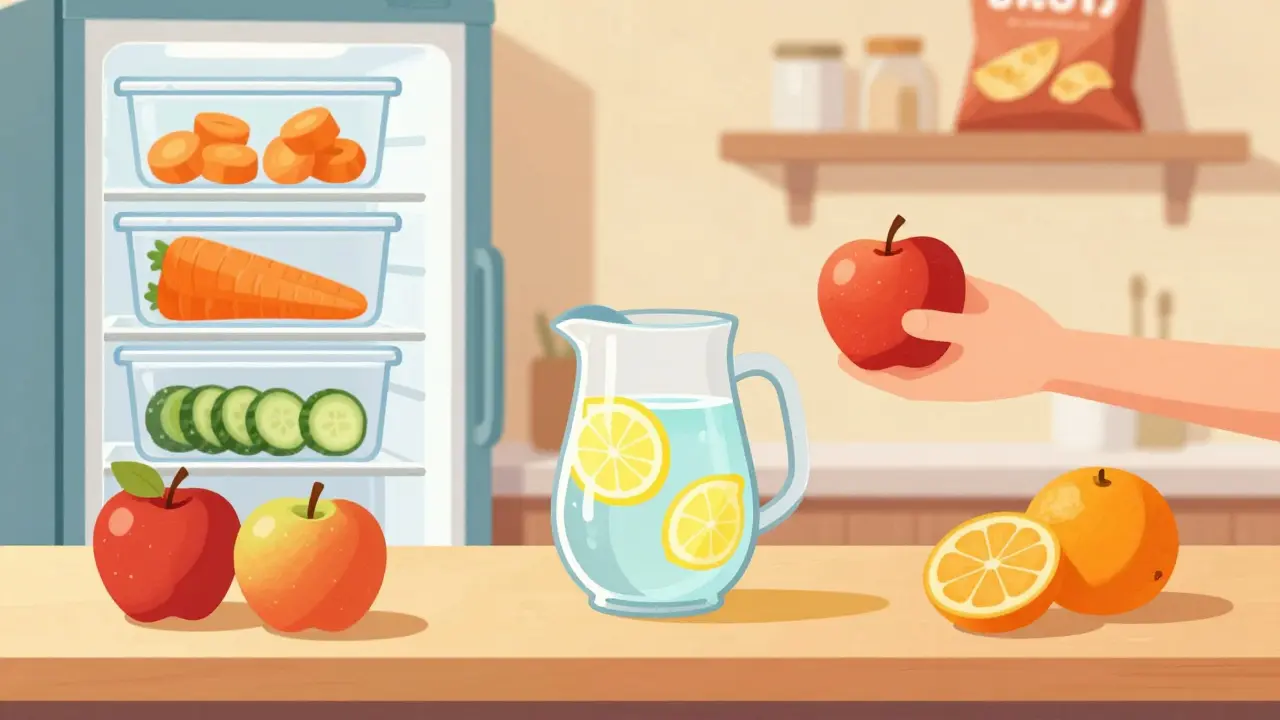
Place fresh fruit-apples, bananas, oranges-at counter level. Studies show this increases fruit consumption by 23%. Keep pre-cut veggies like carrots, bell peppers, and cucumber in clear containers at eye level in the fridge. Prime Health MD’s clinical data shows this boosts vegetable intake by 17%. Don’t hide them in the crisper drawer. Put them front and center.
Keep a small bowl of nuts or trail mix on the counter for quick snacks. Portion them out in advance: 1/4 cup per serving. Use small containers or snack bags. This cuts decision fatigue and prevents mindless eating. A 2023 Truemade study found that people who pre-portioned snacks saved 2.4 hours a week just by not wondering what to eat.
Drinks matter too. Keep a pitcher of water in the fridge with lemon slices. Put it next to the door so you see it every time you open it. Swap out sugary drinks for sparkling water or unsweetened tea. If soda is in the back, and water is front and center, you’ll drink more water without even thinking about it.
Organize for Speed, Not Just Looks
A messy kitchen leads to takeout. A clean, organized one leads to meals.
Use clear glass or plastic containers for meal prep. Not only do they make food look fresh, they help you see exactly what you have. Truemade’s data shows this reduces food waste by 31%. Label containers with the date. Eat the oldest stuff first.
Store your most-used healthy ingredients-rice, beans, oats, canned tomatoes-at waist level. Keep less healthy items like pasta sauce with added sugar or boxed mac and cheese on the top shelf. You have to stand on tiptoes to reach them. That small barrier makes a difference.
Keep your knife, cutting board, and mixing bowls in an easy-to-reach spot. If it takes more than 30 seconds to get started, you’ll skip it. Meal prep doesn’t need to be perfect. Even 20 minutes twice a week makes a huge difference. Chop veggies while watching TV. Cook a big batch of quinoa or chicken on Sunday. The goal isn’t to cook every meal from scratch-it’s to make healthy meals faster than grabbing a bag of chips.
Change Where and How You Eat
It’s not just what’s in your kitchen-it’s where you eat.
UCSF Health’s 2023 guidelines are simple: eat only at the table. No eating while standing at the fridge. No eating while scrolling on your phone. No eating in front of the TV. The NIH study found that families who ate while watching TV had a 47% higher chance of being overweight. Why? Because when you’re distracted, you don’t notice when you’re full. You eat more, faster, and without satisfaction.
Turn off the TV during meals. Put your phone in another room. Sit down. Chew slowly. Notice the taste. This isn’t fancy mindfulness-it’s basic biology. When you pay attention, you eat less and feel more satisfied.
Also, avoid eating straight from the package. Pour your snack into a bowl. Even if it’s just a handful of almonds. This small act helps your brain register how much you’ve eaten. It’s why people who snack from bags tend to eat 50% more than those who serve themselves.
Involve the Household
If you live with others, this isn’t a solo mission.
Get everyone involved in meal planning. Let each person pick one healthy recipe for the week. Cook together. Clean up together. When people feel ownership, they’re more likely to stick with it. JM Nutrition’s 2023 data shows involving family members increases long-term success by 57%.
But don’t force change. If someone wants to keep their candy jar on the counter, let them. Just don’t keep it in your own space. Create your own zone. You can’t control everyone’s choices-but you can control your environment. Lead by example. If they see you eating apples instead of cookies, they might start too.
One common complaint? Family members resisting the change. About 34% of people in Prime Health MD’s survey struggled with this. The fix? Don’t argue. Just make your side of the kitchen work for you. Keep your healthy snacks visible. Keep your meals simple. Over time, people notice the difference-and often ask how you did it.

Small Changes, Big Results
You don’t need to overhaul everything at once.
Start with one thing: move the fruit to the counter. That’s it. Wait two weeks. Then add one more: pre-cut veggies at eye level in the fridge. Then, remove one unhealthy snack from the pantry. In 2 to 4 weeks, these habits become automatic. Prime Health MD found that people who made no more than three changes at a time had 89% adherence after 12 weeks.
One woman in Melbourne told her dietitian: “I stopped buying chips. Now I see carrots every time I open the fridge. I’ve lost 12 pounds in three months. I didn’t even try.” That’s the power of environment.
The NIH study showed food placement had the strongest link to healthy eating-stronger than shopping frequency or meal prep. Why? Because it works without effort. You don’t need motivation when the right choice is the easiest one.
And the results add up. People who followed these environmental tweaks lost an average of 1.5 pounds per month without counting calories or cutting out entire food groups. That’s 18 pounds a year. Just by changing where things sit in your kitchen.
What Keeps People From Succeeding?
Most failures aren’t about laziness. They’re about bad design.
People think they need willpower. But willpower is a finite resource. You can’t fight your environment forever. That’s why diets fail. The kitchen doesn’t change. The cravings don’t go away.
Another mistake? Waiting for the “perfect time.” You don’t need to wait for Monday or the new year. Start now. Do the purge today. Put the fruit out tonight. It takes less than an hour.
And don’t get discouraged if your partner doesn’t change right away. Focus on your own space. Your habits will ripple out. People notice when you look better, feel better, and don’t snack all day.
Environment doesn’t promise quick fixes. It promises steady, sustainable results. No hunger. No guilt. Just a kitchen that works for you-not against you.
Do I need to throw away all my junk food?
Yes, if you want lasting results. Keeping unhealthy foods in the house-even in small amounts-triggers automatic eating. The Mayo Clinic found that removing visible snacks cuts unplanned eating by 42%. You don’t have to ban treats forever, but remove them from your daily environment. If you want them later, you’ll have to go out of your way to get them. That pause makes all the difference.
How long does it take to see results?
Most people notice changes in cravings and snacking within 7 to 10 days. Weight loss typically starts in 2 to 4 weeks. A 2023 Truemade study showed people lost an average of 1.5 pounds per month just by organizing their kitchen and pre-portioning snacks. The key is consistency, not speed. After 2 to 4 weeks, these habits become automatic.
What if I live with others who don’t want to change?
You don’t need everyone to change for you to succeed. Create your own zone. Keep your healthy foods visible and easy to grab. Store your meals in labeled containers. Eat at your own table. Lead by example. Over time, others notice. They might ask how you lost weight. You don’t need to convince them-just keep doing what works for you. Studies show 57% more success when family is involved, but even one person changing can shift the whole household’s habits.
Do I need special containers or gadgets?
No. Clear glass or plastic containers from your cupboard work fine. You don’t need fancy portion cups or smart fridges. What matters is visibility and accessibility. Pre-cut veggies in a clear bowl. Fruit on the counter. Water front and center. The tools are simple. The strategy is what counts.
Is this just for people trying to lose weight?
No. This setup helps anyone who wants to eat better, feel more energized, or reduce food waste. People who organize their kitchens report saving 2.4 hours a week on meal decisions. They also waste 18% less food. It’s not just about weight-it’s about making daily life easier, calmer, and more predictable.
Start tonight. Open your fridge. Move the fruit to the counter. Put the veggies where you can see them. Toss one bag of chips. That’s it. You’ve already changed your food environment. The rest will follow.

Cassandra Collins
December 16, 2025 AT 10:04Elizabeth Bauman
December 16, 2025 AT 19:14Mike Smith
December 17, 2025 AT 01:50Ron Williams
December 17, 2025 AT 23:37anthony epps
December 19, 2025 AT 14:08Andrew Sychev
December 20, 2025 AT 11:40Dan Padgett
December 21, 2025 AT 20:46Hadi Santoso
December 23, 2025 AT 08:09Arun ana
December 24, 2025 AT 00:39Kayleigh Campbell
December 25, 2025 AT 05:13