
Imagine a small child needing a precise dose of thyroid medication, but the only available tablet is ten times the amount they actually need. Or a patient with a severe dye allergy who can't take a standard pill. This is where customized medications save the day. However, the very thing that makes Pharmaceutical Compounding is helpful-the fact that it's made from scratch-is also what makes it risky. A single misplaced decimal point or a contaminated workspace can turn a life-saving treatment into a dangerous mistake.
Preventing these errors isn't just about being careful; it's about building a system where it's almost impossible to fail. Whether you are a pharmacy owner, a technician, or a patient, understanding the guardrails that keep customized meds safe is critical for avoiding adverse reactions and ensuring patient health.
| Safety Pillar | Primary Goal | Key Standard/Tool |
|---|---|---|
| Environmental Control | Prevent contamination | USP <795> and <797> |
| Verification | Stop dosage mistakes | Dual-check system |
| Documentation | Ensure reproducibility | Electronic batch records |
| Accreditation | Standardize quality | PCAB Certification |
The Golden Rules of the Compounding Environment
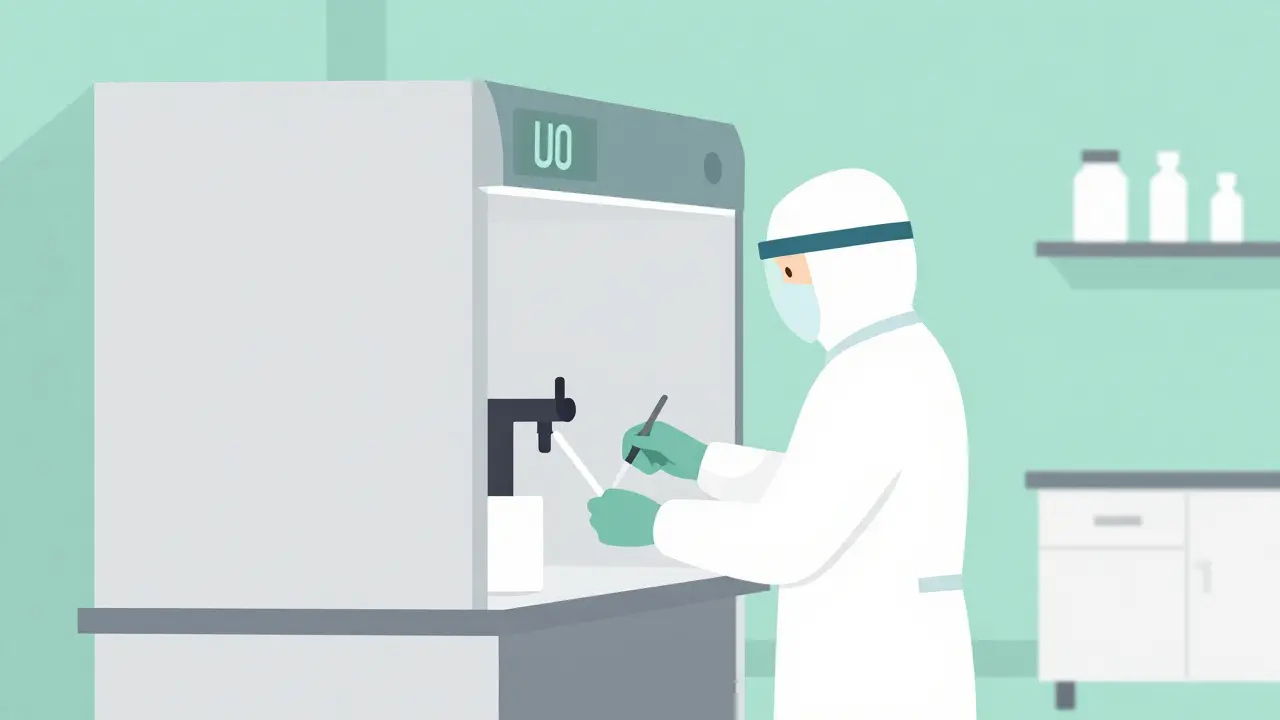
You can't make a precise medication in a dusty room. The physical space where the drug is mixed determines the purity of the final product. For non-sterile medications, the industry follows USP <795>, which is a set of standards for non-sterile compounding. This requires a dedicated clean area with air quality at ISO Class 8 or better. If the air is dirty, the medicine is dirty.
When things get more serious-like injections-we move to USP <797>, the standard for sterile compounding. This is where a "clean room" becomes an absolute necessity. Specifically, pharmacists must use ISO Class 5 primary engineering controls. Why does this matter? Because in the 2012 New England Compounding Center outbreak, contaminated steroid injections led to over 60 deaths. That tragedy fundamentally changed how we view sterile environments, leading to the 2013 Drug Quality and Security Act.
For those handling dangerous materials, USP <800> provides the framework for managing hazardous drugs to protect both the patient and the staff from toxic exposure. Without these strict zoning laws, cross-contamination becomes a silent killer.
Stopping the "Decimal Point" Disaster
The most common and dangerous compounding errors are calculation mistakes. A misplaced decimal can mean a patient receives 10mg instead of 1mg. To stop this, the American Society of Health-System Pharmacists (ASHP) recommends a dual-check system. This isn't just two people looking at the same paper; it's two qualified professionals performing the calculation independently. If their answers don't match, the process stops immediately.
Verification doesn't stop at the math. The ingredients themselves must be vetted. High-tech tools like Fourier-transform infrared spectroscopy (FTIR) or high-performance liquid chromatography (HPLC) are used to ensure that the raw chemical is actually what the label says it is. Imagine the horror of using an ingredient that was mislabeled by the supplier-that's why double-checking purity and potency is non-negotiable.
Modern pharmacies are now moving away from handwritten notes toward specialized software. Tools like Compounding.io or PharmScript use automated formula verification and electronic batch records. Research shows these digital systems can slash human error by about 40% because they flag illogical doses before the pharmacist even touches the scale.
Labeling and the Danger of Misinterpretation
A medication is only safe if the person administering it understands exactly how to use it. Labeling errors are a top safety concern for nearly 67% of pharmacists. One of the most dangerous mistakes is confusing "concentration per container" with "concentration per mL." There have been documented cases of patients suffering from serotonin syndrome because a tramadol solution was mislabeled, leading to a massive overdose.
To fix this, the FDA has pushed for standardized concentration labeling. Instead of vague terms, labels should explicitly state "mg/mL." This removes the guesswork for the nurse or parent at the bedside. Clear labels should also include the Beyond-Use Date (BUD). Since compounded drugs don't have the massive stability trials of factory-made drugs, they expire faster. Non-sterile meds usually last 30 to 180 days, while sterile ones might only be safe for a few hours or up to 45 days depending on the storage conditions.
The Role of Accreditation and Oversight
Not all compounding pharmacies are created equal. There's a big difference between a 503A pharmacy (traditional) and a 503B outsourcing facility. While 503A pharmacies are a vital part of community care, 503B facilities must follow Current Good Manufacturing Practices (CGMPs) and face stricter FDA inspections. Statistics show that 503B facilities have a 22% lower error rate because the oversight is so much tighter.
For community pharmacies, the gold standard is PCAB (Pharmacy Compounding Accreditation Board) accreditation. Getting certified isn't easy-it takes 12 to 18 months and costs upwards of $25,000. However, the investment pays off. Facilities that are accredited have significantly lower error rates (around 2%) compared to non-accredited shops, where errors can jump as high as 25%.
Practical Steps for Staff Training and Implementation
You can have the best equipment in the world, but if your staff isn't trained, the equipment is useless. Experts suggest that quarterly competency assessments are the most effective way to keep a team sharp. This means testing staff on their aseptic technique and their ability to perform complex pharmaceutical calculations under pressure.
If you're implementing a new safety protocol, start with these practical steps:
- Implement Barcode Verification: Use scanners for every ingredient. One study showed this reduced identification errors by 92% in just six months.
- Mandate Continuing Education: Require at least 8-12 hours of compounding-specific education annually.
- Build a Culture of "Stop the Line": Encourage technicians to speak up if they see a deviation in the process, regardless of the pharmacist's seniority.
- Audit Your Batch Records: Ensure every record includes the lot number, equipment used, and the signatures of both the preparer and the verifier.
Remember that these safety checks take time. Dual verification can increase preparation time by 25% to 40%. While it might seem slow, it is a small price to pay compared to the cost of a medication error and the subsequent legal or medical fallout.
What is the difference between USP <795> and <797>?
USP <795> focuses on non-sterile compounding, such as creams and oral liquids, requiring an ISO Class 8 environment. USP <797> covers sterile compounding, such as IV bags and injections, which requires much stricter controls, including ISO Class 5 primary engineering controls to prevent microbial contamination.
Why are compounded medications riskier than FDA-approved drugs?
FDA-approved drugs undergo rigorous clinical trials with thousands of participants to prove safety and efficacy. Compounded drugs are customized for individuals and do not undergo these large-scale trials, meaning the pharmacy must rely on strict adherence to compounding standards and internal quality checks to ensure safety.
How often should compounding staff be tested for competency?
Experts recommend mandatory competency assessments every quarter. This should include practical tests on aseptic technique, equipment operation, and mathematical calculations to ensure that skills haven't degraded over time.
What is a Beyond-Use Date (BUD)?
A BUD is the date after which a compounded preparation should not be used. Unlike a commercial expiration date, the BUD is based on the specific formulation and storage conditions. Non-sterile products typically have BUDs of 30-180 days, while sterile products can range from 3 hours to 45 days.
Can software really prevent compounding errors?
Yes. Specialized software like Compounding.io helps by automating calculations and providing electronic batch records. This reduces the risk of manual math errors and ensures that the identity and potency of every ingredient are tracked digitally, which can reduce human error by up to 40%.
Next Steps and Troubleshooting
If you are a pharmacy manager noticing a trend in "near-misses" (errors caught before they reached the patient), don't ignore them. Perform a root-cause analysis. Was the error due to a lack of lighting? A distraction in the lab? Or a failure in the dual-check process? Often, a simple change in the physical layout of the lab can prevent a recurring mistake.
For patients, always ask your pharmacist for a consultation when picking up a compounded medication. Ask them to verify the concentration on the label and explain the correct dosage. If the color or consistency of the medication changes between refills, contact the pharmacy immediately, as this could indicate a stability issue or a formulation error.
