
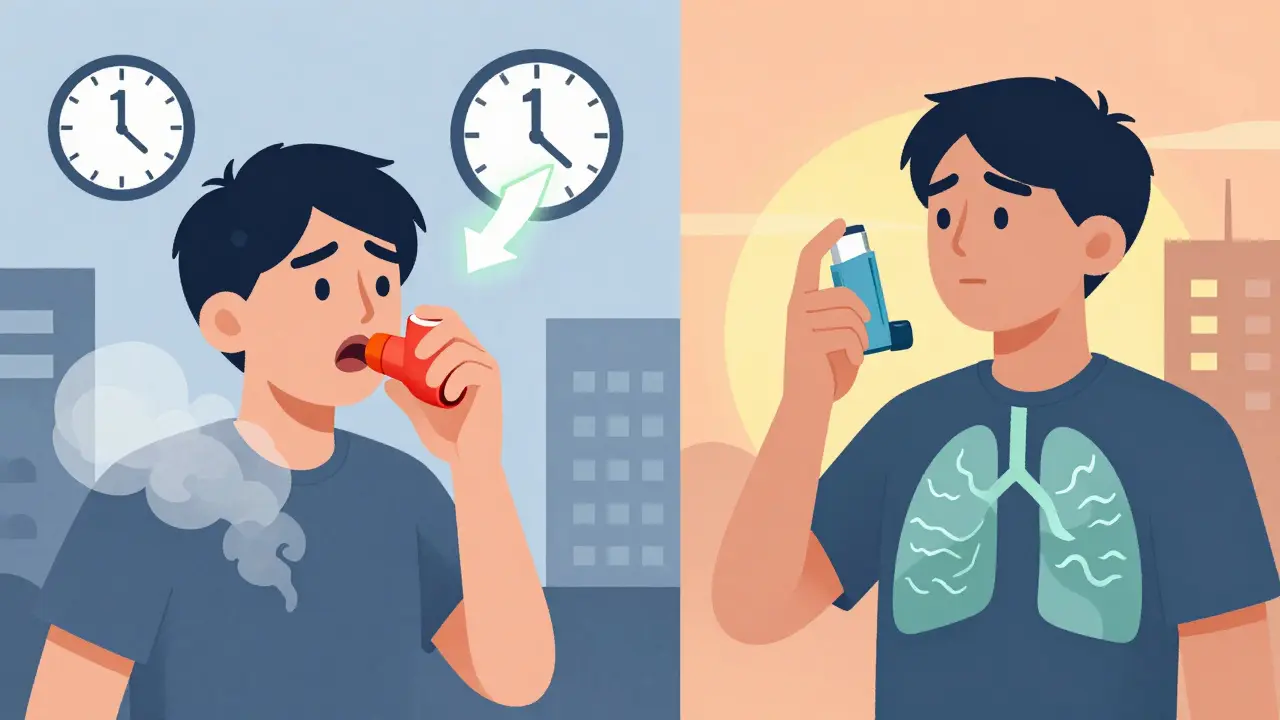
If you or someone you care about uses an inhaler for asthma, you’ve probably seen two very similar-looking devices and wondered: which one do I use when? Mixing them up isn’t just a mistake-it can be dangerous. Rescue inhalers and maintenance inhalers aren’t interchangeable. They work differently, at different speeds, and for completely different reasons. Understanding the difference could mean the difference between a quick fix and a trip to the emergency room.
What Rescue Inhalers Do (and When to Use Them)
Rescue inhalers are your emergency tool. They’re meant for sudden asthma attacks-when your chest feels tight, you can’t catch your breath, or your peak flow meter drops suddenly. These inhalers contain short-acting beta agonists (SABAs), like albuterol (sold as Ventolin, ProAir, or Proventil) or levalbuterol (Xopenex). They work fast-within 1 to 5 minutes-by relaxing the muscles around your airways so you can breathe again.
Think of them like a fire extinguisher. You don’t use them every day. You use them when there’s a fire. The relief lasts about 4 to 6 hours. But here’s the catch: they don’t fix the underlying problem. They don’t reduce inflammation. They don’t prevent future attacks. They just open the door so you can breathe right now.
Using a rescue inhaler more than twice a week (outside of exercise) is a red flag. It means your asthma isn’t under control. The American Lung Association recommends tracking your rescue inhaler use. If you’re going through more than one inhaler a month, it’s time to talk to your doctor. Overuse isn’t a sign you need more rescue meds-it’s a sign you’re missing your maintenance treatment.
What Maintenance Inhalers Do (and Why You Need Them Daily)
Maintenance inhalers are the quiet heroes of asthma management. They’re not for emergencies. They’re for daily use-even when you feel fine. These contain inhaled corticosteroids (ICS) like fluticasone or budesonide, or sometimes long-acting beta agonists (LABAs) like formoterol or salmeterol. Some combine both in one device, like Advair or Symbicort.
These medications work by reducing swelling and mucus in your airways. But they don’t work fast. It takes 24 to 48 hours just to start seeing an effect. Full benefit? That takes 1 to 3 weeks of consistent daily use. That’s why people skip them-they don’t feel immediate results. But skipping them is like skipping your daily toothbrush. You won’t feel pain right away, but over time, damage builds up.
Studies show people who use maintenance inhalers regularly cut their risk of severe asthma attacks by 40% to 60%. That’s not a small number. It’s life-changing. One 2022 Cochrane Review of over 15,000 patients found consistent use led to fewer hospital visits, fewer missed days at work or school, and better overall lung function.
The Big Difference: Speed vs. Prevention
Here’s the clearest way to compare them:
- Rescue inhalers: Fast action (1-5 minutes), short duration (4-6 hours), no anti-inflammatory effect. Used only when needed.
- Maintenance inhalers: Slow action (days to weeks), long-term protection, reduces inflammation. Used every day, no matter how you feel.
When you’re having an attack, a rescue inhaler can improve your peak expiratory flow by up to 85% in 10 minutes. A maintenance inhaler? Maybe 15%. That’s why you can’t use your daily inhaler to stop an attack-it’s too slow.
And here’s the dangerous part: if you rely only on your rescue inhaler, your airways keep getting more inflamed. Over time, your asthma gets worse. You’ll need more rescue puffs. You’ll be more likely to end up in the ER. The American College of Allergy, Asthma & Immunology found that 38% of near-fatal asthma cases happened because people didn’t use their maintenance inhaler at all.
What About Combination Inhalers Like Symbicort?
Symbicort and Advair contain both a corticosteroid and a long-acting bronchodilator. For years, they were only approved for daily maintenance use. But in 2023, the Global Initiative for Asthma (GINA) updated its guidelines to allow Symbicort to be used for both maintenance and as-needed rescue-in specific cases.
This is called SMART therapy (Single Inhaler Maintenance and Reliever Therapy). It’s now recommended for moderate to severe asthma. The idea? One device does both jobs. You take it daily to prevent attacks, and you can also use it when symptoms flare up. But this only works if your doctor specifically prescribes it for dual use. Don’t assume your combination inhaler can double as a rescue inhaler. Always check the label or ask your pharmacist.
There’s a catch: Symbicort isn’t approved for everyone. If you have mild asthma, using it as a rescue inhaler isn’t necessary-and could expose you to more steroids than needed. For mild cases, a simple albuterol rescue inhaler is still the standard.
Why People Mix Them Up (And How to Prevent It)
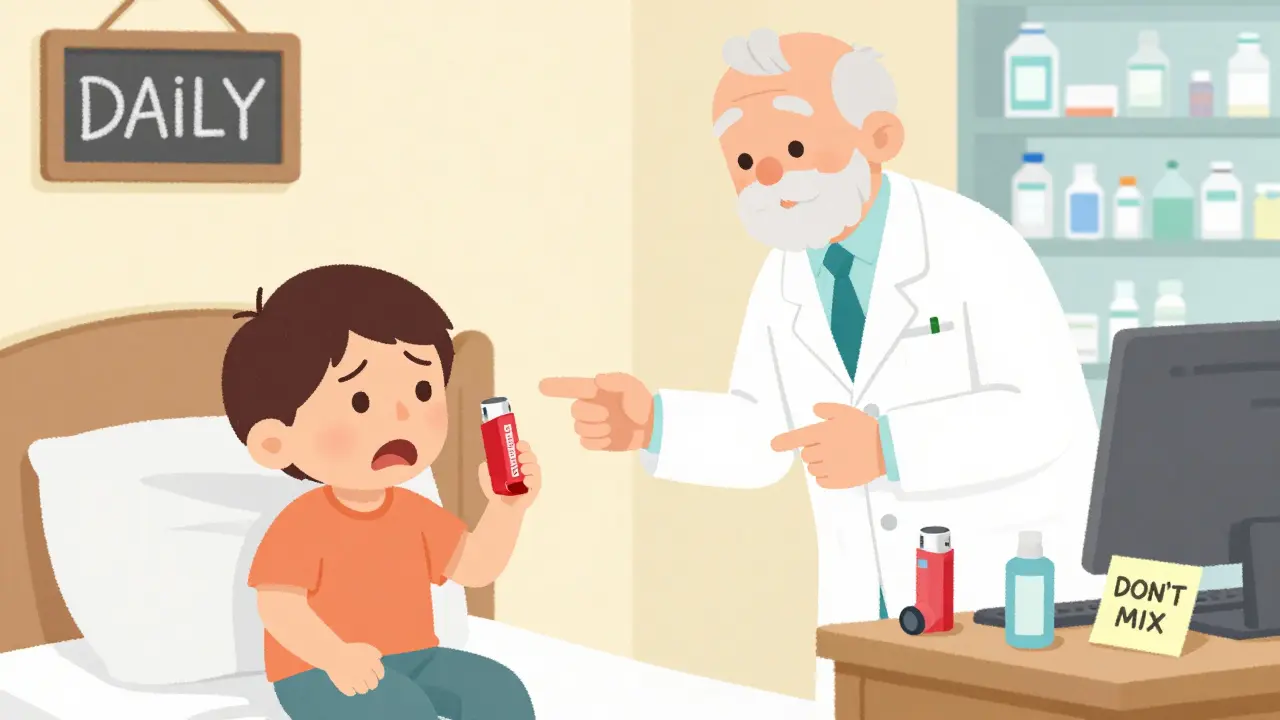
It’s not your fault if you’ve confused the two. Many inhalers look almost identical. Both are small, plastic, and often red. In a 2023 case documented by Consumer Medsafety, a 9-year-old grabbed his red Symbicort inhaler during an asthma attack instead of his red ProAir rescue inhaler. It took 12 minutes before someone realized the mistake. That delay nearly cost him his life.
Here’s how to avoid that:
- Color-code: Rescue inhalers are usually red. Maintenance inhalers are often white, blue, or brown. Check your device’s packaging or ask your pharmacist.
- Label them: Write “RESQUE” on the cap of your albuterol inhaler. Write “DAILY” on your corticosteroid one.
- Store them separately: Keep your rescue inhaler in your bag, car, or by your bed. Keep your maintenance inhaler where you’ll see it daily-next to your toothbrush or coffee maker.
- Set reminders: Use your phone to remind yourself to take your maintenance inhaler every morning and night. Missing even 3 doses a week cuts effectiveness by nearly half.
The FDA noticed this problem too. In 2023, they required all new inhalers to have clearly different colors and shapes to reduce confusion. But millions of older devices are still in use. Don’t rely on color alone-know your meds.
Cost, Access, and the Hidden Problem
One of the biggest reasons people skip their maintenance inhaler? Cost. A rescue inhaler like generic albuterol can cost $35-$50 without insurance. But a maintenance inhaler like Symbicort? $300-$350 a month. That’s a lot for people paying out of pocket.
A 2024 Kaiser Family Foundation survey found that 42% of asthma patients skip doses because they can’t afford their maintenance meds. That’s not laziness. That’s a system failure. If you’re struggling to pay, ask your doctor about generic options, patient assistance programs, or mail-order pharmacies. Some insurers cover maintenance inhalers at lower tiers than rescue ones-so check your plan.
And here’s something surprising: many people with mild asthma are prescribed maintenance inhalers they don’t need. The European Respiratory Society found that 27% of patients were getting daily corticosteroids when they only needed a rescue inhaler for occasional symptoms. Over-treatment can lead to side effects like thrush or hoarseness. The key is matching the treatment to your asthma severity-not just prescribing the same thing to everyone.
How to Know If Your Treatment Is Working
Good asthma control means:
- Using your rescue inhaler ≤2 times per week (not counting exercise)
- Waking up at night because of asthma ≤2 times per month
- Not missing work, school, or activities because of asthma
- Having a peak flow reading that stays above 80% of your personal best
If you’re checking off most of these, you’re doing well. If you’re not, it’s time to reevaluate. Maybe your maintenance dose needs adjusting. Maybe you’re not using your inhaler correctly.
Proper technique matters more than you think. If you don’t inhale slowly for 5-7 seconds and hold your breath for 10 seconds after pressing the inhaler, you’re only getting 10-15% of the medicine into your lungs. With the right technique, that jumps to 30-40%. Ask your pharmacist to watch you use your inhaler. Most will do it for free.
What’s Changing in 2025 and Beyond
The future of asthma treatment is moving toward simpler systems. By 2027, experts predict 60% of new asthma patients will start with a single inhaler that does both maintenance and rescue-like Symbicort used as needed. This reduces confusion, improves adherence, and cuts down on emergency visits.
There’s also new research. The NIH-funded PREPARE trial is testing a new rescue inhaler that works in under 90 seconds-faster than albuterol. Results are expected in late 2025. If successful, it could become the new gold standard.
But for now, the rules are clear: rescue inhalers are for emergencies. Maintenance inhalers are for prevention. One doesn’t replace the other. And if you’re unsure which is which, ask. Don’t guess. Your lungs can’t afford it.
Can I use my maintenance inhaler during an asthma attack?
No. Maintenance inhalers take days to weeks to work and won’t stop an acute attack. Using one during an emergency delays proper treatment and can be dangerous. Always use your rescue inhaler-usually red-for sudden symptoms. If you’re unsure, call for help.
Why do I need to use my maintenance inhaler every day if I feel fine?
Asthma inflammation happens even when you don’t feel symptoms. Skipping your daily inhaler lets that inflammation build up slowly. Over time, your airways become more sensitive, making attacks more frequent and severe. Daily use prevents that damage before it starts.
How do I know if I’m using my inhaler correctly?
Hold your inhaler upright, breathe out fully, press the canister while breathing in slowly for 5-7 seconds, then hold your breath for 10 seconds. If you’re not doing this, you’re losing up to 70% of the medication. Ask your pharmacist to watch you use it-they can spot mistakes you can’t see.
Is it safe to use a rescue inhaler multiple times a day?
Occasional use is safe, but using it more than 2-3 times a week means your asthma isn’t controlled. Frequent rescue use is a warning sign. You likely need to start or adjust your maintenance inhaler. Don’t ignore it-talk to your doctor.
What should I do if I run out of my rescue inhaler?
Don’t wait. Run out of rescue inhalers is a medical risk. Call your doctor or pharmacy immediately for a refill. If you’re having trouble breathing and can’t get one, go to urgent care or call emergency services. Never use someone else’s inhaler or try to stretch your supply.

Hilary Miller
January 22, 2026 AT 08:48Just use red = emergency, blue/white = daily. Done. No overthinking needed.
Philip House
January 23, 2026 AT 09:51Look, I get it-people think asthma is just wheezing and panic. But the real issue is the systemic failure to treat inflammation like the silent killer it is. We’ve got a generation raised on quick fixes, and now they wonder why their lungs are wrecked by 30. Maintenance inhalers aren’t optional-they’re the foundation. Skip ‘em, and you’re just delaying the inevitable ER visit. It’s not rocket science, it’s biology.
And don’t even get me started on the cost. $350 a month for a maintenance inhaler? That’s a luxury tax on breathing. Meanwhile, albuterol’s cheaper than a Starbucks latte. The system’s rigged to keep people dependent on emergency care. Profit over prevention. Classic.
And yeah, color-coding helps, but only if you’re lucky enough to have access to newer devices. Millions still have those damn identical red inhalers. The FDA’s late to the game, and people are dying because of bureaucratic inertia.
Also, the whole ‘use it only when needed’ thing? That’s how you end up with steroid-dependent lungs. You don’t brush your teeth only when your mouth hurts. You don’t pay your rent only when the landlord shows up. You maintain.
And don’t even try to tell me ‘I feel fine’-that’s the whole damn point. You feel fine because the maintenance is working. Take it away, and the silence turns to screaming.
It’s not about fear. It’s about discipline. And discipline is the one thing our culture has forgotten how to teach.
Liberty C
January 23, 2026 AT 18:17Oh, so now we’re pretending asthma is just a matter of willpower? Let me guess-you also think diabetes is caused by eating too much cake and not enough discipline. Maintenance inhalers aren’t ‘daily toothbrushes’-they’re life-support for a body that’s been betrayed by its own immune system. And yet, here we are, blaming patients for not being ‘consistent’ while the pharmaceutical industry laughs all the way to the bank with their $300-per-month monopolies.
And don’t even get me started on the ‘color-coded’ nonsense. You think a 7-year-old in a panic is going to remember ‘red = rescue’ when every inhaler they’ve ever seen looks the same? That’s like telling a drowning person to ‘just swim harder.’
The real problem? No one’s talking about the fact that 42% of patients skip meds because they can’t afford them. That’s not negligence. That’s poverty. And yet, the loudest voices are the ones telling people to ‘just take it.’
Meanwhile, the FDA requires new inhalers to be color-differentiated-but lets millions of identical ones stay on shelves. That’s not safety. That’s corporate liability laundering.
And let’s not forget the ‘SMART therapy’ hype. Symbicort as both maintenance and rescue? Brilliant-if you can afford it. For the rest of us? We’re stuck choosing between food and breath.
It’s not about understanding inhalers. It’s about understanding who gets to breathe easily-and who doesn’t.
Sarvesh CK
January 25, 2026 AT 07:29It is truly remarkable how the medical community has, over decades, refined the distinction between rescue and maintenance therapy-yet societal awareness lags far behind. The physiological mechanisms underlying asthma are complex, yet the educational burden is placed entirely on the patient. This is not merely a pharmacological issue but a public health communication failure.
One must consider the cognitive load placed upon individuals managing chronic conditions. The expectation that a patient must memorize color codes, label devices, store inhalers in separate locations, and maintain daily routines-while simultaneously navigating financial hardship, misinformation, and systemic inequities-is, frankly, unreasonable.
The emergence of SMART therapy, as outlined, represents a significant advancement in treatment paradigms. By consolidating functions into a single device, adherence improves, errors decrease, and outcomes enhance. Yet, its applicability remains restricted by cost, regulatory approval, and physician familiarity.
Moreover, the data cited regarding the 40–60% reduction in severe attacks is compelling. This is not anecdotal; it is evidence-based medicine at its most vital. The reluctance to adopt maintenance therapy is not rooted in ignorance alone, but in the erosion of trust between patient and provider-a trust that must be rebuilt through empathy, not instruction.
It is also worth noting that cultural attitudes toward medication vary widely. In some communities, daily pharmaceutical use is stigmatized as weakness. In others, it is normalized as routine. The challenge lies not in educating, but in adapting education to context.
Ultimately, the solution lies not in more labels or more reminders, but in equitable access, simplified regimens, and compassionate care. The inhaler is merely the delivery mechanism. The real treatment is dignity.
Alec Amiri
January 26, 2026 AT 05:21Bro, I used to be like you-thought my rescue inhaler was all I needed. Then I ended up in the ER with my kid’s asthma flare-up because I forgot to refill my maintenance one. I’m not even joking-I thought I was fine because I wasn’t wheezing. Turns out my lungs were just… waiting to collapse. Now I take mine every night like clockwork. No more drama. Just breathe.
Also, I wrote ‘DAILY’ on mine with a Sharpie. Best decision ever.
Lana Kabulova
January 27, 2026 AT 05:27Wait-so if you use your rescue inhaler more than twice a week, you’re supposed to be on maintenance? But what if you’re just allergic to pollen? Or you work in a dusty warehouse? Or you live in a city with terrible air? It’s not always ‘poor management’-sometimes it’s just… environment. Why is it always the patient’s fault? Why not fix the air? Why not fix the cost? Why not fix the system?
And why does every article about asthma sound like a PSA from a 1998 pharmaceutical ad? ‘Use your inhaler like a toothbrush!’-no, I don’t brush my teeth because I feel like it-I brush because my dentist told me to. Why don’t doctors just say that? ‘If you don’t take this, your lungs will slowly die.’
Also-how many people actually know how to use these things? I watched my neighbor use hers and she didn’t hold her breath at all. Zero. She just puffed and walked away. That’s 70% of the dose wasted. And she thinks it’s not working. It’s not the medicine-it’s the technique. And no one teaches it.
shivani acharya
January 28, 2026 AT 08:05Ohhh so now the pharmaceutical companies are telling us to ‘color code’ our life-saving devices? Cute. And who do you think designed these identical red inhalers in the first place? The same people who made the pills that made your asthma worse in the first place. You think this is about safety? No. It’s about profit. They want you to buy two inhalers. They want you to think you need two. They want you to forget that the real problem is air pollution, industrial toxins, and corporate greed. And now you’re out here labeling your inhalers like you’re a kindergarten teacher? Pathetic.
And don’t even get me started on ‘SMART therapy.’ Symbicort? That’s just a fancy way of saying ‘pay more for the same poison.’ You think they’d let a generic version of this work as a rescue? No. Because then they’d lose the $300/month gravy train. They need you hooked on the expensive combo. They need you scared.
And the FDA? They only changed the rules because someone died. Again. Again. Again. And now they’re patting themselves on the back like heroes. Meanwhile, your local pharmacy won’t give you your albuterol without a prescription because they’re scared of liability. So you can’t refill it on a Saturday. So you wait. So you panic. So you die.
They don’t want you healthy. They want you dependent. And you’re helping them by writing ‘DAILY’ on your inhaler like it’s a sticky note on your fridge.
Meanwhile, in India, my uncle uses a nebulizer made from a plastic bottle and a bike pump. He’s 72. He’s still breathing. Because he doesn’t believe in Big Pharma. He believes in air. And he’s right.
arun mehta
January 30, 2026 AT 04:18Thank you for this clear, well-researched breakdown. 🙏 The distinction between rescue and maintenance inhalers is one of the most critical yet overlooked aspects of asthma care. Many patients, especially in developing nations, are unaware that inflammation persists even in asymptomatic phases. Daily use of corticosteroids is not overmedication-it is preventive medicine at its finest.
I have personally witnessed a friend who avoided maintenance therapy for years due to fear of side effects-only to suffer a near-fatal attack last year. The irony? The side effects of untreated asthma (lung damage, hospitalizations, missed work) are far more severe than the minimal risk of oral thrush, which can be easily managed with rinsing after use.
Moreover, the cost barrier is indeed a global crisis. In India, many patients ration their inhalers or use expired ones. We need policy changes-not just individual fixes like color-coding. Generic alternatives, subsidized programs, and community health education are essential.
Proper inhaler technique remains a silent epidemic. A simple 2-minute demonstration by a pharmacist can increase medication efficacy by over 200%. Yet, few clinics offer this. Let’s advocate for mandatory technique checks during every prescription refill.
And yes-Symbicort as SMART therapy is a game-changer… but only if accessible. We must push for equitable distribution. Health is a right, not a privilege. 🌍💙
Chiraghuddin Qureshi
February 1, 2026 AT 04:03Love this! 🙌 So many people don’t realize asthma is a chronic disease, not an occasional inconvenience. I used to think my rescue inhaler was enough too-until I started tracking my usage and realized I was using it 4-5 times a week. That’s not ‘bad luck,’ that’s a warning sign. Now I take my daily inhaler every morning with my coffee. No more panic attacks. Just calm breathing. 🌿💙
Also, I put mine next to my toothbrush. Now I can’t forget it. Best habit I’ve ever made.
Lauren Wall
February 1, 2026 AT 06:47People who skip maintenance inhalers are just lazy. If you can’t be bothered to take a puff a day, don’t complain when you end up in the hospital. It’s not rocket science.