
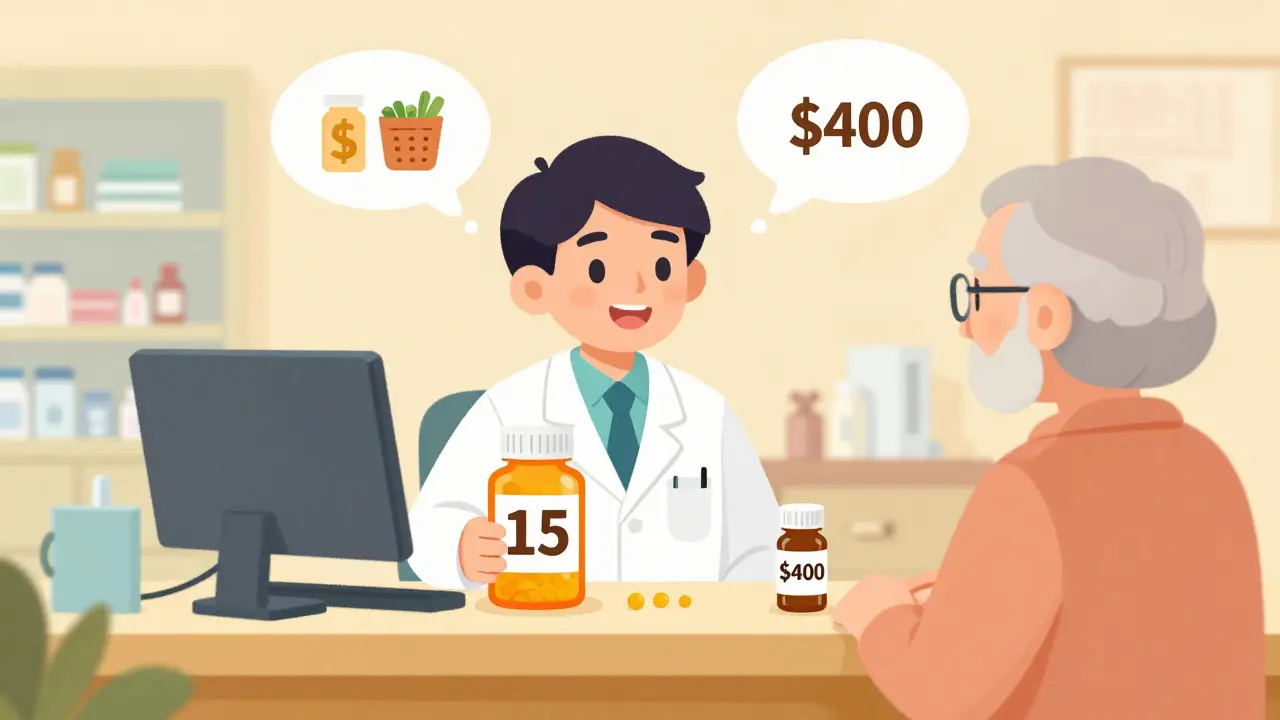
Every year, millions of people skip doses, switch medications, or stop taking their prescriptions altogether-not because they don’t want to get better, but because they can’t afford them. For many, the cost of a brand-name drug is the difference between taking their medicine and skipping it. That’s where pharmacists, trained in medication therapy management (MTM), step in-not just to fill prescriptions, but to fix the hidden problems behind them.
What Is Medication Therapy Management (MTM)?
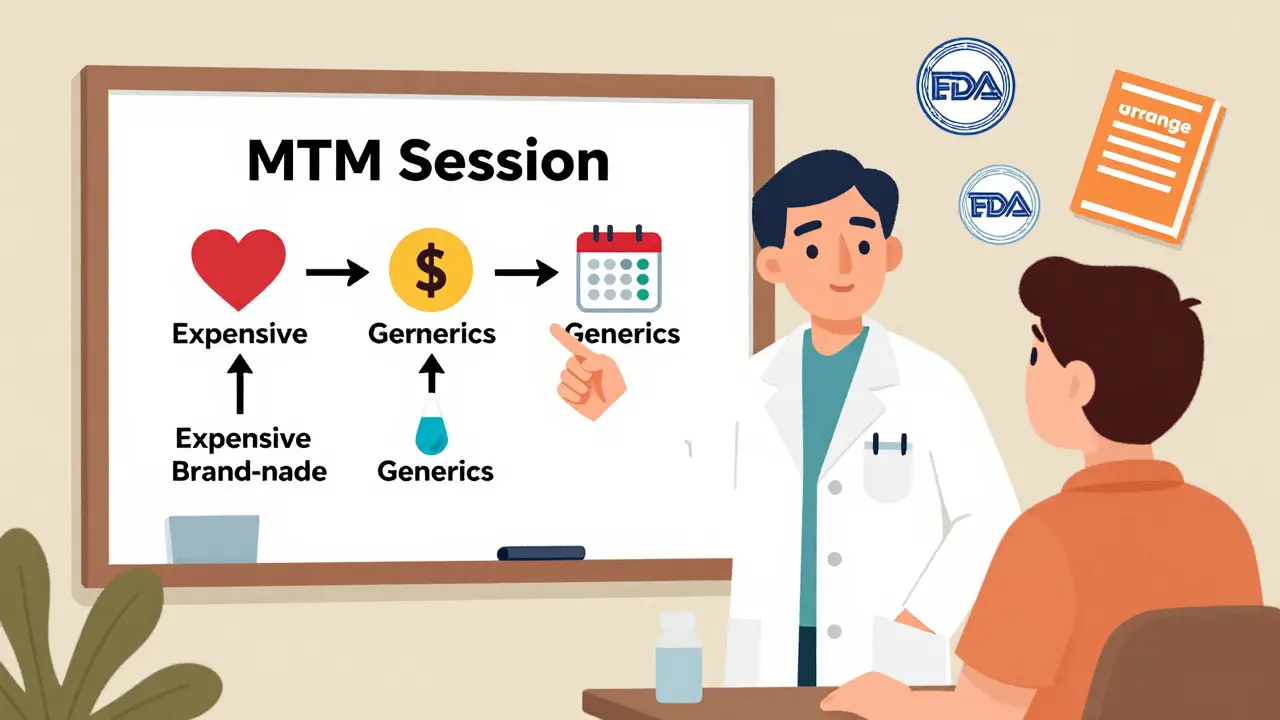
MTM isn’t just checking if you got the right pills. It’s a full review of everything you’re taking-prescription, over-the-counter, supplements-even the ones you forgot to mention. Pharmacists spend 20 to 40 minutes with you, asking questions like: Are you taking this every day? Did your doctor tell you why? Are you paying more than you should?
This service is backed by the American Pharmacists Association and required by Medicare Part D for eligible patients since 2006. But unlike a quick pickup at the counter (which averages just 1.7 minutes), MTM is proactive. Pharmacists look for medication-related problems before they turn into hospital visits. Studies show MTM reduces hospital readmissions by 23% in just 30 days and cuts medication errors by 61%.
The Generic Drug Advantage
Generic drugs aren’t cheaper because they’re weaker. They’re cheaper because they don’t carry the marketing and patent costs of brand names. The FDA says generics must have the same active ingredient, strength, dosage form, and route of administration as the brand. In most cases, they’re identical in how they work in your body.
And the savings? Up to 85%. A $400-a-month brand-name inhaler? There’s often a generic version for $15. A $200 monthly blood pressure pill? A generic might cost $8. Pharmacists use the FDA’s Orange Book to confirm therapeutic equivalence-those are the A-rated generics that can be substituted without hesitation.
But here’s the catch: patients don’t always trust them. Some think generics are “second-rate.” Others worry about switching from a brand they’ve used for years. That’s where the pharmacist’s role becomes critical. They don’t just suggest a cheaper option-they explain why it’s safe, show the data, and address fears.
How Pharmacists Use MTM to Cut Costs Without Compromising Care
Let’s say a patient is on three medications: one brand-name statin, one brand-name antidepressant, and a high-cost diabetes drug. The pharmacist reviews their history, checks for duplicates, and finds:
- The statin has a generic equivalent that’s been used safely by over 10 million people.
- The antidepressant has a generic version with identical bioavailability and fewer side effects reported in real-world use.
- The diabetes drug? There’s a generic, but the patient is on a dose that’s higher than necessary-reducing it could cut costs further without losing effectiveness.
After the MTM session, the patient’s monthly out-of-pocket cost drops from $520 to $233. That’s $287 saved every month. That’s not a small change. That’s groceries, rent, or gas.
One study by HealthPartners found that when pharmacists actively optimized generic use during MTM, patients saved an average of 32% on total medication costs. Another review of 47 studies showed that interventions focused on generic substitution accounted for 37% of all cost savings from MTM.
Why Pharmacists Are Better at This Than Doctors
Doctors are experts in diagnosis and treatment plans. Pharmacists are experts in how drugs work together, interact, and cost. A doctor might prescribe a brand-name drug because it’s what they’re familiar with. A pharmacist sees the whole picture: what’s in your cabinet, what you’ve stopped taking, what you can’t afford.
Pharmacists also track changes across multiple prescribers. A patient might see a cardiologist, a rheumatologist, and a primary care doctor-each prescribing something new. Without a central review, duplicates, interactions, and unnecessary costs pile up. MTM brings it all together.
And it works. Patients who go through MTM are 18.7 percentage points more likely to take their meds as prescribed. That’s not a minor bump-it’s the difference between managing a condition and letting it spiral.
Challenges in Making MTM Work
Even with all the proof that MTM saves money and lives, it’s still not widely used. Only 15 to 25% of eligible Medicare patients actually participate. Why? Many don’t know it’s free. Others think it’s just another pharmacy visit. Some pharmacies don’t offer it because reimbursement is inconsistent.
Medicare pays $50 to $150 per Comprehensive Medication Review. Commercial insurers? Often only $25 to $75. For a 30-minute appointment, that’s not enough to cover staff time, training, and documentation-especially if the pharmacy is busy.
Another barrier? Technology. Only 38% of community pharmacies have seamless electronic health record (EHR) integration. That means pharmacists spend extra time writing notes by hand or entering data manually. Without good documentation, it’s hard to prove the value of MTM to insurers or doctors.
What Pharmacists Need to Do It Right
Good MTM doesn’t happen by accident. Pharmacists need training. Many complete 40 to 60 hours of specialized education and earn certifications like BCPS (Board Certified Pharmacotherapy Specialist) or BCACP (Board Certified Ambulatory Care Pharmacist).
They use tools like the Medication Appropriateness Index (MAI), which checks 10 factors: Is the drug needed? Is it effective? Is the dose right? Is it cost-appropriate? Is there a better generic?
They also need time. Scheduling MTM appointments isn’t optional-it’s essential. A rushed 10-minute chat won’t uncover hidden problems. Patients need space to talk about side effects, fears, or financial stress. And pharmacists need time to document everything in SOAP format: Subjective (what the patient says), Objective (lab results, pill counts), Assessment (what’s wrong), and Plan (what to fix).

Real Stories Behind the Numbers
One patient on Reddit shared how her $400/month brand-name inhaler was switched to a generic. She cried-not from sadness, but relief. “I was choosing between my inhaler and groceries,” she wrote. “The pharmacist didn’t just give me a cheaper pill-he gave me back my breathing.”
Another patient, a retired teacher on fixed income, was taking four medications. Her MTM pharmacist found two were duplicates, one had a cheaper generic, and another could be stopped entirely. Her monthly cost dropped from $390 to $85. She started buying books again.
These aren’t rare cases. A 2022 survey of 1,247 MTM participants found 68% saw lower out-of-pocket costs, 76% took their meds more consistently, and 89% understood their treatment better.
The Future of MTM and Generic Drug Use
MTM is growing. In 2022, over 12.7 million Medicare beneficiaries received MTM services. Commercial plans cover another 85 million Americans. Employers see a $3.17 return for every $1 spent on MTM.
New tools are emerging too. Telehealth MTM sessions are now common-63% of programs use them. Some pharmacists are even starting to use pharmacogenomics: testing how a patient’s genes affect drug metabolism to pick the best generic option.
And policy is catching up. The Pharmacist Medicare Benefits Act, introduced in 2021, could expand direct Medicare reimbursement to pharmacists, opening MTM to 38 million more people.
By 2025, 78% of health systems plan to expand pharmacist roles in MTM. The Bureau of Labor Statistics expects pharmacist jobs to grow 4.6% through 2032-mostly because of clinical services like this.
What You Can Do
If you’re on multiple medications, especially if you’re struggling to pay for them, ask your pharmacist: Do you offer MTM? If they say no, ask why. If they say yes, show up. Bring a list of everything you take, including vitamins and herbal supplements.
Don’t assume your doctor knows everything you’re taking. Don’t assume your pharmacy is just filling pills. Pharmacists are the medication experts you already have access to-and they’re trained to help you save money without sacrificing your health.
Is MTM free for Medicare beneficiaries?
Yes, MTM is free for Medicare Part D beneficiaries who qualify. To qualify, you typically need to have multiple chronic conditions, take several medications, and have spent over a certain amount on prescriptions in a year. Your plan will notify you if you’re eligible. There’s no extra charge for the service.
Are generic drugs really as good as brand names?
Yes. The FDA requires generics to have the same active ingredient, strength, dosage form, and route of administration as the brand. They must also meet the same strict manufacturing standards. The only differences are in inactive ingredients (like fillers or dyes), which rarely affect how the drug works. For 90% of medications, generics are just as safe and effective.
Can pharmacists switch my brand-name drug to a generic without my doctor’s permission?
In most cases, yes-unless your doctor specifically wrote “dispense as written” or “no substitution” on the prescription. Pharmacists are legally allowed to substitute FDA-approved generics unless prohibited. But in MTM, they won’t just switch it. They’ll explain why, check for interactions, and make sure it’s right for you.
What if I’m worried about side effects from switching to a generic?
It’s a common concern. Some people notice small differences, especially with narrow therapeutic index drugs like warfarin or thyroid meds. That’s why pharmacists don’t make changes lightly. They check the FDA’s Orange Book for A-rated generics, review your history, and monitor you after the switch. If you feel different, they’ll work with your doctor to adjust.
Why don’t all pharmacies offer MTM?
Reimbursement is the biggest issue. Medicare pays $50-$150 per session, but many private insurers pay only $25-$75. For a 30-minute appointment with documentation, that’s often not enough to cover time and staff. Some pharmacies also lack the technology to integrate MTM into their systems. But demand is growing, and more are starting to offer it.

Arjun Seth
January 15, 2026 AT 16:09People just don't get it-medicines aren't candy. You don't just pick them up because they're cheap. If you can't afford your meds, maybe you shouldn't be taking them at all. This MTM nonsense is just enabling bad decisions. People need to get jobs, not rely on pharmacists to fix their life choices.
Mike Berrange
January 16, 2026 AT 10:22Actually, the FDA’s bioequivalence standards for generics are not as rigorous as the article implies. Many generics have different inactive ingredients that can alter absorption rates-especially in narrow therapeutic index drugs. The data cited here is cherry-picked from industry-funded studies. I’ve seen patients destabilized after switching. This is dangerous pseudoscience dressed up as cost-saving.
Dan Mack
January 17, 2026 AT 16:12Pharmacists aren’t healers-they’re corporate agents. MTM is a Trojan horse. Big Pharma pays them to push generics so they can monopolize the market later. The real reason they want you to switch? So they can patent the generic formula again under a new name. They’re not saving you money-they’re locking you in.
Amy Vickberg
January 19, 2026 AT 01:14I’ve seen this work firsthand. My mom was on five meds, spending $600/month. After her MTM session, they cut it to $140. She started walking again. She bought her grandkids books. This isn’t about drugs-it’s about dignity. If you think saving someone’s ability to breathe or eat is wrong, you’ve lost touch with what matters.
Ayush Pareek
January 19, 2026 AT 23:53As someone from India where generics are the only option for most, I can say this: the fear around generics is mostly cultural. In our villages, people have used generics for decades. No one dies from them. The real issue is access to a pharmacist who listens. If you treat the patient like a person-not a prescription number-the results speak for themselves.
Nishant Garg
January 20, 2026 AT 23:12Let’s be real-the system is rigged. Brand names are overpriced because of patent trolling and marketing fluff. Pharmacists are the only ones left who actually care whether you live or die. But here’s the twist: the same people who scream about ‘big pharma’ are the ones who won’t walk five minutes to their local pharmacy for a free consult. It’s not about the science-it’s about the laziness. You want cheaper meds? Show up. Talk. Listen. Stop blaming doctors. Stop blaming pharmacists. Start taking responsibility.
Nicholas Urmaza
January 21, 2026 AT 23:49MTM is the future. Period. Pharmacists are underutilized healthcare heroes. We don’t need more doctors-we need more trained medication experts who can see the whole picture. Employers are already saving thousands per employee. Medicare will catch up. The only question is whether we’ll let bureaucracy kill innovation before it spreads
Sarah Mailloux
January 23, 2026 AT 19:32My pharmacist switched my blood pressure med to a generic. I was terrified. She sat with me for 35 minutes. Showed me the FDA charts. Asked if I was sleeping okay. Told me to call if I felt weird. I did. She called my doctor. We adjusted. I saved $250 a month. She didn’t just fill a prescription. She gave me back my life.
Nilesh Khedekar
January 25, 2026 AT 18:36Of course it works-when you have a pharmacist who actually gives a damn. But let’s not pretend this is common. Most pharmacies treat you like a vending machine. They’re overworked, underpaid, and stuck with software from 2008. MTM sounds great until you’re the one waiting 45 minutes just to ask if your new pill is the same as the old one. So yes-it’s brilliant. But only if you’re lucky enough to find the right pharmacist. And that’s the real tragedy.