
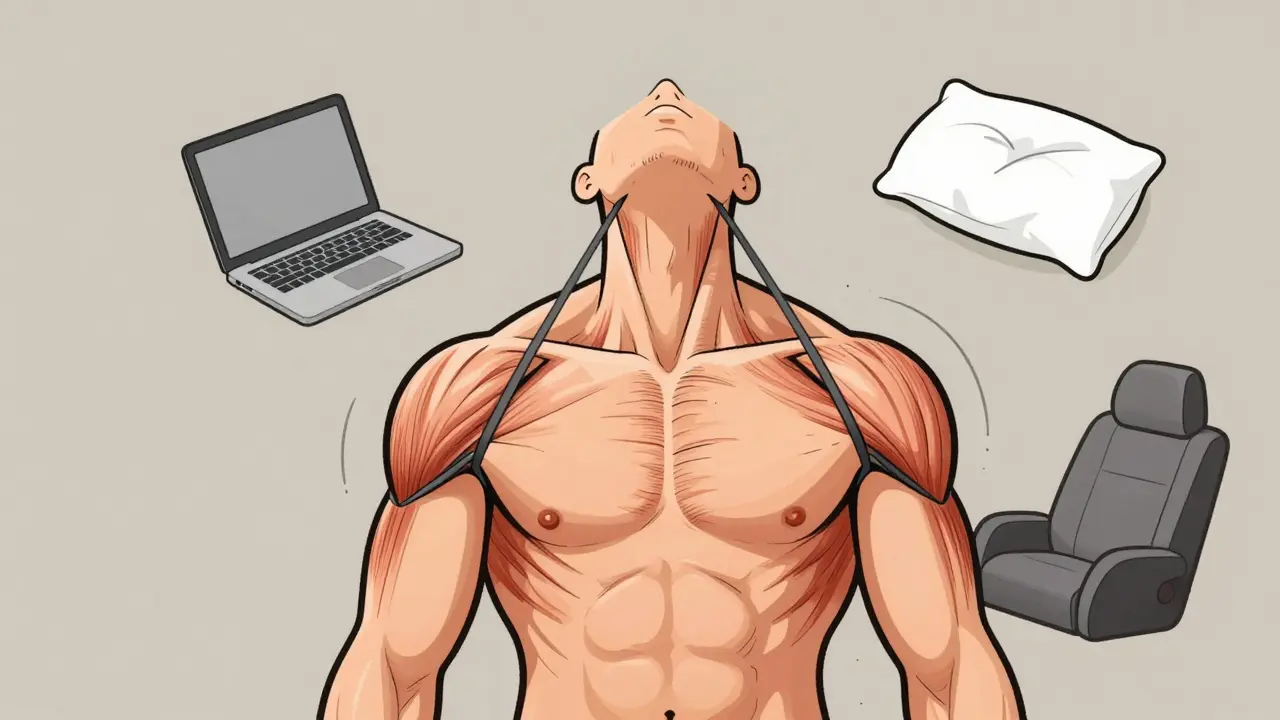
What Is Cervical Strain?
Cervical strain is a common injury to the muscles and tendons in the neck, caused by overstretching or tearing due to sudden movement, poor posture, or prolonged strain. It’s not a fracture or nerve issue-it’s soft tissue damage. Think of it like pulling a muscle in your shoulder, but in your neck. The most affected areas are the trapezius, levator scapulae, and sternocleidomastoid muscles. These muscles help you turn your head, lift your shoulders, and keep your posture upright. When they’re overstressed, pain and stiffness follow.
Unlike arthritis or a pinched nerve, cervical strain doesn’t cause numbness, tingling, or weakness down your arm. The pain stays localized-mostly in the back and sides of your neck, sometimes spreading to the shoulders. It hits fast: you might wake up stiff after sleeping wrong, or feel it after a car accident, a fall, or hours hunched over a screen.
How Bad Is It? Symptoms and Severity Levels
Not all neck strains are the same. They’re graded by how much tissue is damaged:
- Mild (Grade I): Tiny tears in muscle fibers. You feel soreness and stiffness, but can still move your neck. Pain fades in 2-3 days.
- Moderate (Grade II): Partial tearing. Pain is sharper, movement is limited, and it hurts to turn your head. Recovery takes 1-2 weeks.
- Severe (Grade III): Complete tear or rupture. Rare, but causes intense pain, swelling, and inability to move the neck. Takes 6-12 weeks to heal and may need specialist care.
According to Mayo Clinic data, 92% of people with cervical strain report localized neck pain. Around 87% feel stiffness, and 73% can’t turn their head fully. Pain usually rates between 4 and 6 out of 10 during the first few days. It spikes when you look up, turn your head, or lift something heavy.
What’s Not Cervical Strain? Ruling Out Other Causes
Neck pain can come from many places. Knowing the difference matters because treatment changes completely.
- Cervical radiculopathy (pinched nerve): Pain shoots down your arm, sometimes with numbness or weakness in your hand. This isn’t strain-it’s nerve pressure.
- Cervical stenosis: Common in people over 40. Causes numbness in hands, trouble walking, or bladder issues. It’s a narrowing of the spinal canal, not muscle damage.
- Osteoarthritis: Gradual, achy pain that gets worse with movement. You might hear or feel grinding when you turn your head. It’s joint wear, not a sudden injury.
- Rheumatoid arthritis: Morning stiffness lasting over 30 minutes, swelling in multiple joints, fatigue. This is an autoimmune condition.
If your pain came on suddenly after a twist, fall, or long day at your desk-it’s likely cervical strain. If it crept in slowly or came with other symptoms like numbness, see a doctor to rule out something more serious.
How Is It Diagnosed?
You don’t need an X-ray or MRI for most cervical strains. Doctors diagnose it by asking about how the pain started and what makes it better or worse. They’ll check your range of motion, press on your neck muscles, and test for nerve signs.
Imaging is only ordered if:
- Pain doesn’t improve after 2 weeks
- You have numbness, tingling, or weakness
- You had a high-impact injury like a car crash
Ultrasound imaging can show muscle tears in moderate to severe cases, but it’s not routine. Most diagnoses are based on symptoms and physical exam alone.

Best Treatment Options: What Actually Works
There’s no magic pill or quick fix. But the right steps can get you back to normal in days, not weeks.
Days 1-3: Rest, Ice, and Gentle Movement
Don’t stay in bed. Studies show that resting too long slows recovery. Instead:
- Apply ice packs for 15-20 minutes every 2-3 hours. This cuts swelling and pain by 32% compared to heat in the first 48 hours.
- Take over-the-counter pain relievers like acetaminophen or ibuprofen-but don’t use NSAIDs longer than 7-10 days. They don’t help more after that, and can irritate your stomach.
- Move your neck gently. Slow chin tucks (pulling your chin toward your chest) and shoulder rolls help keep things from stiffening up.
Days 4-14: Start Moving, Then Strengthen
This is where recovery really begins. Most people feel better by now, but skipping movement leads to long-term problems.
- Do 10-15 chin tucks 3 times a day. This retrains your neck posture.
- Add scapular retractions: squeeze your shoulder blades together and hold for 5 seconds. Repeat 10 times.
- Try gentle neck rotations-turn your head slowly left and right. Stop if it hurts.
Research in the Spine Journal shows people who did these exercises daily improved their neck rotation by almost 19 degrees in just two weeks.
Weeks 3-6: Build Strength to Prevent Recurrence
Strains often come back if you don’t fix the root cause. For most people, that’s weak shoulder blades and forward head posture.
- Use a TheraBand® resistance band for neck and shoulder exercises. Do 2 sets of 15 reps, 3 times a week.
- Focus on lower trapezius and serratus anterior muscles. These stabilize your shoulder blades and pull your head back into alignment.
- Try wall angels: stand with your back against a wall, arms in a “W” shape. Slowly slide arms up and down. This fixes posture over time.
One Reddit user, after six months of PT focused on these muscles, reduced their forward head posture from 4.2 cm to 1.8 cm-and their daily headaches disappeared.
What About Chiropractic Care or Massage?
Many people turn to chiropractors or massage therapists. The data is mixed.
- Chiropractic adjustments: Can give quick relief-many report feeling better right after. But 32% of users say the relief is temporary and they need repeated visits. It doesn’t fix the underlying weakness.
- Massage therapy: Helps reduce muscle tension and improve blood flow. Best when combined with movement exercises.
Physical therapy consistently scores higher in patient reviews-4.3 out of 5 stars-with 78% saying they saw real improvement within two weeks.
Why Most People Don’t Get Better
Here’s the hard truth: 10-15% of cervical strains turn chronic. Why?
- Delaying treatment: The average person waits 8.2 weeks before seeing a specialist. By then, the strain turns into myofascial pain syndrome-much harder to treat.
- Ignoring posture: If you sit at a desk all day with your head jutting forward, you’re setting yourself up for repeat injuries. Studies show 68% of office workers have this posture.
- Stopping exercises too soon: Compliance drops from 68% at 2 weeks to just 41% at 6 weeks. The people who stick with it for 6-8 weeks rarely get it again.
Successful patients don’t wait until they’re pain-free to stop. They keep doing their exercises-even when they feel good-because prevention is easier than recovery.
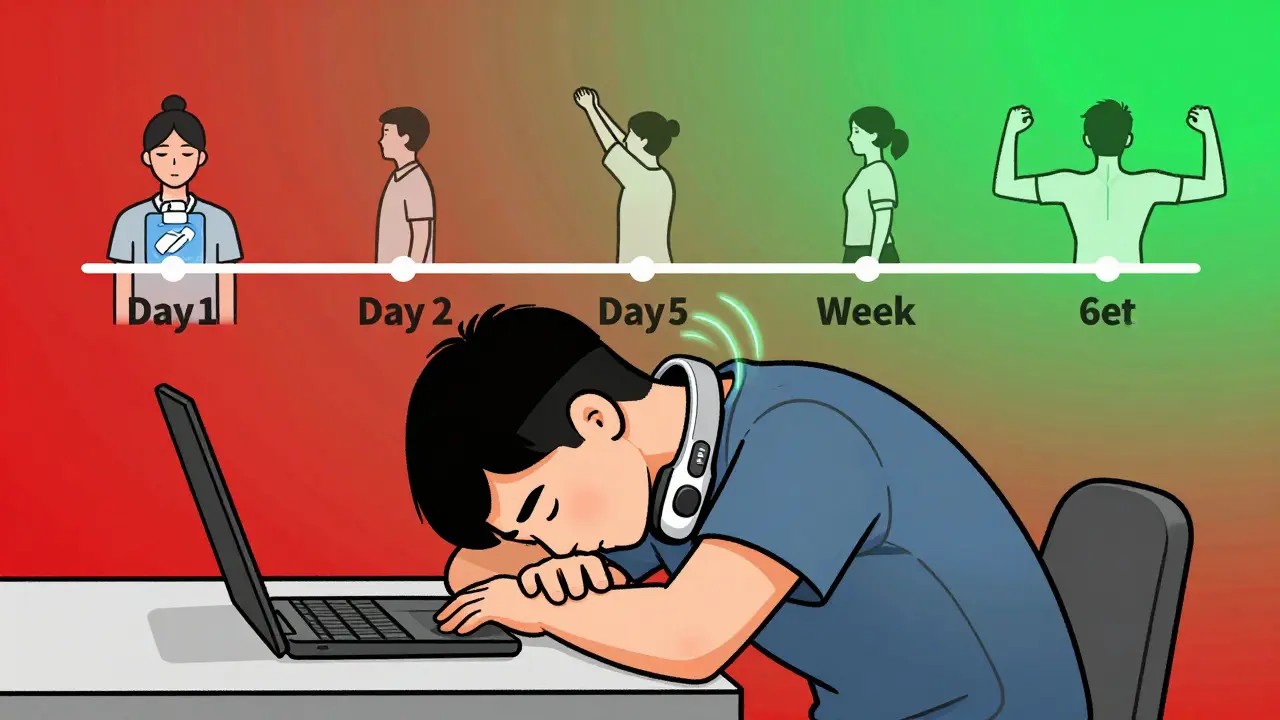
What’s New in Treatment?
Technology is helping people recover faster and smarter.
- NeckSense™: A wearable device approved by the FDA in early 2023. It tracks your neck posture in real time and vibrates when you slouch. It’s 92.7% accurate compared to X-rays.
- Cognitive-behavioral strategies: If you’re catastrophizing your pain (“This will never get better”), you’re 3.2 times more likely to develop chronic pain. Therapy helps reframe those thoughts.
- Sensorimotor training: Combining balance and coordination drills with manual therapy cuts recurrence rates from 39% to just 18% over a year.
The NIH is funding a major trial called CERVICO, testing whether treating strains within 72 hours can drop chronic pain rates from 15% to 8%. Early results look promising.
Prevention: Stop It Before It Starts
Neck pain is preventable. Here’s how:
- Adjust your computer screen so the top is at eye level.
- Take a 2-minute break every 30 minutes to stretch your neck and shoulders.
- Use a supportive pillow-no more sleeping on your stomach.
- Strengthen your upper back and shoulders 2-3 times a week.
- Practice chin tucks while brushing your teeth. Habit-stacking makes it stick.
Office workers are 2.3 times more likely to get cervical strain than manual laborers-not because they’re weak, but because they sit still too long. Movement is medicine.
When to See a Doctor
Most strains heal on their own. But call a doctor if:
- Pain lasts longer than 2 weeks despite home care
- You feel numbness, tingling, or weakness in your arms or hands
- You have trouble walking, balancing, or controlling your bladder
- Pain came after a fall, car crash, or head injury
Early intervention cuts recovery time and prevents long-term issues. Don’t wait until it becomes a chronic problem.
Final Thoughts
Cervical strain isn’t dangerous, but it’s annoying-and it doesn’t have to be. The key isn’t painkillers or expensive treatments. It’s movement, posture, and consistency. Most people recover fully with simple exercises and a few lifestyle tweaks. The ones who don’t? They waited too long or skipped the hard work of strengthening their body.
You don’t need to live with neck pain. Start today. Do one chin tuck. Adjust your screen. Stretch your shoulders. Small steps add up. Your neck will thank you.

Alex Ronald
December 31, 2025 AT 06:41Also, the NeckSense™ thing sounds wild but actually makes sense. I’d buy one if it wasn’t so pricey.
Teresa Rodriguez leon
January 1, 2026 AT 00:58Louis Paré
January 1, 2026 AT 16:40Also, 78% improvement? With what sample size? Who funded this? Where’s the peer review?
Samar Khan
January 3, 2026 AT 13:39Russell Thomas
January 4, 2026 AT 07:44Joe Kwon
January 5, 2026 AT 11:32Nicole K.
January 6, 2026 AT 13:11Fabian Riewe
January 8, 2026 AT 03:27Also, the TheraBand stuff? Totally worth the $12. I got mine on Amazon. No need to go to PT if you’re consistent.
Amy Cannon
January 9, 2026 AT 04:08