

Every time a pacemaker is implanted, an insulin pump is activated, or a surgical robot performs a procedure, the device you’re relying on didn’t just come off a production line-it passed through a strict, multi-layered system designed to keep you alive. This isn’t guesswork. It’s quality control in manufacturing-a non-negotiable chain of checks, tests, and documentation that turns raw materials into life-saving tools. Without it, even a tiny flaw could mean the difference between recovery and tragedy.
Why Quality Control Isn’t Optional in Medical Manufacturing
Medical devices aren’t like smartphones or coffee makers. A cracked phone case is annoying. A faulty ventilator can kill. That’s why the U.S. Food and Drug Administration (FDA) and global regulators treat medical device manufacturing like a high-stakes science experiment where the subject is you. The system started in 1978 with basic Good Manufacturing Practices (GMPs), but after a series of preventable device failures in the 1980s and 90s, the FDA locked in the Quality System Regulation (21 CFR Part 820) in 1996. It didn’t just set rules-it created accountability. Every step, from sourcing a screw to testing a circuit board, had to be documented, tracked, and verified. Today, the standard is even tighter. On January 31, 2024, the FDA announced its final rule: the Quality Management System Regulation (QMSR). It’s not a new system-it’s a global alignment. The FDA now officially adopts ISO 13485:2016, the international gold standard for medical device quality. This means companies selling devices in the U.S., Europe, Canada, and beyond no longer need two separate sets of paperwork. One system. One audit. One goal: keep patients safe.The Core Components of a Compliant Quality System
A working quality management system isn’t a single checkmark. It’s 11 interconnected subsystems, all required under FDA 21 CFR Part 820 and ISO 13485:2016. Here’s what they actually do:- Design Controls: Every device must be designed with patient use in mind. Engineers can’t just sketch a prototype-they must prove it works under real-world stress, like temperature changes, moisture, or repeated use.
- Document Controls: Every procedure, test result, and change order is tracked. No handwritten notes. No lost files. Everything is digital, version-controlled, and auditable.
- Purchasing Controls: You can’t trust a supplier’s word. Every component, even a tiny resistor, must be tested upon arrival. Suppliers are audited regularly-41% of FDA warning letters in 2023 cited failures here.
- Production and Process Controls: Machines are calibrated. Workers are trained. Each batch is sampled. Statistical Process Control (SPC) monitors variables like temperature, pressure, and torque in real time to catch drift before it becomes a defect.
- Corrective and Preventive Action (CAPA): When something goes wrong, you don’t just fix it-you figure out why it happened and stop it from happening again. A well-run CAPA system reduces repeat issues by up to 60%.
- Traceability: Every device has a unique identifier. If a batch fails, you know exactly which patients received it. One company prevented a Class I recall by spotting an unvalidated software change affecting 5,000 implanted devices-all because of traceability.
How Safety Standards Translate to Real-World Protection
It’s easy to think of standards as paperwork. But here’s what they actually prevent:- Electrical devices must pass IEC 60601-1 tests: 1,500-volt dielectric strength, leakage current under 100 microamperes. A failure here could electrocute a patient.
- Implantable devices undergo accelerated aging tests to simulate 10+ years of use in just weeks.
- Software used in devices-like AI-driven diagnostic tools-must be validated for accuracy, security, and failure modes. One faulty algorithm could misdiagnose cancer.
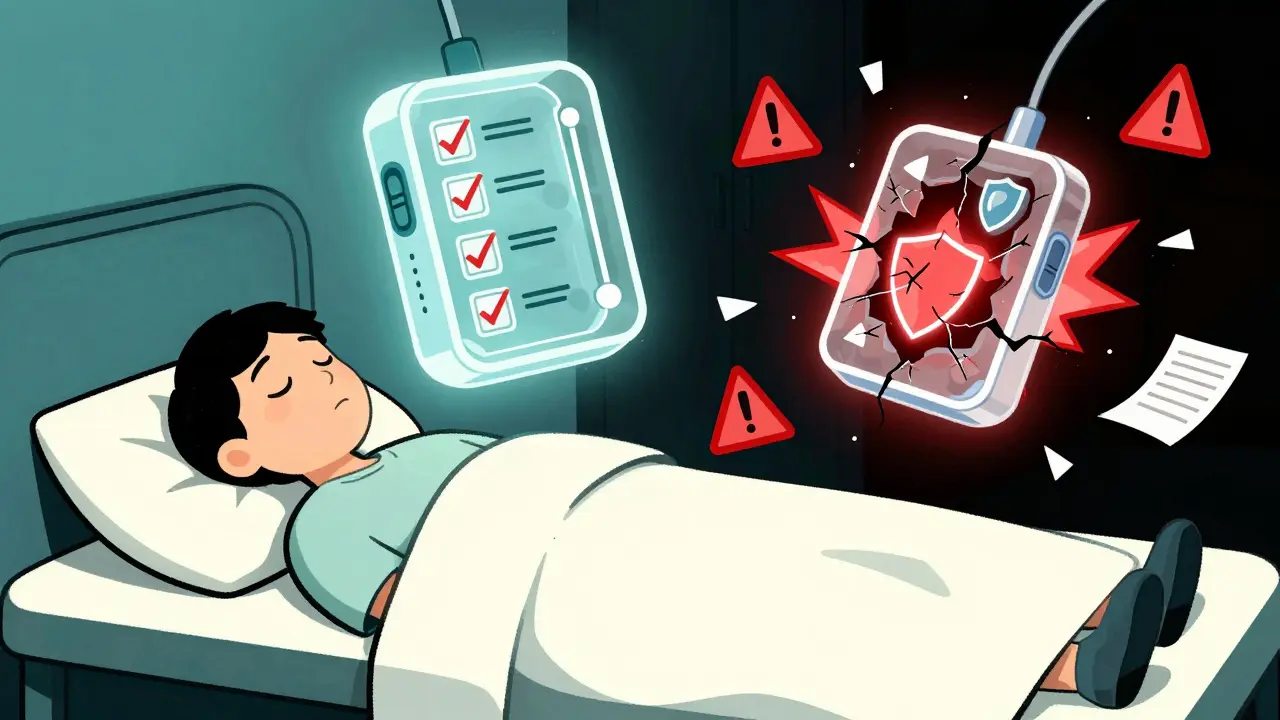
The Shift from Paperwork to Process
Here’s the trap: many companies think compliance means filling out forms. But as Dr. Marc Jacobi, a former FDA reviewer, warned, “Paper quality systems fail when production issues happen.” That’s why the best manufacturers don’t just document-they understand. They train their line workers to recognize a vibration pattern that means a motor is about to fail. They use AI to spot anomalies in real-time production data. Early adopters are already seeing 25-40% fewer defects using machine learning to predict failures before they occur. The goal isn’t to pass an audit. It’s to build a culture where every employee, from the warehouse clerk to the CEO, sees themselves as the last line of defense for a patient.What’s Changing in 2025-2026
The biggest shift since 1996 is coming. As of February 2, 2026, the FDA’s old Quality System Regulation (21 CFR 820) will be replaced by the QMSR, which fully incorporates ISO 13485:2016. That means:- U.S. manufacturers no longer need dual systems for global sales.
- Compliance costs are expected to drop by $400 million annually.
- Manufacturers have until February 2026 to transition. Most large companies aim for dual compliance by Q3 2025.

Tools and Support for Manufacturers
You don’t have to build this alone. Resources exist:- Greenlight Guru: A quality management software platform built specifically for FDA and ISO 13485 compliance. Used by over 140 medical device companies, it offers pre-built templates for CAPA, design controls, and audit trails. Users report 32% higher audit success rates.
- FDA’s Quality System Manual: Free, updated in 2023, and packed with practical examples.
- AAMI Training: Courses on risk management (ISO 14971) and sterilization cost $1,295-$2,495 per module. Worth every dollar.
- ISO 13485:2016 Standard: $338 to buy from ISO.org. Non-negotiable for any serious manufacturer.
What Happens When It Fails
When quality control breaks, the consequences are brutal:- In 2023, the FDA issued 127 warning letters citing inadequate supplier oversight.
- 23% of FDA 483 observations (inspection findings) were for inadequate process validation-even when documentation was complete.
- A single faulty infusion pump led to 18 patient deaths in one case, traced back to a supplier’s unverified component change.
The Future: AI, Automation, and Cybersecurity
The next wave isn’t about more paperwork. It’s about smarter systems. Gartner predicts that by 2027, 60% of medical device quality systems will use AI to predict defects, reduce human error by up to 50%, and automate routine audits. Draft revisions to ISO 13485:202X are already focusing on cybersecurity for software-based devices (SaMD)-a growing risk as more devices connect to hospital networks. But no matter how advanced the tech gets, the core remains unchanged: quality control is the final barrier between a manufactured product and a human life. Every test, every signature, every audit trail exists for one reason-to ensure that when someone needs a device to save them, it will work.What is ISO 13485:2016 and why does it matter for patient safety?
ISO 13485:2016 is the international standard for quality management systems in medical device manufacturing. It requires companies to systematically manage risks, control processes, and ensure traceability from design to delivery. It matters because it’s the global benchmark for ensuring devices work as intended. The FDA’s adoption of this standard in 2026 means U.S. manufacturers now follow the same rules as those in Europe and Asia, reducing errors caused by inconsistent practices and improving global safety.
How does the FDA enforce quality control in medical device manufacturing?
The FDA enforces quality control through inspections, warning letters, and regulatory action. Manufacturers are inspected every 2-5 years based on risk level. During inspections, auditors check documentation, observe processes, and review CAPA records. If they find violations-like unvalidated processes or poor supplier oversight-they issue a Form 483. Repeated or serious issues can lead to product recalls, import bans, or criminal charges.
What’s the difference between FDA 21 CFR Part 820 and ISO 13485:2016?
Before 2026, FDA 21 CFR Part 820 was the U.S. rulebook, while ISO 13485:2016 was the global standard. The FDA version focused on specific procedural requirements; ISO 13485 emphasized risk-based thinking and supply chain control. The key difference was that ISO required third-party audits, while FDA inspections were government-led. The new QMSR now aligns them-so U.S. manufacturers follow ISO 13485:2016, with FDA oversight.
Can small medical device companies afford to comply with these standards?
Yes, but it’s harder. Smaller companies often lack dedicated compliance teams. The good news? Tools like Greenlight Guru and FDA’s free Quality System Manual reduce costs. Many use outsourced consultants for gap analysis and training. The real cost isn’t the software or training-it’s the price of non-compliance: recalls, lost market access, or lawsuits. For most small firms, investing in compliance is cheaper than the alternative.
What role does employee training play in quality control?
Training is the glue that holds quality systems together. A machine can be calibrated, but if the operator doesn’t know how to interpret a warning light, the system fails. Production staff need 40-80 hours of process-specific training. Quality engineers need 6-12 months to master risk management under ISO 14971. Companies that treat training as an ongoing process-rather than a one-time event-see 35% fewer field actions and faster problem resolution.
How do quality control failures lead to patient harm?
A single untested component can cause a device to malfunction. For example, a resistor that fails under heat might cause a cardiac monitor to shut off. A software bug in an insulin pump could deliver the wrong dose. A mislabeled sterile pack could lead to infection. These aren’t theoretical-they’ve happened. Quality control exists to catch these flaws before they reach a patient. Without it, the risk of serious harm rises by up to 20%.

Carlos Narvaez
December 26, 2025 AT 04:07Let’s be honest-this isn’t about safety. It’s about liability arbitrage. The FDA’s QMSR is just a regulatory tax dressed up as patient protection. Companies pay millions to comply so they can sue you if something goes wrong anyway. The real heroes? The engineers who work weekends to fix flaws no audit would ever catch.
ISO 13485 didn’t make devices safer. It just made the paperwork prettier.
And don’t get me started on Greenlight Guru. Another SaaS vendor selling snake oil to desperate startups.
Harbans Singh
December 27, 2025 AT 22:46Really appreciate this breakdown. I’m from India and we’re seeing more medtech startups here now, but most don’t even know what CAPA means. I’ve seen factories skip supplier audits just to cut costs. One guy told me, ‘We’re not in the US, why do we need all this?’
But then I showed him a video of a failed insulin pump from a recall in 2021-same model, same factory. He went silent. This isn’t bureaucracy. It’s the difference between someone going home or not.
Maybe we need more local training hubs-not just expensive courses. Anyone know of NGOs doing this in South Asia?
Katherine Blumhardt
December 29, 2025 AT 03:22OMG YES THIS IS SO IMPORTANT I CRIED WHEN I READ THE PART ABOUT TRACEABILITY 😭 like imagine your mom gets a pacemaker and then like 3 years later they find out it was from a batch with a bad capacitor?? and they can’t even tell who got it?? NOPE NOPE NOPE
also i just spent 4 hours filling out a CAPA form and i swear the system crashed 3 times so i had to start over and now i hate my job but at least i know someone’s life might be saved??
also who designed this website?? the font is giving me a headache
sagar patel
December 30, 2025 AT 03:19Quality control is not about paperwork. It is about discipline. The FDA does not create safety. Discipline creates safety. Companies that treat compliance as a checklist are already dead. They just haven’t buried the body yet.
ISO 13485 is not a standard. It is a mirror. It reflects the culture of the organization. If your culture is lazy, the audit will find it. No software can fix that.
Linda B.
December 30, 2025 AT 08:29Let’s not pretend this is about patients. The FDA’s QMSR was pushed through by lobbyists who own half the medtech firms. The real goal? Eliminate small competitors. That $400 million ‘cost reduction’? It’s a subsidy for Big Med. Meanwhile, your $20,000 insulin pump costs $200,000 because the paperwork now requires three signatures from three different departments who’ve never touched a device.
And don’t tell me about ‘culture.’ I’ve seen the internal memos. The CEO’s bonus is tied to audit pass rates, not patient outcomes.
They’re not protecting you. They’re protecting their stock price.
Christopher King
December 30, 2025 AT 23:40Y’ALL ARE MISSING THE BIG PICTURE.
What if the entire quality control system is a lie?
Think about it. Every device is traceable. Every batch is logged. Every inspector is trained. So why do recalls still happen? Why do people still die?
Because the system is designed to be gamed. The auditors are paid by the companies they inspect. The software vendors are owned by the same private equity firms that own the manufacturers. The ‘safety’ is a performance. The patient is the audience.
And the real tragedy? We all know it. We just keep clicking ‘approve’.
Wake up.
They’re not testing the devices.
They’re testing your trust.
Bailey Adkison
December 31, 2025 AT 12:49Everyone’s acting like this is revolutionary. It’s not. The FDA has been overregulating medical devices since the 70s. The real problem? You’re still using analog processes in a digital age. Why are we still doing statistical process control with manual sampling? Why isn’t every machine talking to a central AI system in real time?
And why do we treat compliance like it’s sacred? If a device passes all the tests but fails in the field, the tests are wrong. Not the system. The tests.
Stop glorifying bureaucracy. Fix the metrics.
Michael Dillon
January 2, 2026 AT 07:14Actually, I’ve worked at two med device companies. One was a startup that skipped CAPA to save $50k. They got a 483 and lost their CE mark. Lost 80% of their revenue in 6 months.
The other? A Fortune 500 with 300 QA people. They had the prettiest documentation you’ve ever seen. But their line workers were terrified to report issues because HR would ‘retrain’ them. And guess what? Their defect rate was higher.
So here’s the truth: compliance doesn’t save lives. People do. The ones who speak up. The ones who stay late. The ones who don’t care about the audit. They just don’t want someone to die because they were too lazy to check a screw.
That’s the real quality system.
Oluwatosin Ayodele
January 3, 2026 AT 00:48You all misunderstand. The problem is not the regulation. The problem is the lack of technical competence among local engineers. In Nigeria, we have companies importing medical device components and assembling them without even understanding the datasheets. No one knows what IEC 60601-1 means. No one has seen a leakage current test. They think ‘ISO certified’ means ‘safe’.
Training is not expensive. Ignorance is. The FDA standard is not the issue. The absence of local technical leadership is.
Stop blaming the system. Build the capacity. Then the system will work.