
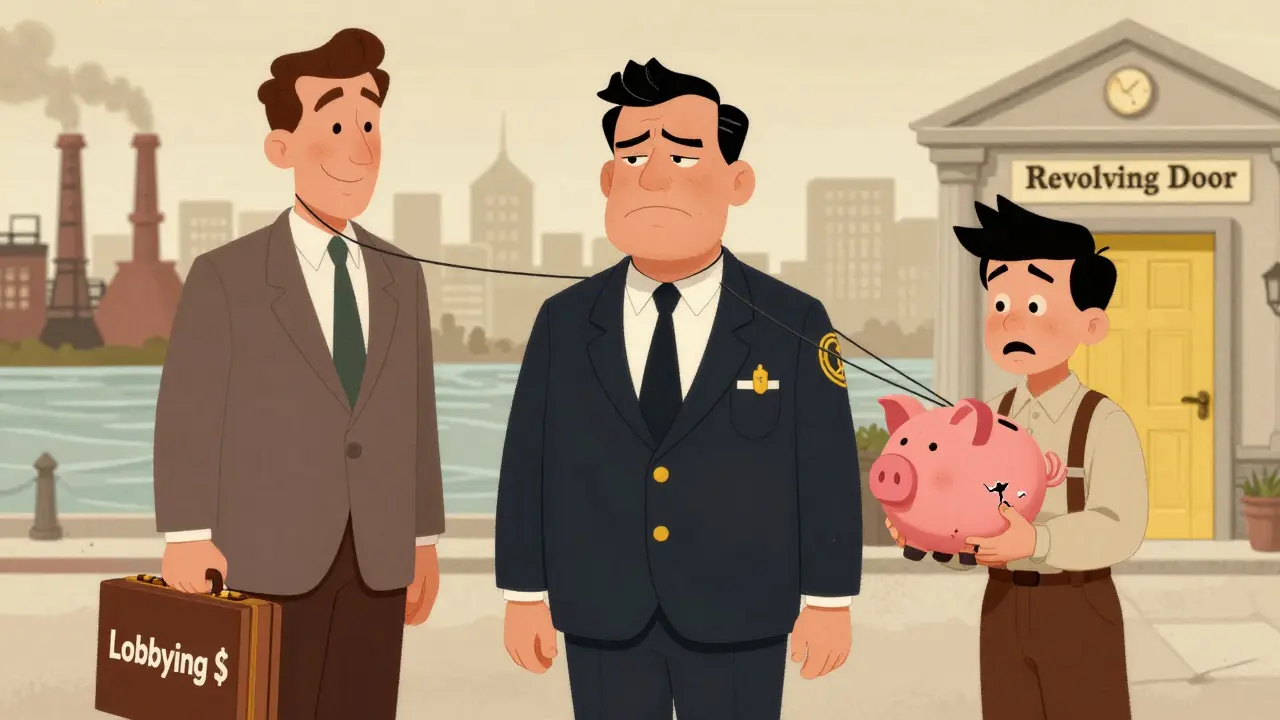
When you think of government regulators, you probably imagine watchdogs keeping dangerous products off shelves, making sure banks don’t gamble with your savings, or stopping polluters from poisoning rivers. But what if those watchdogs have become part of the pack? That’s regulatory capture-when the agencies meant to protect the public end up serving the industries they’re supposed to control.
What Regulatory Capture Really Means
Regulatory capture isn’t about bribery or illegal deals, though those happen too. It’s subtler. It’s when regulators start thinking like the companies they’re supposed to oversee. They adopt their language, their priorities, their fears. Over time, the line between regulator and regulated blurs. The public interest gets pushed aside-not because someone ordered it, but because the system slowly tilted that way. This isn’t theory. It’s documented. In the U.S., 53% of senior Defense Department officials moved into defense industry jobs within a year of leaving government between 2008 and 2018. That’s not coincidence. It’s a revolving door that turns policy into profit. In the UK, energy regulator OFGEM approved $24 billion in consumer bill hikes between 2015 and 2020 to fund grid upgrades-while letting energy companies keep profit margins at 11.2%, far above the 6.8% limit. Consumers paid the price. The companies? They thrived.How It Happens: The Three Main Ways
There are three main paths to regulatory capture, and they often work together. First, materialist capture-money talks. Industries spend billions lobbying, donate to political campaigns, and offer high-paying jobs to regulators after they leave government. The U.S. sugar industry, for example, spends millions to keep tariffs high. That keeps sugar prices three times the global rate. Every American household pays about $33 a year extra. Not because it’s fair, but because 4,318 sugar producers benefit hugely, while the cost is spread across 330 million people. No one feels it enough to fight back. Second, cultural capture-it’s about relationships. Regulators spend years working with the same companies, attending the same conferences, sharing the same technical jargon. They begin to see the industry’s side. They worry about “stifling innovation” or “hurting competitiveness.” Enforcement becomes a suggestion, not a demand. A 2021 study found agencies with formal industry advisory committees were 3.7 times more likely to adopt rules favored by those industries. Third, information asymmetry-regulators don’t know enough. Modern industries-crypto, AI, biotech-are insanely complex. Regulators can’t hire enough experts. So they rely on industry-provided data, studies, and even draft regulations. The result? Rules written by the industry, signed off by the regulator. The FAA let Boeing employees do 96% of the safety reviews on the 737 MAX. That’s not oversight. That’s delegation to the accused.Who Pays the Price?
The cost isn’t just financial. It’s trust. When people see regulators protecting banks instead of customers, or drug companies instead of patients, they stop believing in the system. A 2023 Pew survey found 78% of Americans are deeply concerned about industry influence on regulators. On Reddit, 82% of comments about FDA drug approvals blamed capture for high prices and unsafe products. On Yelp, financial services get 2.1 out of 5 stars-not because banks are bad, but because people feel the system is rigged. The consequences are real. In the 2008 financial crisis, the SEC had revolving door ties with 87% of the biggest Wall Street firms. They missed warning signs because they didn’t want to upset the people who might hire them next. The Financial Crisis Inquiry Commission called it systemic failure. The cost? Trillions lost. Millions of homes foreclosed. Lives upended.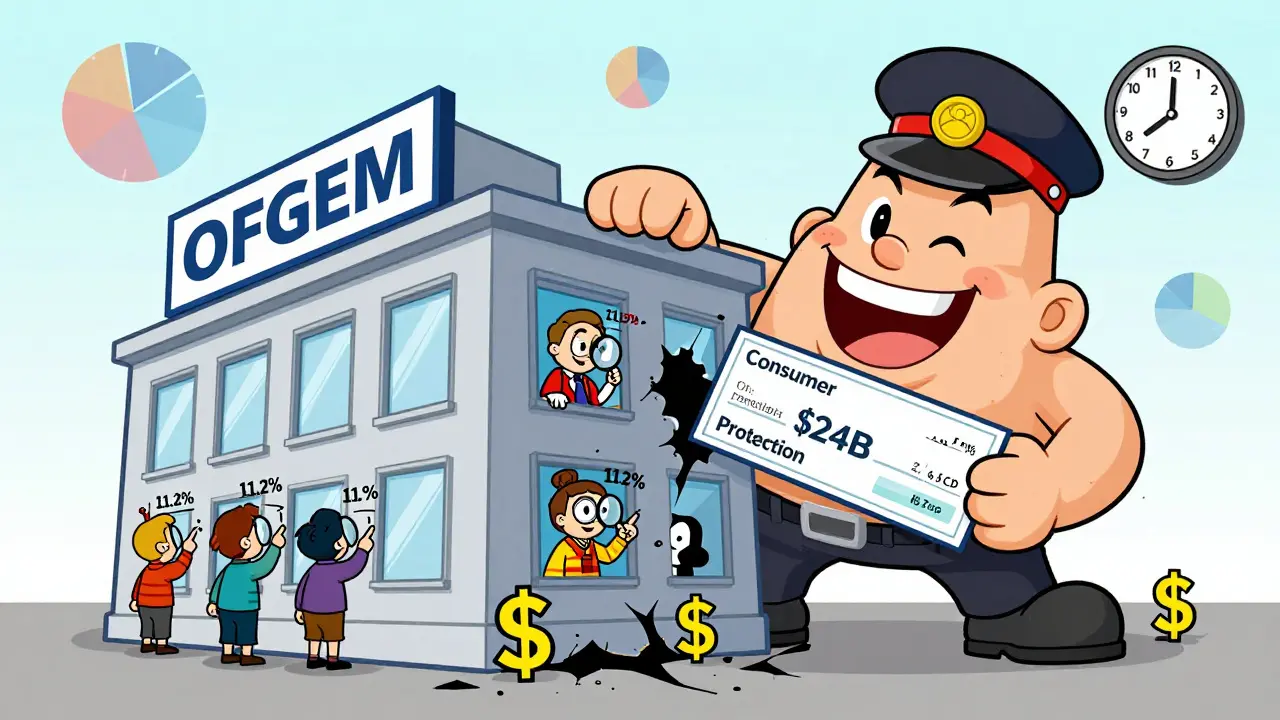
Why It’s Hard to Fix
You’d think the solution is simple: ban lobbying, close the revolving door, hire smarter regulators. But it’s not that easy. The U.S. has the Ethics in Government Act, which requires a “cooling-off period” before former officials join regulated industries. But 41% of violations go unpunished. The EU has a Transparency Register for lobbyists. Only 32% of big corporations comply. Why? Because the system is designed to let influence flow. Industries have money, expertise, and motivation. The public? Most people don’t even know how to file a comment on a regulation, let alone organize a campaign. Also, regulators are often isolated. They don’t report to elected officials directly. They’re supposed to be independent. But independence without accountability becomes a blank check. A World Bank study found agencies with less than 30% congressional oversight were 4.2 times more likely to be captured. And then there’s the political resistance. Between 2015 and 2022, 78% of proposed anti-capture laws failed. Why? Because the same industries that benefit from capture also fund the politicians who vote against reform.What’s Working
It’s not all bleak. Some places are fighting back. New Zealand introduced an independent process to review all new regulations. Between 2016 and 2022, industry-preferred rules dropped from 68% to 31%. Canada trained its regulators to limit industry meetings and increase public input. Result? Industry meetings got 27% shorter. Public consultations jumped 43%. France tried something radical: the Convention Citoyenne pour le Climat. They picked 150 random citizens, gave them experts, time, and resources, and asked them to draft climate policy. The energy industry’s influence on the final plan dropped by 52%. That’s not luck. That’s democracy working. The U.S. Federal Trade Commission launched its own “Regulatory Capture Initiative” in 2023. It requires full disclosure of all industry contacts and created a new Office of Regulatory Integrity with $23 million in funding. It’s early, but it’s a start.
The Bigger Picture
Regulatory capture isn’t just about sugar or energy or drugs. It’s about who gets to decide what’s fair. When regulators serve industry instead of the public, the whole system loses legitimacy. People stop trusting institutions. They stop voting. They stop believing change is possible. The good news? We know how to fix it. We need:- Longer cooling-off periods-no industry jobs for at least five years after public service
- Publicly funded regulatory agencies-no more reliance on industry-funded studies
- Random citizen panels to review major regulations-like France’s model
- Full transparency: every meeting, every email, every draft rule made public
- Independent oversight committees with real power-not just advisory roles
What You Can Do
You don’t need to be a policymaker to make a difference. - Read regulatory notices. They’re posted online. You can comment. Most people don’t. - Support watchdog groups like Public Citizen, Consumer Reports, or the Center for Responsive Politics. - Ask your representatives: “What are you doing to stop regulatory capture?” - Share stories. When someone says, “My drug price went up again,” say: “That’s not just the market. That’s regulatory capture.” Change doesn’t come from the top alone. It comes from people who refuse to accept that the system is broken beyond repair.Is regulatory capture the same as corruption?
No. Corruption involves illegal acts like bribes or kickbacks. Regulatory capture is legal but unethical. It happens through lobbying, revolving doors, and subtle influence. A regulator doesn’t take cash-they take a job, a dinner, or a shared belief that industry needs protection. That’s why it’s harder to spot-and harder to stop.
Which industries are most prone to regulatory capture?
The financial sector leads, with 67% of countries showing high capture risk, according to the World Bank. Energy comes second at 58%, followed by pharmaceuticals at 52%. These industries have high profits, complex rules, and deep pockets. They also benefit from concentrated gains-like a few drug companies making billions-while costs are spread across millions of consumers. That makes it easy to influence policy and hard to organize public pushback.
Can regulators ever be truly independent?
Yes-but only with strong safeguards. Independence means freedom from pressure, not isolation. Canada and New Zealand show that with public funding, transparency rules, citizen input, and strict conflict-of-interest rules, regulators can stay focused on public interest. The key is accountability. Independent agencies that answer to no one become vulnerable. Independent agencies that answer to the public? That’s the goal.
Why doesn’t the public fight back more?
Because the costs are small for each person but huge in total. Paying $33 extra a year on sugar doesn’t feel like a crisis. But when 330 million people each pay $33, that’s over $10 billion a year going to a handful of companies. Meanwhile, the industry spends millions to lobby and shape the narrative. The public doesn’t have the same resources, time, or organization. That imbalance is intentional-and it’s why capture works.
Is this happening in Australia too?
Yes. Australia’s Therapeutic Goods Administration (TGA) has faced criticism for fast-tracking drug approvals under industry pressure. The Australian Energy Regulator has been accused of favoring energy companies in pricing decisions. The country’s lobbying register shows corporations spend far more than consumer groups. While Australia has stronger transparency laws than the U.S., the same dynamics-revolving doors, technical complexity, and political influence-are at play.

Tiffany Adjei - Opong
January 6, 2026 AT 03:18Okay but let’s be real - if you think this is new, you’ve never read a single regulatory filing. This has been going on since the 1970s. Reagan deregulated everything because ‘markets know best,’ and now we’re just reaping what they planted. The sugar tariffs? The FAA letting Boeing self-certify? Classic. We didn’t wake up to this - we just finally noticed the rot.
And don’t even get me started on how the ‘public interest’ is just a buzzword used to sell ethics seminars. Real public interest would mean banning lobbying entirely. Not ‘transparency.’ Not ‘cooling-off periods.’ Ban. It. All.
Ryan Barr
January 6, 2026 AT 15:15Regulatory capture isn’t a bug. It’s the feature.
Cam Jane
January 7, 2026 AT 21:23Hey - I know this feels overwhelming, but you’re not powerless. Seriously. I used to think nothing I did mattered until I actually filed a comment on an FDA rule about drug pricing. It was awkward, I had to read 40 pages of legalese, and I cried a little. But guess what? Two months later, they changed the draft. Not because of me alone - but because 3,000 other people did the same thing.
Don’t wait for a hero. Be the person who shows up. Read the notices. Comment. Share. Even one voice makes the noise louder. And noise is how change starts.
Also - Public Citizen has a free email alert for new regulations. Sign up. It takes 30 seconds. You’ll thank me later.
Mukesh Pareek
January 8, 2026 AT 23:58The structural incentives are misaligned due to principal-agent asymmetry exacerbated by rent-seeking behavior and institutional isomorphism. The regulatory apparatus has been co-opted through endogenous institutional capture, wherein the epistemic authority of industry actors supersedes the normative mandate of public welfare. This is not dysfunction - it’s equilibrium under neoliberal governance architecture.
Ashley S
January 9, 2026 AT 12:44So basically the government is just a puppet for rich people? I knew it. I KNEW IT. I told my cousin this last week and she laughed at me. Now I’m like… SEE?!?!
Why don’t they just fire all the regulators and hire normal people? Like, I know a guy who works at Walmart and he’s way smarter than half the people in DC.
Rachel Wermager
January 10, 2026 AT 13:52Actually, the data on revolving doors is misleading. You’re conflating correlation with causation. The fact that 53% of Defense officials go to defense firms doesn’t mean they were captured - it means they’re qualified. These aren’t bureaucrats. They’re engineers, logistics experts, policy wonks. Of course they get hired by the industry - they’re the best in the field.
And let’s not pretend public regulators are saints. The EPA had a 72% turnover rate in the 2010s because they couldn’t compete with private sector pay. This isn’t capture - it’s market efficiency.
Katelyn Slack
January 11, 2026 AT 08:28i just read this and i think… why do we even have agencies if they just work for the companies?? i mean like… if the faa let boeing do the safety checks… that’s like letting the thief check the lock on his own house??
also i think i spelled faa wrong. oops.
Melanie Clark
January 12, 2026 AT 17:59THIS IS ALL A SETUP BY THE BILLIONAIRE ELITE TO MAKE US THINK WE LIVE IN A DEMOCRACY WHILE THEY CONTROL EVERYTHING THROUGH THE FEDERAL RESERVE AND THE IMF AND THE WORLD ECONOMIC FORUM AND THE CRYPTO ELITES WHO OWN THE BLOCKCHAIN AND THE AI SYSTEMS THAT DECIDE WHAT YOU SEE ONLINE
THEY WANT YOU TO THINK THIS IS ABOUT SUGAR AND ENERGY BUT ITS REALLY ABOUT THE NEW WORLD ORDER AND THEY’RE USING REGULATORY CAPTURE TO PREPARE FOR THE GREAT RESET AND WHEN THEY TAKE YOUR CARS AND YOUR MONEY AND YOUR CHILDREN WILL YOU REMEMBER THIS POST
THEY’RE LISTENING TO YOU RIGHT NOW
THEY’RE LISTENING
THEY’RE LISTENING
Harshit Kansal
January 12, 2026 AT 22:02Bro in India we got the same thing. Telecom regulators cozying up to Reliance? Pharma approvals fast-tracked for companies that sponsor ministerial trips? It’s global. We just call it ‘networking.’
But honestly? People here are starting to wake up. Last year, a viral TikTok about a medicine price hike got 10 million views. The company had to backtrack. Turns out, people still care when you show them the numbers.
Saylor Frye
January 14, 2026 AT 20:08Interesting. But is this really worse than the 1980s? Or the 1920s? Seems like every era has its version of this. The tools change, the actors stay the same.
Matt Beck
January 16, 2026 AT 19:45It’s not just capture… it’s *cosmic* capture. 🌌 The system is a living organism - and it’s evolved to feed on public trust. We’re not fighting corporations. We’re fighting entropy. The universe wants things to be inefficient, hidden, and profitable for the few. That’s why the truth is buried under jargon, lobbying, and 3am press releases.
But here’s the thing… every time someone reads this and says ‘I’m not okay with this’… they’re throwing a pebble into the machine. One pebble. Then another. Then a landslide.
So go on. Comment. Share. Be the pebble. 💫