

Traveling doesn’t have to wreck your weight management goals. You’ve probably been there: stuck in an airport terminal, hungry, surrounded by greasy burgers, sugary pastries, and oversized salads that turn out to be calorie bombs. Or maybe you’re sitting at a restaurant after a long flight, tempted by the menu that looks delicious but feels like a trap. The truth? You can eat well while traveling - even in airports - if you know what to look for and how to plan ahead.
Why Airports Are Trickier Than You Think
Airports used to be nightmares for anyone trying to eat healthy. Fast food chains dominated the terminals, and the only "healthy" option was a sad-looking salad with a side of ranch dressing that had more fat than protein. But things have changed. Since 2015, major airports like JFK, LaGuardia, and Chicago O’Hare started requiring food vendors to meet basic nutrition standards. Today, 38.7% of all food options at U.S. airports are labeled as "healthy" - up from just 19.2% in 2018. That’s a big shift.
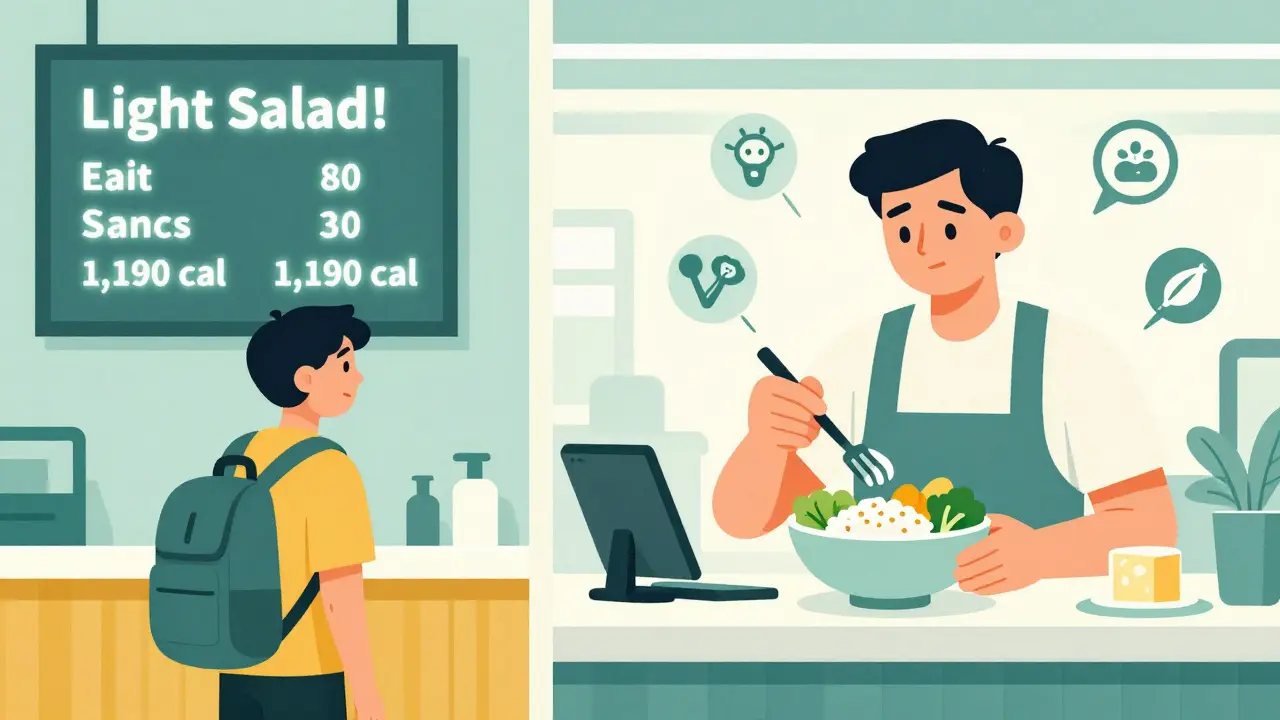
But here’s the catch: just because something says "healthy" doesn’t mean it is. A "grilled chicken salad" might look clean, but add a drizzle of creamy dressing, a handful of cheese, and a side of croutons, and you’ve jumped from 350 calories to over 800. One traveler at JFK found out the hard way - their "light" salad had 1,190 calories, not the 590 listed on the menu. That’s not a mistake. That’s a common tactic.
What You Should Actually Look For
The secret to eating well while traveling isn’t about avoiding carbs or cutting out fats. It’s about balance. Registered dietitian Hernandez says the best airport meals have three things: protein, fiber, and controlled carbs.
- Protein: Aim for 15-20 grams per meal. It keeps you full longer and stabilizes blood sugar. Think grilled chicken, hard-boiled eggs, tofu, or a protein-rich hummus cup.
- Fiber: At least 3 grams per meal. Fiber slows digestion, helps with hunger control, and supports gut health. Fresh veggies, whole grains, beans, and fruit are your friends.
- Carbs: Keep them under 25 grams per snack. Too many refined carbs (like white bread, rice, or sugary sauces) spike your blood sugar and crash it later - leaving you hungry again before your flight even takes off.
Here’s what that looks like in real life:
- A hard-boiled egg = 6g protein
- A cup of Greek yogurt = 10-20g protein (check the label - some have added sugar)
- A Justin’s nut butter packet = 2g protein, 190 calories (perfect for snacking)
- A Trader Joe’s hummus cup = 2g protein, 70 calories (great with baby carrots)
- A fresh fruit cup = 3-4g fiber
Pair them. Two eggs + a fruit cup + a small nut butter packet = 18g protein, 4g fiber, 20g carbs. That’s a winning combo.
Smart Swaps at Airport Restaurants
Not every airport option is created equal. Here’s how to navigate the most common choices:
Sandwiches
Sandwiches from places like Au Bon Pain or UFood Grill often have decent protein (15-25g), but watch the sodium. Many contain 800-1,200mg - that’s over a third of your daily limit. Skip the cheese, ask for no sauce, and choose whole grain if available. Better yet: ask for it as a bowl instead. Less bread, more veggies.
Salads
Salads are the most dangerous option. They look healthy, but they’re often loaded with hidden calories. Ranch dressing? 140 calories and 14g fat in just two tablespoons. Oil and vinegar? 70 calories and 7g fat. Always ask for dressing on the side. And skip the crispy chicken, bacon bits, and fried toppings. Go for grilled chicken or tofu. At Denver’s Mod Market, travelers rate their salad bar 4.5/5 because you can build your own - double veggies, half rice, and skip the cheese.
Breakfast
Starbucks oatmeal with fruit and nuts: 300-350 calories, 8g protein, 5g fiber. A sausage-egg-cheese biscuit? Over 500 calories, 25g fat, only 2g fiber. The choice is obvious. If you’re in a rush, grab a hard-boiled egg and an apple from a convenience store. No lines. No surprises.
Burrito Bowls
At places like Mod Market or Chipotle-style counters, the temptation is to load it up. Rice, beans, cheese, sour cream, guac - it adds up fast. A full bowl can hit 900+ calories. The fix? Order "double vegetables, half rice, no cheese, light dressing." That cuts it down to 500-600 calories without leaving you hungry.
What to Pack
The best airport meal is the one you bring with you. TSA allows solid snacks without restriction. Here’s what works:
- GoMacro protein bars (10g protein, 18g carbs per bar)
- Justin’s nut butter packets (under 3.4 oz - no TSA issues)
- Pre-peeled hard-boiled eggs (store them in a small container with a teaspoon of water - they stay fresh for hours)
- Individual almond packs (Walmart’s 100-calorie packs are rated 4.7/5 by over 200 reviewers)
- Trail mix - but only if you portion it. A handful = 300 calories. Buy 100-calorie packs instead.
Pro tip: If you’re checking a bag, toss in a few hard-boiled eggs. USDA says they’re safe at room temperature for up to 5 hours. No fridge needed.
What to Avoid
Some "healthy" options are traps:
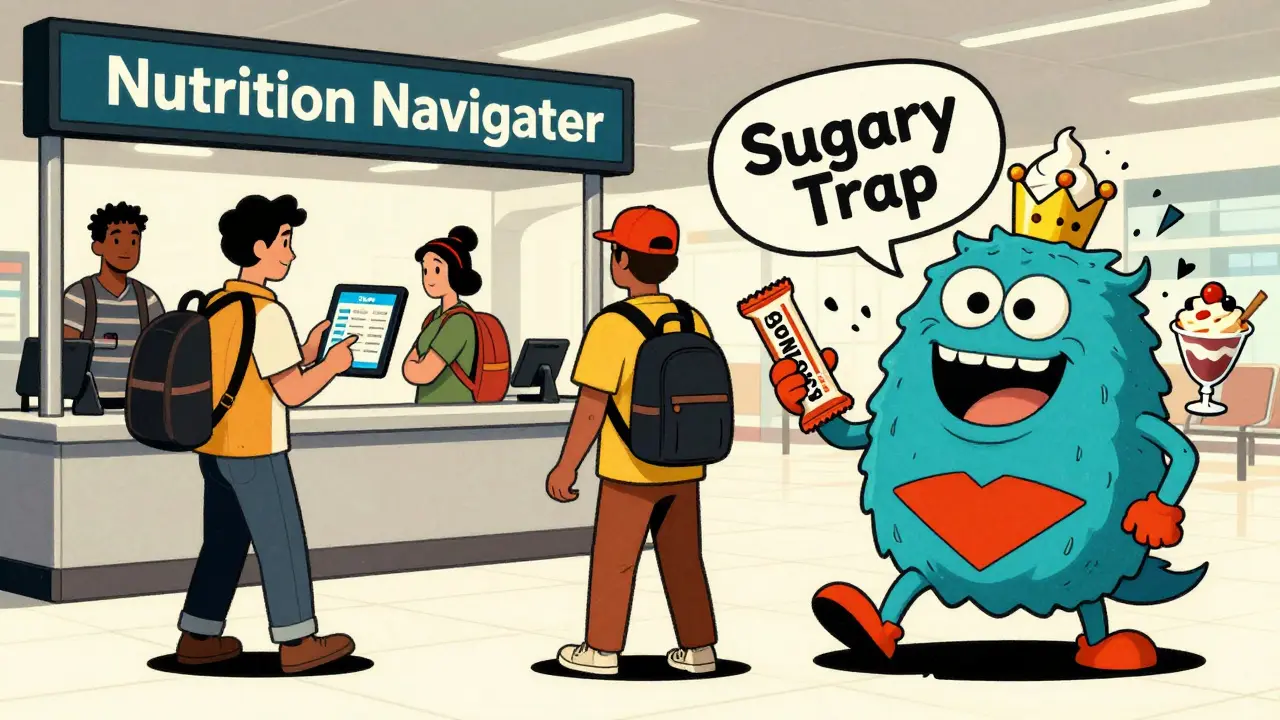
- Yogurt parfaits - many have 35-48g of sugar. That’s more than a soda. One JetBlue traveler found 48g sugar in a "healthy" parfait at JFK.
- Smoothies - Jamba Juice’s "Green Greens" has 48g of sugar. The American Heart Association recommends no more than 36g for men.
- Grab-and-go salads - pre-made ones often have 600-900mg of sodium. That’s 25-40% of your daily limit.
- Any item with "crispy," "fried," "loaded," or "gourmet" - those are code words for extra calories.
Plan Ahead - It Makes All the Difference
Here’s the most important tip: Research before you go. Most major airports have websites with full menus. Go to dfwairport.com, flychicago.com, or lairport.com and check what’s available. Look for protein sources first - grilled chicken, tofu, eggs, beans. Then see what veggies and whole grains are offered.
Travelers who plan ahead save an average of 227 calories per meal compared to those who just grab whatever’s closest. That’s over 1,500 calories saved on a 7-day trip. That’s not just weight - that’s energy, mood, and sleep quality.
Apps like Lose It! and MyFitnessPal now have airport-specific databases. In a March 2024 study, travelers using these apps cut their intake by 18.7% compared to those who didn’t.
The Future Is Better
Airports are getting smarter. Dallas-Fort Worth launched "Nutrition Navigator" kiosks in January 2024 - real-time calorie and nutrient info for every food option. United Airlines now offers Beyond Meat meals in 87 lounges. JetBlue’s "Evening Well" program at JFK serves Mediterranean bowls with 25-30g protein and 8-10g fiber. These aren’t gimmicks. They’re responses to real demand.
Corporate travel policies are changing too. 68% of companies now require healthy meal options for business travelers. That’s not just about health - it’s about productivity. People who eat well on trips sleep better, focus longer, and bounce back faster.
Final Rule: Protein First, Then Build
Dr. Lisa Young, a nutrition professor at NYU, says it best: "Airports have become battlegrounds for healthy eating. The best strategy? Identify the protein source first, then build around it with vegetables and controlled carbs."
That’s it. No fancy diets. No starvation. Just protein + fiber + smart choices. You don’t need to be perfect. You just need to be intentional.
Can I bring my own food through airport security?
Yes. Solid foods like sandwiches, hard-boiled eggs, protein bars, nuts, and fruit are completely allowed. Liquids, gels, or sauces must follow the 3.4 oz (100 ml) rule - so keep dressings and hummus in small containers. Nut butter packets are ideal because they’re under the limit and don’t require refrigeration.
What’s the best airport snack under 200 calories?
A Justin’s almond butter packet (190 calories, 16g fat, 2g protein) paired with a small apple (95 calories, 4g fiber) gives you 285 calories total - but you can split them. The nut butter alone is a great 190-calorie option that keeps you full for hours. Trader Joe’s hummus cup (70 calories) with baby carrots is another excellent combo.
Are airport salads really healthy?
Only if you customize them. A plain mixed greens salad with grilled chicken and vinaigrette can be under 400 calories. But add croutons, cheese, bacon, and creamy dressing, and it jumps to 800+. Always ask for dressing on the side, skip the fried toppings, and go for lean protein. If you’re unsure, check the menu online before you go - many airports now list full nutrition info.
Why do airport meals cost so much?
Airport food is expensive because of high rent, limited space, and captive customers. Healthy options typically cost $12.50-$18.00, which is 25-40% more than fast food. But if you bring your own snacks, you can save $10-$15 per meal. That adds up fast on a long trip.
How can I avoid overeating during long flights?
Stay hydrated - dehydration often feels like hunger. Drink water before and during the flight. Pack a protein-rich snack (like a hard-boiled egg or protein bar) to eat before boarding so you’re not starving when the snack cart comes around. Avoid sugary drinks. And if you’re tempted to eat everything offered, remember: you don’t have to eat just because it’s there.

Carla McKinney
February 14, 2026 AT 10:07Let me just say this: the idea that 'healthy' airport food labels mean anything is laughable. I work in food compliance, and I've seen the audits. That 38.7% statistic? It's based on their own self-reported data, which ignores serving size, added sugars, and sodium spikes from 'natural' sources like soy sauce or broth. One 'healthy' grilled chicken wrap I analyzed had 2.3g of trans fat from 'hydrogenated vegetable oil' - legally labeled as 0g because it's under 0.5g per serving. They're gaming the system. Don't trust labels. Trust your own math.
Rachidi Toupé GAGNON
February 15, 2026 AT 20:02Protein first? YES. 🙌 I always pack 2 hard-boiled eggs and a Justin’s almond butter. Boom. 280 calories. Full for 4 hours. No more airport sugar crashes. Life changed. ✈️
Vamsi Krishna
February 17, 2026 AT 14:48Wow, this whole post is just a corporate PR piece disguised as nutrition advice. Did you know that 70% of 'healthy' airport options are owned by the same 3 corporations? They're not here to help you - they're here to sell you overpriced, processed crap with a green label. And the 'Nutrition Navigator' kiosks? They're designed to make you feel good while spending $16 on a 'quinoa bowl' that’s mostly rice and oil. Wake up. You’re being manipulated.
christian jon
February 17, 2026 AT 17:48OH MY GOD, I JUST REALIZED - I’ve been falling for the 'salad trap' for YEARS. I thought I was being so healthy at O'Hare with that 'grilled chicken Caesar'... until I looked at the nutrition panel. 1,100 CALORIES?!?! I’m not even mad - I’m impressed. That’s a whole meal. And I ate it in 12 minutes. I’m literally a walking calorie bomb. I’m gonna start packing eggs. And maybe cry. But I’m gonna do better.
steve sunio
February 19, 2026 AT 15:13Why bother? You're gonna eat junk anyway. Airports are designed to make you spend. You think you're saving calories? Nah. You're just paying more for less. Bring a sandwich from home. Or don't eat. Either way, you're losing.
Neha Motiwala
February 20, 2026 AT 01:20This is all lies. They want you to think you're in control, but they're watching you. Every time you scan a QR code for nutrition info, they log your choices. Your DNA, your sleep, your cortisol - all tied to your food habits. They’re building a profile. Next thing you know, your insurance premium goes up because you 'chose' a hummus cup instead of a burger. This isn't health advice. It's surveillance.
Alyssa Williams
February 22, 2026 AT 00:22YES! Protein first. I do this every time. Egg + apple + nut butter = game changer. No more 3pm crash. No more airport panic. I even started doing it at home. My husband thinks I’m weird. I don’t care. I’m flying to Tokyo next week and I’m packed and ready. You got this 💪
Joanne Tan
February 23, 2026 AT 04:08Just tried the hummus + baby carrots trick last week and it saved me. I didn’t even realize how hungry I was until I ate it. So simple. So good. I’m never buying airport salads again. Also, TSA lets you bring hard boiled eggs?? Mind blown. I’m telling my whole family.
Pat Mun
February 23, 2026 AT 05:21Look, I’m not here to judge anyone’s choices. But I’ve flown over 120,000 miles in the last five years, mostly for work, and I’ve learned one thing: the real secret isn’t protein or fiber - it’s timing. If you eat a balanced meal 90 minutes before you leave, you’re less likely to be ravenous when you hit the terminal. Also, water. Always water. I carry a 32oz bottle. I refill it at every gate. It’s not about the food you eat - it’s about the hunger you avoid. And yes, I’ve tried all the snacks. The GoMacro bar is okay. The Justin’s nut butter? Perfection. No judgment. Just facts.
Sophia Nelson
February 23, 2026 AT 09:14Ugh. This post is so naive. You think 'controlled carbs' is enough? Have you seen the portion sizes? A 'small' fruit cup is 300 calories. A 'protein bar' is 250. And you're supposed to eat all that and still have room for the flight? The real solution? Skip the airport entirely. Just eat before you leave. Or don't fly. Or both.
Steve DESTIVELLE
February 25, 2026 AT 08:00There is a deeper truth here. The modern airport is a microcosm of late capitalism - where health is commodified, where convenience is a trap, and where the illusion of choice masks systemic manipulation. We are not merely choosing between a salad and a burger. We are choosing whether to participate in a system that profits from our anxiety, our fatigue, our desire to be good. The real weight we carry is not fat - it is the burden of having to optimize every bite. Perhaps the most radical act is to eat without guilt. To eat because you are human. Not because you must.
Craig Staszak
February 26, 2026 AT 22:42Love this. I’ve been doing the protein + fiber combo for months now. My flights are smoother. My sleep’s better. My mood? Way less jagged. I even started bringing my own trail mix in those little 100-calorie packs. It’s not perfect. But it’s progress. Keep going.
Gloria Ricky
February 28, 2026 AT 18:23OMG I just tried the hard boiled egg + apple thing and I’m obsessed. I’m not even trying anymore - it just works. I used to stress so much about airport food. Now I just chill. My partner says I’ve become a snack zen master. I don’t even know what that means but I’ll take it 😊
Kristin Jarecki
February 28, 2026 AT 19:32Thank you for this comprehensive and evidence-based overview. The integration of nutritional science with practical behavioral strategies is both thoughtful and actionable. I particularly appreciate the emphasis on protein and fiber as anchor nutrients, and the acknowledgment that labeling systems are imperfect. The inclusion of specific brand examples with caloric and macronutrient data enhances utility, while the recommendation to consult official airport menus prior to travel demonstrates a high degree of preparedness. This approach aligns with the principles of behavioral nutrition and supports sustainable, long-term health outcomes in transient environments. Well done.